


Page 772 - Hematology_ Basic Principles and Practice ( PDFDrive )
P. 772
Chapter 46  Autoimmune Hemolytic Anemia  659


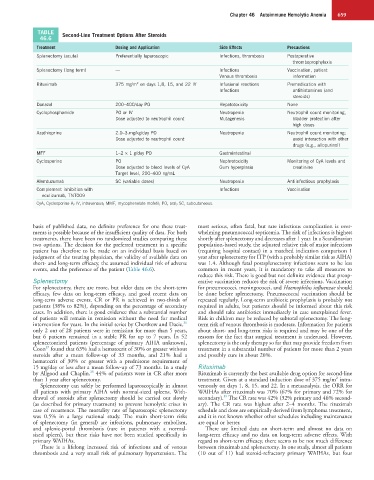
             TABLE   Second-Line Treatment Options After Steroids
              46.6
             Treatment                 Dosing and Application            Side Effects          Precautions
             Splenectomy (acute)       Preferentially laparoscopic       Infections, thrombosis  Postoperative
                                                                                                 thromboprophylaxis
             Splenectomy (long term)   —                                 Infections            Vaccination, patient
                                                                         Venous thrombosis       information
             Rituximab                 375 mg/m  on days 1,8, 15, and 22 IV  Infusional reactions  Premedication with
                                              2
                                                                         Infections              antihistamines (and
                                                                                                 steroids)
             Danazol                   200–400/day PO                    Hepatotoxicity        None
             Cyclophosphamide          PO or IV                          Neutropenia           Neutrophil count monitoring,
                                       Dose adjusted to neutrophil count  Mutagenesis            bladder protection after
                                                                                                 high doses
             Azathioprine              2.0–3.mg/kg/day PO                Neutropenia           Neutrophil count monitoring;
                                       Dose adjusted to neutrophil count                         avoid interaction with other
                                                                                                 drugs (e.g., allopurinol)
             MFF                       1–2 × 1 g/day PO                  Gastrointestinal
             Cyclosporine              PO                                Nephrotoxicity        Monitoring of CyA levels and
                                       Dose adjusted to blood levels of CyA  Gum hyperplasia     creatinine
                                       Target level, 200–400 ng/mL
             Alemtuzumab               SC (variable doses)               Neutropenia           Antiinfectious prophylaxis
             Complement inhibition with                                  Infections            Vaccination
               eculizumab, TNT009
             CyA, Cyclosporine A; IV, intravenous; MMF, mycophenolate mofetil; PO, oral; SC, subcutaneous.


            basis of published data, no definite preference for one these treat-  most  serious,  often  fatal,  but  rare  infectious  complication  is  over-
            ments is possible because of the insufficient quality of data. For both   whelming pneumococcal septicemia. The risk of infections is highest
            treatments, there have been no randomized studies comparing these   shortly after splenectomy and decreases after 1 year. In a Scandinavian
            two options. The decision for the preferred treatment in a specific   population-based study, the adjusted relative risk of major infections
            patient  has  therefore  to  be  made  on  an  individual  basis  based  on   (requiring hospital contact) in a matched indication comparison 1
            judgment of the treating physician, the validity of available data on   year after splenectomy for ITP (with a probably similar risk as AIHA)
            short- and long-term efficacy, the assumed individual risk of adverse   was 1.4. Although fatal postsplenectomy infections seem to be less
            events, and the preference of the patient (Table 46.6).  common  in  recent  years,  it  is  mandatory  to  take  all  measures  to
                                                                  reduce this risk. There is good but not definite evidence that preop-
            Splenectomy                                           erative vaccination reduces the risk of severe infections. Vaccination
            For splenectomy, there are more, but older data on the short-term   for pneumococci, meningococci, and Haemophilus influenzae should
            efficacy,  few  data  on  long-term  efficacy,  and  good  recent  data  on   be  done  before  splenectomy.  Pneumococcal  vaccination  should  be
            long-term  adverse  events.  CR  or  PR  is  achieved  in  two-thirds  of   repeated regularly. Long-term antibiotic prophylaxis is probably not
            patients (38% to 82%), depending on the percentage of secondary   required in adults, but patients should be informed about this risk
            cases. In addition, there is good evidence that a substantial number   and should take antibiotics immediately in case unexplained fever.
            of patients will remain in remission without the need for medical   Risk in children may be reduced by subtotal splenectomy. The long-
                                                             36
            intervention for years. In the initial series by Chertkow and Dacie,    term risk of venous thrombosis is moderate. Information for patients
            only 2 out of 28 patients were in remission for more than 5 years,   about short- and long-term risks is required and may be one of the
            but  6  patients  remained  in  a  stable  PR  for  up  to  7  years.  In  52   reasons for the fact that surgical treatment is underused. However,
            splenectomized  patients  (percentage  of  primary  AIHA  unknown),   splenectomy is the only therapy so far that may provide freedom from
                37
            Coon  found that 63% had a hematocrit of 30% or greater without   treatment in a substantial number of patients for more than 2 years
            steroids  after  a  mean  follow-up  of  33  months,  and  21%  had  a   and possibly cure in about 20%.
            hematocrit  of  30%  or  greater  with  a  prednisone  requirement  of
            15 mg/day or less after a mean follow-up of 73 months. In a study   Rituximab
                               38
            by Allgood and Chaplin,  44% of patients were in CR after more   Rituximab is currently the best available drug option for second-line
                                                                                                               2
            than 1 year after splenectomy.                        treatment. Given at a standard induction dose of 375 mg/m  intra-
              Splenectomy can safely be performed laparoscopically in almost   venously on days 1, 8, 15, and 22. In a metaanalysis, the ORR for
            all  patients  with  primary  AIHA  with  normal-sized  spleens.  With-  WAIHAs after rituximab was 70% (67% for primary and 72% for
                                                                          39
            drawal  of  steroids  after  splenectomy  should  be  carried  out  slowly   secondary).  The CR rate was 42% (32% primary and 46% second-
            (as described for primary treatment) to prevent hemolytic crises in   ary).  The  CR  rate  was  highest  after  2–4  months.  The  rituximab
            case of recurrence. The mortality rate of laparoscopic splenectomy   schedule and dose are empirically derived from lymphoma treatment,
            was  0.5%  in  a  large  national  study.  The  main  short-term  risks   and it is not known whether other schedules including maintenance
            of  splenectomy  (in  general)  are  infections,  pulmonary  embolism,   are equal or better.
            and  splenic-portal  thrombosis  (rare  in  patients  with  a  normal-  There  are  limited  data  on  short-term  and  almost  no  data  on
            sized  spleen),  but  these  risks  have  not  been  studied  specifically  in    long-term efficacy and no data on long-term adverse effects. With
            primary WAIHAs.                                       regard to short-term efficacy, there seems to be not much difference
              There  is  a  lifelong  increased  risk  of  infections  and  of  venous   between rituximab and splenectomy. In one study, almost all patients
            thrombosis and a very small risk of pulmonary hypertension. The   (10  out  of  11)  had  steroid-refractory  primary  WAIHAs,  but  four

