


Page 768 - Hematology_ Basic Principles and Practice ( PDFDrive )
P. 768
Chapter 46  Autoimmune Hemolytic Anemia  655


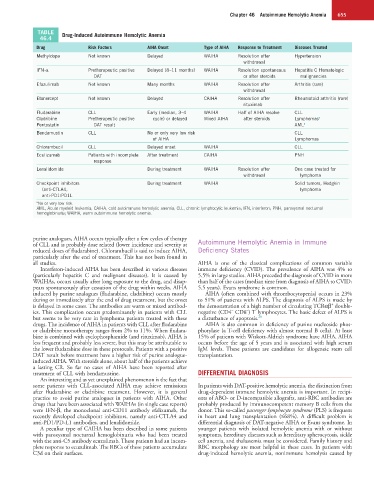
             TABLE   Drug-Induced Autoimmune Hemolytic Anemia
              46.4
             Drug             Risk Factors       AIHA Onset         Type of AIHA  Response to Treatment  Diseases Treated
             Methyldopa       Not known          Delayed            WAIHA      Resolution after   Hypertension
                                                                                 withdrawal
             IFN-α            Pretherapeutic positive   Delayed (8–11 months)  WAIHA  Resolution spontaneous   Hepatitis C Hematologic
                                DAT                                              or after steroids  malignancies
             Efazulimab       Not known          Many months        WAIHA      Resolution after   Arthritis (rare)
                                                                                 withdrawal
             Etanercept       Not known          Delayed            CAIHA      Resolution after   Rheumatoid arthritis (rare)
                                                                                 rituximab
             Fludarabine      CLL                Early (median, 3–4   WAIHA    Half of AIHA resolve   CLL
             Cladribine       Pretherapeutic positive   cycle) or delayed  Mixed AIHA  after steroids  Lymphomas a
             Pentostatin        DAT result                                                       AML a
             Bendamustin      CLL                No or only very low risk                        CLL
                                                   of AIHA                                       Lymphomas
             Chlorambucil     CLL                Delayed onset      WAIHA                        CLL
             Eculizumab       Patients with incomplete   After treatment  CAIHA                  PNH
                                response
             Lenalidomide                        During treatment   WAIHA      Resolution after   One case treated for
                                                                                 withdrawal        lymphoma
             Checkpoint inhibitors               During treatment   WAIHA                        Solid tumors, Hodgkin
               (anti-CTLA4,                                                                        lymphoma
               anti-PD1/PD1L
             a No or very low risk.
             AML, Acute myeloid leukemia; CAIHA, cold autoimmune hemolytic anemia; CLL, chronic lymphocytic leukemia; IFN, interferon; PNH, paroxysmal nocturnal
             hemoglobinuria; WAIHA, warm autoimmune hemolytic anemia.


            purine analogues, AIHA occurs typically after a few cycles of therapy
            of CLL and is probably dose related (lower incidence and severity at   Autoimmune Hemolytic Anemia in Immune
            reduced doses of fludarabine). Chlorambucil is said to induce AIHA,   Deficiency States
            particularly after the end of treatment. This has not been found in
            all studies.                                          AIHA  is  one  of  the  classical  complications  of  common  variable
              Interferon-induced AIHA has been described in various diseases   immune  deficiency  (CVID). The  prevalence  of  AIHA  was  4%  to
            (particularly  hepatitis  C  and  malignant  diseases).  It  is  caused  by   5.5% in large studies. AIHA preceded the diagnosis of CVID in more
            WAIHAs, occurs usually after long exposure to the drug, and disap-  than half of the cases (median time from diagnosis of AIHA to CVID:
            pears spontaneously after cessation of the drug within weeks. AIHA   5.5 years). Evans syndrome is common.
            induced by purine analogues (fludarabine, cladribine) occurs mostly   AIHA (often combined with thrombocytopenia) occurs in 23%
            during or immediately after the end of drug treatment, but the onset   to 51% of patients with ALPS. The diagnosis of ALPS is made by
                                                                                                             +
            is delayed in some cases. The antibodies are warm or mixed antibod-  the demonstration of a high number of circulating TCRαβ  double-
                                                                                  –
                                                                             –
            ies. This complication occurs predominantly in patients with CLL   negative (CD4  CD8 ) T lymphocytes. The basic defect of ALPS is
            but seems to be very rare in lymphoma patients treated with these   a disturbance of apoptosis. 26
            drugs. The incidence of AIHA in patients with CLL after fludarabine   AIHA is also common in deficiency of purine nucleoside phos-
            or cladribine monotherapy ranges from 2% to 11%. When fludara-  phorylase (a T-cell deficiency with almost normal B cells). At least
            bine is combined with cyclophosphamide (and rituximab), AIHA is   15% of patients with Wiskott-Aldrich syndrome have AIHA. AIHA
            less frequent and probably less severe, but this may be attributable to   occurs before the age of 5 years and is associated with high serum
            the lower fludarabine dose in these protocols. Patients with a positive   IgM  levels.  These  patients  are  candidates  for  allogeneic  stem  cell
            DAT result before treatment have a higher risk of purine analogue-  transplantation.
            induced AIHA. With steroids alone, about half of the patients achieve
            a  lasting  CR.  So  far  no  cases  of  AIHA  have  been  reported  after
            treatment of CLL with bendamustine.                   DIFFERENTIAL DIAGNOSIS
              An interesting and as yet unexplained phenomenon is the fact that
            some  patients  with  CLL-associated  AIHA  may  achieve  remissions   In patients with DAT-positive hemolytic anemia, the distinction from
            after  fludarabine  or  cladribine  treatment.  However,  it  is  general   drug-dependent immune hemolytic anemia is important. In recipi-
            practice  to  avoid  purine  analogues  in  patients  with  AIHA.  Other   ents of ABO- or D-incompatible allografts, anti-RBC antibodies are
            drugs that have been associated with WAIHAs (in single case reports)   probably produced by immunocompetent memory B cells from the
            were  IFN-β,  the  monoclonal  anti-CD11  antibody  efalizumab,  the   donor. This so-called passenger lymphocyte syndrome (PLS) is frequent
            recently developed checkpoint inhibitors, namely anti-CTLA4 and   in  heart  and  lung  transplantation  (≤68%).  A  difficult  problem  is
            anti-PD1/PD-L1 antibodies, and lenalidomide.          differential diagnosis of DAT-negative AIHA or Evans syndrome. In
              A peculiar type of CAIHA has been described in some patients   younger  patients  with  isolated  hemolytic  anemia  with  or  without
            with  paroxysmal  nocturnal  hemoglobinuria  who  had  been  treated   symptoms, hereditary diseases such as hereditary spherocytosis, sickle
            with the anti-C5 antibody ecuzulimab. These patients had an incom-  cell anemia, and thalassemia must be considered. Family history and
            plete response to ecuzulimab. The RBCs of these patients accumulate   RBC morphology are most helpful in these cases. In patients with
            C3d on their surfaces.                                drug-induced hemolytic anemia, nonimmune hemolysis caused by

