


Page 767 - Hematology_ Basic Principles and Practice ( PDFDrive )
P. 767
654    Part V  Red Blood Cells

                      30
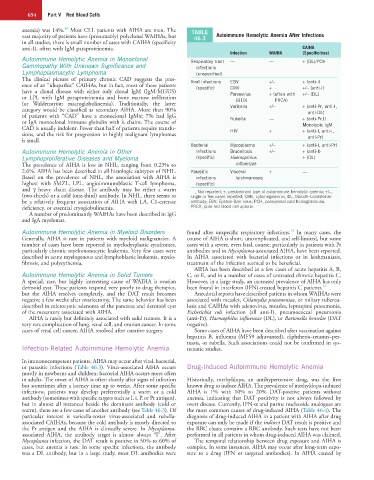
        anemia) was 14%.  Most CLL patients with AIHA are men. The   TABLE
        vast majority of patients have (presumably) polyclonal WAIHAs, but   46.3  Autoimmune Hemolytic Anemia After Infections
        in all studies, there is small number of cases with CAIHA (specificity
        anti-I), often with IgM paraproteinemia.                                                    CAIHA
                                                                            Infection    WAIHA      (Specificities)
        Autoimmune Hemolytic Anemia in Monoclonal              Respiratory tract   —     —          + (DL)/PCH
        Gammopathy With Unknown Significance and                 infections
        Lymphoplasmacytic Lymphoma                               (unspecified)
        The  clinical  picture  of  primary  chronic  CAD  suggests  the  pres-  Viral infections   EBV  +/−  + (anti-i)
        ence of an “idiopathic” CAIHAs, but in fact, most of these patients   (specific)  CMV  +    +/− (anti-i)
        have  a  clonal  disease  with  either  only  clonal  IgM  (IgM-MGUS)   Parvovirus   + (often with   +/− (DL)
        or  LPL  with  IgM  paraproteinemia  and  bone  marrow  infiltration   (B19)       PRCA)
        (or  Waldenström  macroglobulinemia).  Traditionally,  the  latter   Varicella   +/−        + (anti-Pr, anti-I,
        category  would  be  classified  as  secondary  AIHA.  More  than  90%                        anti-DL)
        of  patients  with  “CAD”  have  a  monoclonal  IgMκ;  7%  had  IgG   Rubella    —          + (anti-Pr1)
        or IgA monoclonal immune globulin with λ chains. The course of                              Monotypic IgM
        CAD is usually indolent. Fewer than half of patients require transfu-  HIV       +          + (anti-I, anti-i,
        sions, and the risk for progression to highly malignant lymphomas                             anti-Pr)
        is small.
                                                               Bacterial    Mycoplasma   +/−        + (anti-I, anti-Pr)
        Autoimmune Hemolytic Anemia in Other                     infections   Brucellosis  +/−      + (anti-I)
        Lymphoproliferative Diseases and Myeloma                 (specific)  Haemophilus            + (DL)
        The  prevalence  of  AIHA  is  low  in  NHL,  ranging  from  0.23%  to   influenzae
        2.6%. AIHA has been described in all histologic subtypes of NHL.   Parasitic   Visceral   +  —
        Based  on  the  prevalence  of  NHL,  the  association  with  AIHA  is   infections   leishmaniosis
        highest  with  SMZL,  LPL,  angioimmunoblastic  T-cell  lymphoma,   (specific)
        and  γ  heavy  chain  disease.  The  antibody  may  be  either  a  warm   —, Not reported; +, predominant type of autoimmune hemolytic anemia; +/−,
        (two-thirds) or a cold (one-third) antibody. In NHL, there seems to   single or few cases reported; CMV, cytomegalovirus; DL, Donath–Landsteiner
        be  a  relatively  frequent  association  of  AIHA  with  LA,  C1-esterase   antibody; EBV, Epstein-Barr virus; PCH, paroxysmal cold hemoglobinuria;
        deficiency, or essential cryoglobulinemia.             PRCA, pure red blood cell aplasia.
           A number of predominantly WAIHAs have been described in IgG
        and IgA myelomas.
        Autoimmune Hemolytic Anemia in Myeloid Disorders      found  after  unspecific  respiratory  infections.   In  many  cases,  the
                                                                                                13
        Generally,  AIHA  is  rare  in  patients  with  myeloid  malignancies.  A   course of AIHA is short, uncomplicated, and self-limited, but some
        number of cases have been reported in myelodysplastic syndromes,   cases with a severe, even fatal, course, particularly in patients with Pr
        particularly chronic myelomonocytic leukemia. Very few cases were   antibodies and in Mycoplasma-associated AIHA, have been reported.
        described in acute myelogenous and lymphoblastic leukemia, myelo-  In  AIHA  associated  with  bacterial  infections  or  in  leishmaniasis,
        fibrosis, and polycythemia.                           treatment of the infection seemed to be beneficial.
                                                                 AIHA has been described in a few cases of acute hepatitis A, B,
        Autoimmune Hemolytic Anemia in Solid Tumors           C, or E, and in a number of cases of untreated chronic hepatitis C.
        A  special,  rare,  but  highly  interesting  cause  of WAIHA  is  ovarian   However, in a large study, an increased prevalence of AIHA has only
        dermoid cyst. These patients respond very poorly to drug therapies,   been found in interferon (IFN)-treated hepatitis C patients. 31
        but  the  AIHA  resolves  completely,  and  the  DAT  result  becomes   Anecdotal reports have described patients in whom WAIHAs were
        negative a few weeks after ovariectomy. The same behavior has been   associated with measles, Chlamydia pneumoniae, or miliary tubercu-
        described in microcystic adenoma of the pancreas and dermoid cyst   losis and CAIHAs with adenovirus, measles, leptospiral pneumonia,
        of the mesentery associated with AIHA.                Escherichia  coli  infection  (all  anti-I),  pneumococcal  pneumonia
           AIHA is rarely but definitely associated with solid tumors. It is a   (anti-Pr), Haemophilus influenzae (DL), or Bartonella henselae (DAT
        very rare complication of lung, renal cell, and ovarian cancer. In some   negative).
        cases of renal cell cancer, AIHA resolved after curative surgery.  Some cases of AIHA have been described after vaccination against
                                                              hepatitis B, influenza (MF59 adjuvanted), diphtheria–tetanus–per-
                                                              tussis, or rubella. Such associations could not be confirmed in sys-
        Infection-Related Autoimmune Hemolytic Anemia         tematic studies.

        In immunocompetent patients, AIHA may occur after viral, bacterial,
        or  parasitic  infections  (Table  46.3).  Virus-associated  AIHA  occurs   Drug-Induced Autoimmune Hemolytic Anemia
        mostly in newborns and children; bacterial AIHA occurs more often
        in adults. The onset of AIHA is often shortly after signs of infection   Historically,  methyldopa,  an  antihypertensive  drug,  was  the  first
        but sometimes after a latency time up to weeks. After some specific   known drug to induce AIHA. The prevalence of methyldopa-induced
        infections,  patients  may  develop  preferentially  a  warm  or  a  cold   AIHA  is  1%  with  10%  to  20%  DAT-positive  patients  without
        antibody (sometimes with specific targets such as I, i, P, or Pr antigen),   anemia,  indicating  that  DAT  positivity  is  not  always  followed  by
        but in almost all instances beside the dominant antibody (cold or   overt disease. Currently, IFN-α and purine nucleoside analogues are
        warm), there are a few cases of another antibody (see Table 46.3). Of   the most common causes of drug-induced AIHA (Table 46.4). The
        particular  interest  is  varicella-zoster  virus-associated  and  rubella-  diagnosis of drug-induced AIHA in a patient with AIHA after drug
        associated CAIHAs, because the cold antibody is mostly directed to   exposure can only be made if the indirect DAT result is positive and
        the  Pr  antigen  and  the  AIHA  is  clinically  severe.  In  Mycoplasma-  the RBC eluate contains a RBC antibody. Such tests have not been
        associated  AIHA,  the  antibody  target  is  almost  always  “I”.  After   performed in all patients in whom drug-induced AIHA was claimed.
        Mycoplasma infection, the DAT result is positive in 50% to 60% of   The temporal relationship between drug exposure and AIHA is
        cases, but anemia is rare. In some specific infections, the antibody   complex. In some instances, AIHA may occur after long-term expo-
        was a DL antibody, but in a large study, most DL antibodies were   sure  to  a  drug  (IFN  or  targeted  antibodies).  In  AIHA  caused  by

