


Page 806 - Hematology_ Basic Principles and Practice ( PDFDrive )
P. 806
692    Part VI  Non-Malignant Leukocytes


                                                                      Sialyl Lewis     Integrin receptor
                                                                      carbohydrates
                                                                      Selectins        ICAM-1, 2
                                                                      Chemotactic
                                                                      receptor         PECAM-1
                                                                      Chemotactic
                                                                      agent
                                                                              Impaired integrin adhesion
                                                                              Leukocyte adhesion defect I
                      Endothelium


                                             Impaired E-selectin adhesion
                                             (absent Sialyl Lewis)
                        Phagocytic defect    Leukocyte adhesion defect II
                        Leukocyte adhesion defect I
                        Actin polymerization defect
                        Chediak-Higashi syndrome
                                                                            Chemotactic defect
                                                                            Leukocyte adhesion defect I
                                                                            Chediak-Higashi syndrome
                                                                            Hyper-IgE (Job) syndrome
                                                                            Actin polymerization defect
                                                                            Neonatal neutrophils
                                                                            Localized juvenile periodontitis
                          Antibody
                          Fc receptor
                          Complement                 Bacterial killing defects
                                                     Chronic granulomatous disease
                          Bacteria
                                                     Chediak-Higashi syndrome
                                                     Specific granule deficiency
                          NADPH oxidase              Neutrophil G6PD deficiency
                          Specific granules
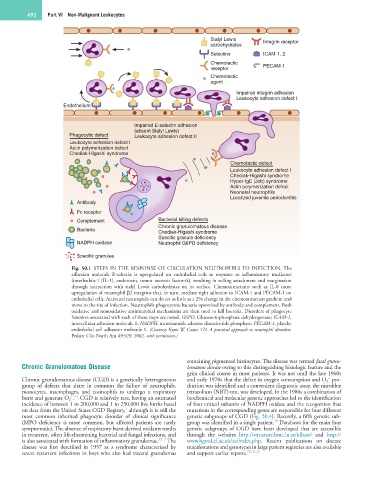
                        Fig.  50.1  STEPS IN THE RESPONSE OF CIRCULATION NEUTROPHILS TO INFECTION. The
                        adhesion  molecule  E-selectin  is  upregulated  on  endothelial  cells  in  response  to  inflammatory  mediators
                        (interleukin-1 [IL-1], endotoxin, tumor necrosis factor-α), resulting in rolling attachment and margination
                        through  interaction  with  sialyl  Lewis  carbohydrates  on  its  surface.  Chemoattractants  such  as  IL-8  cause
                        upregulation of neutrophil β2 integrins that, in turn, mediate tight adhesion to ICAM-1 and PECAM-1 on
                        endothelial cells. Activated neutrophils can detect as little as a 2% change in the chemoattractant gradient and
                        move to the site of infection. Neutrophils phagocytoze bacteria opsonized by antibody and complement. Both
                        oxidative and nonoxidative antimicrobial mechanisms are then used to kill bacteria. Disorders of phagocyte
                        function associated with each of these steps are noted. G6PD, Glucose-6-phosphate dehydrogenase; ICAM-1,
                        intercellular adhesion molecule 1; NADPH, nicotinamide adenine dinucleotide phosphate; PECAM-1, platelet
                        endothelial cell adhesion molecule 1. (Courtesy Kyoto W, Coates TD: A practical approach to neutrophil disorders.
                        Pediatr Clin North Am 49:929, 2002, with permission.)


                                                              containing pigmented histiocytes. The disease was termed fatal granu-
        Chronic Granulomatous Disease                         lomatous disease owing to this distinguishing histologic feature and the
                                                              grim clinical course in most patients. It was not until the late 1960s
                                                                                                            −
        Chronic granulomatous disease (CGD) is a genetically heterogeneous   and early 1970s that the defect in oxygen consumption and O 2  pro-
        group  of  defects  that  share  in  common  the  failure  of  neutrophils,   duction was identified and a convenient diagnostic assay, the nitroblue
        monocytes,  macrophages,  and  eosinophils  to  undergo  a  respiratory   tetrazolium (NBT) test, was developed. In the 1980s a combination of
                        − 3,7
        burst and generate O 2 .  CGD is relatively rare, having an estimated   biochemical and molecular genetic approaches led to the identification
        incidence of between 1 in 200,000 and 1 in 250,000 live births based   of four critical subunits of NADPH oxidase and the recognition that
                                          7
        on data from the United States CGD Registry,  although it is still the   mutations in the corresponding genes are responsible for four different
        most  common  inherited  phagocyte  disorder  of  clinical  significance   genetic subgroups of CGD (Fig. 50.4). Recently, a fifth genetic sub-
                                                                                           10
        (MPO  deficiency  is  more  common,  but  affected  patients  are  rarely   group was identified in a single patient.  Databases for the main four
        symptomatic). The absence of respiratory burst-derived oxidants results   genetic  subgroups  of  CGD  have  been  developed  that  are  accessible
        in recurrent, often life-threatening bacterial and fungal infections, and   through  the  websites  http://structure.bmc.lu.se/idbase/  and  http://
        is also associated with formation of inflammatory granulomas. 3,7–9  The   www.hgmd.cf.ac.uk/ac/index.php.  Recent  publications  on  disease
        disease  was  first  described  in  1957  as  a  syndrome  characterized  by   manifestations and genotypes in large patient registries are also available
        severe recurrent infections in boys who also had visceral granulomas   and support earlier reports. 7,9,11,12

