


Page 820 - Hematology_ Basic Principles and Practice ( PDFDrive )
P. 820
706    Part VI  Non-Malignant Leukocytes


        DEFECTS IN THE STRUCTURE AND FUNCTION OF                TABLE   Summary of Chediak-Higashi Syndrome
        LYSOSOMAL GRANULES                                      50.9
                                                               Incidence            More than 200 cases described
        Two  major  disorders  of  neutrophil  granules  have  been  described,   Inheritance  AR
        CHS and specific granule deficiency (SGD). A great deal has been   Molecular defect  A defect in granule morphogenesis in
        learned about the structural and functional abnormalities of neutro-          multiple tissues resulting from
        phils from patients with these conditions. Although rare, these dis-          mutations in the CHS1 (LYST) gene
        orders are also obligatory components in the differential diagnosis for       encoding a lysosomal trafficking
        any patient with recurrent bacterial and fungal infections.
                                                                                      regulator protein
                                                               Pathogenesis         Giant coalesced azurophil granules in
        Chediak-Higashi Syndrome                                                      neutrophils, resulting in ineffective
                                                                                      granulopoiesis and neutropenia,
        CHS  is  a  rare  AR,  multisystem  disease  resulting  from  widespread      delayed and incomplete degranulation,
        defects in granule morphogenesis, with giant lysosomes in leukocytes          and defective chemotaxis; abnormal
        and other cells throughout the body. 24–26  The disorder is characterized     granules in other cells (NK cells,
        by partial oculocutaneous albinism, frequent (and sometimes fatal)            cytotoxic T cells, platelets,
        bacterial infections, a mild bleeding diathesis, and peripheral as well       melanocytes, neurons)
        as cranial neuropathies associated with defects at the optic chiasm.   Clinical manifestations  Partial oculocutaneous albinism
        Those who survive the recurrent infections develop an “accelerated          Recurrent severe bacterial infections
        phase” of the disease; one of the hereditary forms of HLH, which, if          (usually Staphylococcus aureus)
        untreated, is eventually fatal because of a profound pancytopenia that      Cranial and peripheral neuropathies
        develops.                                                                     (muscle weakness, ataxia, sensory
           The most dramatic granule defects are manifested in the various            loss)
        blood cells. Neutrophils contain a highly inhomogeneous population          HLH (accelerated phase)
        of huge granules derived from coalescence of azurophilic (primary)   Laboratory evaluation  Giant granules in peripheral blood
        granules. The giant granules are often more prominent in the BM               granulocytes and in BM myeloid
        than in the peripheral blood because many of the abnormal myeloid             progenitor cells
        precursors are apparently destroyed before they leave the BM, result-       Widespread lymphohistiocytic infiltrates
        ing in moderate neutropenia with absolute neutrophil counts ranging           in accelerated phase
                             3
        from 500 to 2000 cells/mm . Granules are also markedly deficient in
        antimicrobial  granule  enzymes  such  as  cathepsin  G  and  elastase,   Differential diagnosis  Other genetic forms of partial albinism
        consistent with a defect in granule morphogenesis. Degranulation is         Giant granules can be seen in acute and
        delayed and incomplete in Chediak-Higashi neutrophils, resulting in           CMLs
        impaired  bacterial  killing.  Chemotaxis  is  also  defective,  perhaps   Therapy  Prophylactic TMP-SMX
        related  to  poor  deformability  because  of  the  presence  of  the  large   Parenteral antibiotics for acute infections
        granules. Monocytes and macrophages exhibit similar giant cytoplas-         Ascorbic acid (200 mg/day for infants;
        mic granules, with resultant abnormalities in their phagocytic func-          6 g/day for adults)
        tions. Giant granules are also seen in lymphocytes and are associated       HSCT before or at beginning of HLH
        with  defects  in  cytotoxic  T-lymphocyte  and  NK  cell  function.   Prognosis  Most patients die from infection or
        Eosinophils  contain  large  granules,  the  functional  significance  of     complications of HLH during the first
        which is not known. Platelets in this disorder have a storage pool            or second decade of life unless
        deficiency  of  adenosine  diphosphate  and  serotonin,  presumably           transplantation is performed
        caused by the abnormal granule morphogenesis in megakaryocytes,
        leading to a defect in platelet aggregation.           AR, Autosomal recessive; BM, bone marrow; CML, chronic myeloid leukemia;
                                                               HLH, hemophagocytic lymphohistiocytosis; HSCT, hematopoietic stem cell
           Abnormal giant granules are also present in other cell types. These   transplant; NK, natural killer; TMP-SMX, trimethoprim-sulfamethoxazole.
        include  melanocytes,  which  contain  abnormal  melanosomes  that
        cannot  transfer  their  contents  to  adjacent  keratinocytes;  Schwann
        cells; astrocytes; and certain cells in the liver, spleen, pancreas, gastric
        mucosa, kidney, adrenal gland, and pituitary gland.
                                                              Clinical Manifestations
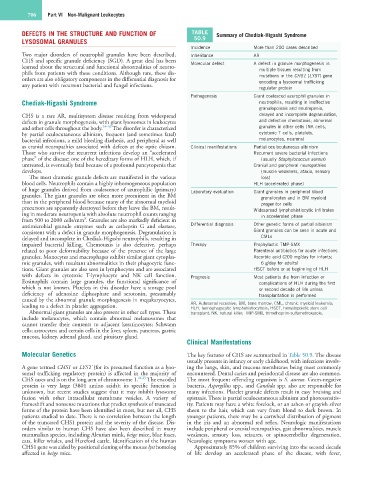
        Molecular Genetics                                    The key features of CHS are summarized in Table 50.9. The disease
                                                              usually presents in infancy or early childhood, with infections involv-
        A gene termed CHS1 or LYST (for its presumed function as a lyso-  ing the lungs, skin, and mucous membranes being most commonly
        somal  trafficking  regulatory  protein)  is  affected  in  the  majority  of   encountered. Dental caries and periodontal disease are also common.
        CHS cases and is on the long arm of chromosome 1. 24,25  The encoded   The most frequent offending organism is S. aureus. Gram-negative
        protein  is  very  large  (3801  amino  acids);  its  specific  function  is   bacteria, Aspergillus spp., and Candida spp. also are responsible for
        unknown,  but  recent  studies  suggest  that  it  may  inhibit  lysosome   many infections. Platelet granule defects result in easy bruising and
        fusion  with  other  intracellular  membrane  vesicles.  A  variety  of   epistaxis. There is partial oculocutaneous albinism and photosensitiv-
        frameshift and nonsense mutations that predict synthesis of truncated   ity. Patients may have a white forelock, or an ashen or grayish silver
        forms of the protein have been identified in most, but not all, CHS   sheen  to  the  hair,  which  can  vary  from  blond  to  dark  brown.  In
        patients studied to date. There is no correlation between the length   younger patients, there may be a cartwheel distribution of pigment
        of the truncated CHS1 protein and the severity of the disease. Dis-  in  the  iris  and  an  abnormal  red  reflex.  Neurologic  manifestations
        orders  similar  to  human  CHS  have  also  been  described  in  many   include peripheral or cranial neuropathies, gait abnormalities, muscle
        mammalian species, including Aleutian mink, beige mice, blue foxes,   weakness,  sensory  loss,  seizures,  or  spinocerebellar  degeneration.
        cats, killer whales, and Hereford cattle. Identification of the human   Neurologic symptoms worsen with age.
        CHS1 gene was aided by positional cloning of the mouse lyst homolog   Approximately 85% of children surviving into the second decade
        affected in beige mice.                               of  life  develop  an  accelerated  phase  of  the  disease,  with  fever,

