


Page 842 - Hematology_ Basic Principles and Practice ( PDFDrive )
P. 842
Chapter 52  Histiocytic Disorders  725


                                        Bone marrow                                Peripheral   Tissue compartment
                                                                                     blood


                                                                                   Neutrophil


                                                CFU-M         Promonocyte           Monocyte
            Pluripotent  Myeloid  CFU-GM                                                                   Mononuclear
             stem cell  progenitor                                                                         phagocyte
                                                                                                             system
                                                          Monoblast
                                                                                                Macrophage/
                                                                                              ordinary histocyte


                                                   CFU-DL                                                   Dendritic
                                                                                                              cell
                                                                                                             system

                                                                                  Dendritic cell  Tissue-based
                                                                                   precursor     dendritic cell

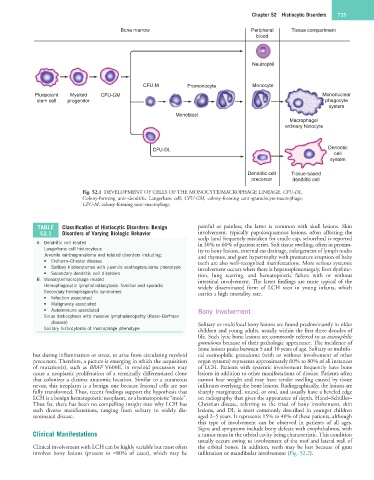
                            Fig. 52.1  DEVELOPMENT OF CELLS OF THE MONOCYTE/MACROPHAGE LINEAGE. CFU-DL,
                            Colony-forming  unit–dendritic  Langerhans  cell;  CFU-GM,  colony-forming  unit–granulocyte-macrophage;
                            CFU-M, colony-forming unit–macrophage.


             TABLE   Classification of Histiocytic Disorders: Benign   painful  or  painless;  the  latter  is  common  with  skull  lesions.  Skin
              52.1   Disorders of Varying Biologic Behavior       involvement, typically papulosquamous  lesions,  often  affecting  the
                                                                  scalp (and frequently mistaken for cradle cap, seborrhea) is reported
              A.  Dendritic cell related                          in 30% to 60% of patient series. Soft tissue swelling, often in proxim-
               Langerhans cell histiocytosis                      ity to bony lesions, external ear drainage, enlargement of lymph nodes
               Juvenile xanthogranuloma and related disorders including:  and thymus, and gum hypertrophy with premature eruption of baby
               •  Erdheim–Chester disease                         teeth are also well-recognized manifestations. More serious systemic
               •  Solitary histiocytomas with juvenile xanthogranuloma phenotype  involvement occurs when there is hepatosplenomegaly, liver dysfunc-
               •  Secondary dendritic cell disorders              tion,  lung  scarring,  and  hematopoietic  failure  with  or  without
              B.  Monocyte/macrophage related                     intestinal  involvement. The  latter  findings  are  more  typical  of  the
               Hemophagocytic lymphohistiocytosis: familial and sporadic  widely  disseminated  form  of  LCH  seen  in  young  infants,  which
               Secondary hemophagocytic syndromes                 carries a high mortality rate.
               •  Infection associated
               •  Malignancy associated
               •  Autoimmune associated                           Bony Involvement
               Sinus histiocytosis with massive lymphadenopathy (Rosai–Dorfman
                  disease)                                        Solitary or multifocal bony lesions are found predominantly in older
               Solitary histiocytoma of macrophage phenotype      children and young adults, usually within the first three decades of
                                                                  life. Such lytic bone lesions are commonly referred to as eosinophilic
                                                                  granuloma because of their pathologic appearance. The incidence of
                                                                  bone lesions peaks between 5 and 10 years of age. Solitary or multifo-
            but during inflammation or stress, to arise from circulating myeloid   cal eosinophilic granuloma (with or without involvement of other
            precursors. Therefore, a picture is emerging in which the acquisition   organ systems) represents approximately 60% to 80% of all instances
            of  mutation(s),  such  as  BRAF  V600E,  in  myeloid  precursors  may   of LCH. Patients with systemic involvement frequently have bone
            cause a neoplastic proliferation of a terminally differentiated clone   lesions in addition to other manifestations of disease. Patients often
            that colonizes a distinct anatomic location. Similar to a cutaneous   cannot bear weight and may have tender swelling caused by tissue
            nevus, this neoplasm is a benign one because lesional cells are not   infiltrates overlying the bone lesions. Radiographically, the lesions are
            fully transformed. Thus, recent findings support the hypothesis that   sharply marginated, round, or oval, and usually have a beveled edge
            LCH is a benign hematopoietic neoplasm, or a hematopoietic “mole”.   on radiography that gives the appearance of depth. Hand–Schüller–
            Thus far, there has been no compelling insight into why LCH has   Christian  disease,  referring to  the triad of  bony  involvement,  skin
            such  diverse  manifestations,  ranging  from  solitary  to  widely  dis-  lesions, and DI, is most commonly described in younger children
            seminated disease.                                    aged 2–5 years. It represents 15% to 40% of these patients, although
                                                                  this  type  of  involvement  can  be  observed  in  patients  of  all  ages.
                                                                  Signs and symptoms include bony defects with exophthalmos, with
            Clinical Manifestations                               a tumor mass in the orbital cavity being characteristic. This condition
                                                                  usually occurs owing to involvement of the roof and lateral wall of
            Clinical involvement with LCH can be highly variable but most often   the  orbital  bones.  In  addition,  teeth  may  be  lost  because  of  gum
            involves  bony  lesions  (present  in  ≈80%  of  cases),  which  may  be   infiltration or mandibular involvement (Fig. 52.2).

