


Page 843 - Hematology_ Basic Principles and Practice ( PDFDrive )
P. 843
726    Part VI  Non-Malignant Leukocytes


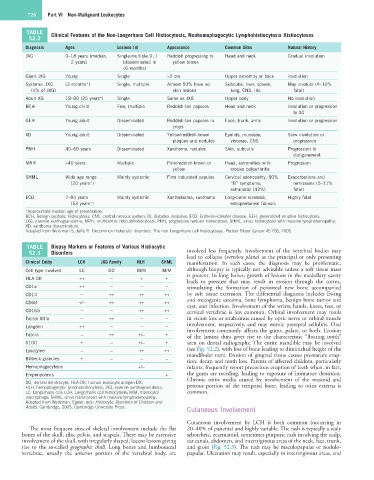
          TABLE   Clinical Features of the Non-Langerhans Cell Histiocytosis, Nonhemophagocytic Lymphohistiocytosis Histiocytoses
          52.2
         Diagnosis    Ages             Lesions (n)      Appearance         Common Sites        Natural History
         JXG          0–18 years (median,   Single:multiple 9 : 1   Reddish progressing to   Head and neck  Gradual involution
                        2 years)         (disseminated in   yellow brown
                                         <6 months)
         Giant JXG    Young            Single           >2 cm              Upper extremity or back  Involution
         Systemic JXG   (3 months*)    Single, multiple  Almost 50% have no   Subcutis, liver, spleen,   May involute (4–10%
           (4% of JXG)                                    skin lesions      lung, CNS, iris      fatal)
         Adult XG     18–80 (35 years*)  Single         Same as JXG        Upper body          No involution
         BCH          Young child      Few, multiple    Reddish-tan papules  Head and neck     Involution or progression
                                                                                                 to XG
         GEH          Young adult      Disseminated     Reddish-tan papules in   Face, trunk, arms  Involution or progression
                                                          crops
         XD           Young adult      Disseminated     Yellow/reddish-brown   Eyelids, mucosae,   Slow involution or
                                                          plaques and nodules  viscerae, CNS     progression
         PNH          40–60 years      Disseminated     Xanthoma, nodules  Skin, subcutis      Progression to
                                                                                                 disfigurement
         MRH          >40 years        Multiple         Pink/reddish-brown or   Head, extremities with   Progression
                                                          yellow            erosive polyarthritis
         SHML         Wide age range    Mainly systemic  Firm indurated papules  Cervical adenopathy, 80%   Exacerbations and
                        (20 years*)                                         “B” symptoms,        remissions (5–11%
                                                                            extranodal (43%)     fatal)
         ECD          7–84 years       Mainly systemic  Xanthelasma, xanthoma  Long-bone sclerosis,   Highly fatal
                        (53 years*)                                         retroperitoneal fibrosis
         *Approximate median age of presentation.
         BCH, Benign cephalic histiocytosis; CNS, central nervous system; DI, diabetes insipidus; ECD, Erdheim–Chester disease; GEH, generalized eruptive histiocytosis;
         JXG, juvenile xanthogranuloma; MRH, multicentric reticulohistiocytosis; PNH, progressive nodular histiocytosis; SHML, sinus histiocytosis with massive lymphadenopathy;
         XD, xanthoma disseminatum.
         Adapted from Weitzman S, Jaffe R: Uncommon histiocytic disorders: The non-Langerhans cell histiocytoses. Pediatr Blood Cancer 45:256, 2005.

          TABLE   Biopsy Markers or Features of Various Histiocytic
          52.3    Disorders                                   involved  less  frequently.  Involvement  of  the  vertebral  bodies  may
                                                              lead to collapse (vertebra plana) as the principal or only presenting
         Clinical Entity   LCH    JXG Family  HLH     SHML    manifestation.  In  such  cases,  the  diagnosis  may  be  problematic,
         Cell type involved  LC      DD       M/M     M/M     although biopsy is typically not advisable unless a soft tissue mass
         HLA-DR            ++        −         +       +      is present. In long bones, growth of lesions in the medullary cavity
                                                              leads  to  pressure  that  may  result  in  erosion  through  the  cortex,
         CD1a              ++        −         −       −      stimulating  the  formation  of  periosteal  new  bone  accompanied
         CD14              −         ++        ++      ++     by  soft  tissue  extension. The  differential  diagnosis  includes  Ewing
                                                              and osteogenic sarcoma, bone lymphoma, benign bone tumor and
         CD68              +/−       ++        ++      ++
                                                              cyst, and infection. Involvement of the wrists, hands, knees, feet, or
         CD163             −         −         ++      ++     cervical  vertebrae  is  less  common.  Orbital  involvement  may result
         Factor XIIIa      −         ++        −       −      in vision loss or strabismus caused by optic nerve or orbital muscle
         Langerin          ++        −         −       −      involvement, respectively, and may mimic preseptal cellulitis. Oral
                                                              involvement  commonly  affects  the  gums,  palate,  or  both.  Erosion
         Fascin            −         ++       +/−      +      of  the  lamina  dura  gives  rise  to  the  characteristic  “floating  tooth”
         S100              +         −        +/−      +      seen on dental radiographs. The entire mandible may be involved
         Lysozyme          −         −         ++      ++     (see Fig. 52.2), with loss of bone leading to diminished height of the
         Birbeck granules  +         −         −       −      mandibular rami. Erosion of gingival tissue causes premature erup-
                                                              tion, decay, and tooth loss. Parents of affected children, particularly
         Hemophagocytosis                     +/−             infants, frequently report precocious eruption of teeth when, in fact,
         Emperipolesis                                 +      the gums are receding, leading to exposure of immature dentition.
                                                              Chronic  otitis  media  caused  by  involvement  of  the  mastoid  and
         DD, dermal dendrocyte; HLA-DR, human leukocyte antigen-DR;
         HLH, hemophagocytic lymphohistiocytosis; JXG, juvenile xanthogranuloma;    petrous  portion  of  the  temporal  bone,  leading  to  otitis  externa  is
         LC, Langerhans cell; LCH, Langerhans cell histiocytosis; M/M, monocyte/  common.
         macrophage; SHML, sinus histiocytosis with massive lymphadenopathy.
         Adapted from Weitzman, Egeler, eds: Histiocytic Disorders of Children and
         Adults. Cambridge, 2005, Cambridge University Press.
                                                              Cutaneous Involvement
                                                              Cutaneous  involvement  by  LCH  is  both  common  (occurring  in
           The most frequent sites of skeletal involvement include the flat   20–40% of patients) and highly variable. The rash is typically a scaly
        bones of the skull, ribs, pelvis, and scapula. There may be extensive   seborrheic, eczematoid, sometimes purpuric rash involving the scalp,
        involvement of the skull, with irregularly shaped, lucent lesions giving   ear canals, abdomen, and intertriginous areas of the neck, face, trunk,
        rise  to  the  so-called  geographic  skull.  Long  bones  and  lumbosacral   and groin (Fig. 52.3). The rash may be maculopapular or nodulo-
        vertebrae,  usually  the  anterior  portion  of  the  vertebral  body,  are   papular. Ulceration may result, especially in intertriginous areas, and

