


Page 845 - Hematology_ Basic Principles and Practice ( PDFDrive )
P. 845
728    Part VI  Non-Malignant Leukocytes


        systemic disease and involvement of the orbit and skull. Fewer than   syndrome. This CNS involvement is typically seen in children who
        one-third of children who ultimately develop DI have polydipsia and   had classic lytic bony involvement or soft tissue mass lesions in or
        polyuria as presenting symptoms of LCH. Most cases of DI present   around the CNS years earlier. Delayed CNS involvement is typically
        within 4 years of diagnosis. DI is caused by infiltration by Langerhans   diagnosed after a prolonged, sometimes insidious, decrease in school
        cells  and  macrophages  into  the  hypothalamus  with  or  without   function.  Magnetic  resonance  imaging  (MRI)  reveals  diffuse  or
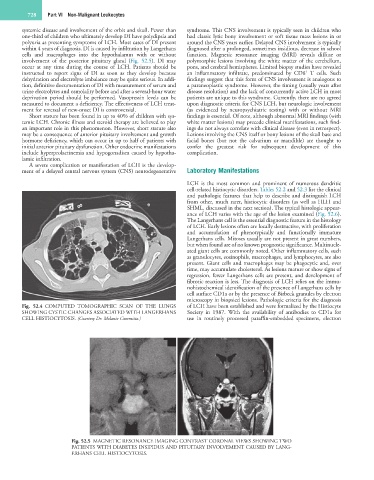
        involvement  of  the  posterior  pituitary  gland  (Fig.  52.5).  DI  may   polymorphic lesions involving the white matter of the cerebellum,
        occur  at  any  time  during  the  course  of  LCH.  Patients  should  be   pons, and cerebral hemispheres. Limited biopsy studies have revealed
                                                                                                     +
        instructed  to  report  signs  of  DI  as  soon  as  they  develop  because   an  inflammatory  infiltrate,  predominated  by  CD8   T  cells.  Such
        dehydration and electrolyte imbalance may be quite serious. In addi-  findings suggest that this form of CNS involvement is analogous to
        tion, definitive documentation of DI with measurement of serum and   a paraneoplastic syndrome. However, the timing (usually years after
        urine electrolytes and osmolality before and after a several-hour water   disease resolution) and the lack of concurrently active LCH in most
        deprivation period should be performed. Vasopressin levels can be   patients are unique to this syndrome. Currently, there are no agreed
        measured to document a deficiency. The effectiveness of LCH treat-  upon diagnostic criteria for CNS LCH, but neurologic involvement
        ment for reversal of new-onset DI is controversial.   (as  evidenced  by  neuropsychiatric  testing)  with  or  without  MRI
           Short stature has been found in up to 40% of children with sys-  findings is essential. Of note, although abnormal MRI findings (with
        temic LCH. Chronic illness and steroid therapy are believed to play   white matter lesions) may precede clinical manifestations, such find-
        an important role in this phenomenon. However, short stature also   ings do not always correlate with clinical disease (even in retrospect).
        may be a consequence of anterior pituitary involvement and growth   Lesions involving the CNS itself or bony lesions of the skull base and
        hormone deficiency, which can occur in up to half of patients with   facial  bones  (but  not  the  calvarium  or  mandible)  are  thought  to
        initial anterior pituitary dysfunction. Other endocrine manifestations   confer  the  greatest  risk  for  subsequent  development  of  this
        include hyperprolactinemia and hypogonadism caused by hypotha-  complication.
        lamic infiltration.
           A severe complication or manifestation of LCH is the develop-
        ment of a delayed central nervous system (CNS) neurodegenerative   Laboratory Manifestations

                                                              LCH  is  the  most  common  and  prominent  of  numerous  dendritic
                                                              cell-related histiocytic disorders. Tables 52.2 and 52.3 list the clinical
                                                              and pathologic features that help to describe and distinguish LCH
                                                              from other, much rarer, histiocytic disorders (as well as HLH and
                                                              SHML, discussed in the next section). The typical histologic appear-
                                                              ance of LCH varies with the age of the lesion examined (Fig. 52.6).
                                                              The Langerhans cell is the essential diagnostic feature in the histology
                                                              of LCH. Early lesions often are locally destructive, with proliferation
                                                              and  accumulation  of  phenotypically  and  functionally  immature
                                                              Langerhans cells. Mitoses usually are not present in great numbers,
                                                              but when found are of no known prognostic significance. Multinucle-
                                                              ated giant cells are commonly noted. Other inflammatory cells, such
                                                              as granulocytes, eosinophils, macrophages, and lymphocytes, are also
                                                              present. Giant cells and macrophages may be phagocytic and, over
                                                              time, may accumulate cholesterol. As lesions mature or show signs of
                                                              regression, fewer Langerhans cells are present, and development of
                                                              fibrotic reaction is less. The diagnosis of LCH relies on the immu-
                                                              nohistochemical identification of the presence of Langerhans cells by
                                                              cell surface CD1a or by the presence of Birbeck granules by electron
                                                              microscopy in biopsied lesions. Pathologic criteria for the diagnosis
        Fig.  52.4  COMPUTED  TOMOGRAPHIC  SCAN  OF  THE  LUNGS   of LCH have been established and were formalized by the Histiocyte
        SHOWING CYSTIC CHANGES ASSOCIATED WITH LANGERHANS     Society  in  1987.  With  the  availability  of  antibodies  to  CD1a  for
        CELL HISTIOCYTOSIS. (Courtesy Dr. Melanie Committo.)  use  in  routinely  processed  paraffin-embedded  specimens,  electron


                        Fig. 52.5  MAGNETIC RESONANCE IMAGING CONTRAST CORONAL VIEWS SHOWING TWO
                        PATIENTS WITH DIABETES INSIPIDUS AND PITUITARY INVOLVEMENT CAUSED BY LANG-
                        ERHANS CELL HISTIOCYTOSIS.

