


Page 844 - Hematology_ Basic Principles and Practice ( PDFDrive )
P. 844
Chapter 52  Histiocytic Disorders  727


                                   P                                      P
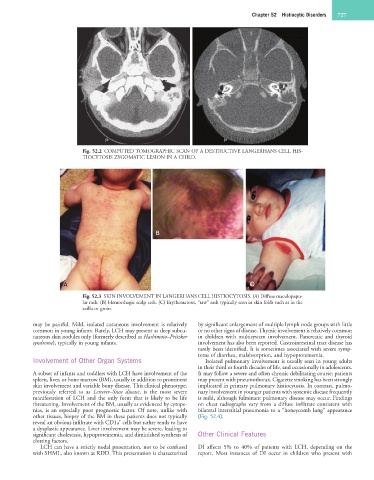
                            Fig. 52.2  COMPUTED TOMOGRAPHIC SCAN OF A DESTRUCTIVE LANGERHANS CELL HIS-
                            TIOCYTOSIS ZYGOMATIC LESION IN A CHILD.


                                                    B


                      A                                                            C

                            Fig. 52.3  SKIN INVOLVEMENT IN LANGERHANS CELL HISTIOCYTOSIS. (A) Diffuse maculopapu-
                            lar rash. (B) Hemorrhagic scalp rash. (C) Erythematous, “raw” rash typically seen in skin folds such as in the
                            axilla or groin.


            may  be  painful.  Mild,  isolated  cutaneous  involvement  is  relatively   by significant enlargement of multiple lymph node groups with little
            common in young infants. Rarely, LCH may present as deep subcu-  or no other signs of disease. Thymic involvement is relatively common
            taneous skin nodules only (formerly described as Hashimoto–Pritzker   in  children  with  multisystem  involvement.  Pancreatic  and  thyroid
            syndrome), typically in young infants.                involvement has also been reported. Gastrointestinal tract disease has
                                                                  rarely been identified. It is sometimes associated with severe symp-
                                                                  toms of diarrhea, malabsorption, and hypoproteinemia.
            Involvement of Other Organ Systems                      Isolated pulmonary involvement is usually seen in young adults
                                                                  in their third or fourth decades of life, and occasionally in adolescents.
            A subset of infants and toddlers with LCH have involvement of the   It may follow a severe and often chronic debilitating course; patients
            spleen, liver, or bone marrow (BM), usually in addition to prominent   may present with pneumothorax. Cigarette smoking has been strongly
            skin involvement and variable bony disease. This clinical phenotype,   implicated in primary pulmonary histiocytosis. In contrast, pulmo-
            previously  referred  to  as  Letterer–Siwe  disease,  is  the  most  severe   nary involvement in younger patients with systemic disease frequently
            manifestation  of  LCH  and  the  only  form  that  is  likely  to  be  life   is mild, although fulminant pulmonary disease may occur. Findings
            threatening. Involvement of the BM, usually as evidenced by cytope-  on  chest  radiographs  vary  from  a  diffuse  infiltrate  consistent  with
            nias,  is  an  especially  poor  prognostic  factor.  Of  note,  unlike  with   bilateral interstitial pneumonia to a “honeycomb lung” appearance
            other tissues, biopsy of the BM in these patients does not typically   (Fig. 52.4).
                                        +
            reveal an obvious infiltrate with CD1a  cells but rather tends to have
            a dysplastic appearance. Liver involvement may be severe, leading to
            significant cholestasis, hypoproteinemia, and diminished synthesis of   Other Clinical Features
            clotting factors.
              LCH can have a strictly nodal presentation, not to be confused   DI  affects  5%  to  40%  of  patients  with  LCH,  depending  on  the
            with SHML, also known as RDD. This presentation is characterized   report.  Most  instances  of  DI  occur  in  children  who  present  with

