


Page 846 - Hematology_ Basic Principles and Practice ( PDFDrive )
P. 846
Chapter 52  Histiocytic Disorders  729


                                                     B


                          A                          C             D            E


                          F                               G                     H
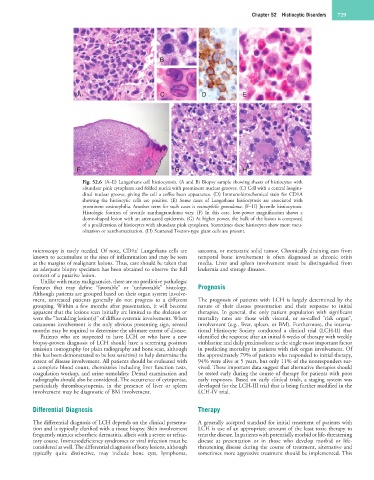
                            Fig. 52.6  (A–E) Langerhans cell histiocytosis. (A and B) Biopsy sample showing sheets of histiocytes with
                            abundant pink cytoplasm and folded nuclei with prominent nuclear grooves. (C) Cell with a central longitu-
                            dinal nuclear groove, giving the cell a coffee bean appearance. (D) Immunohistochemical stain for CD1A
                            showing  the  histiocytic  cells  are  positive.  (E)  Some  cases  of  Langerhans  histiocytosis  are  associated  with
                            prominent eosinophilia. Another term for such cases is eosinophilic granuloma. (F–H) Juvenile histiocytosis.
                            Histologic  features  of  juvenile  xanthogranuloma  vary.  (F)  In  this  case,  low-power  magnification  shows  a
                            dome-shaped lesion with an attenuated epidermis. (G) At higher power, the bulk of the lesion is composed
                            of a proliferation of histiocytes with abundant pink cytoplasm. Sometimes these histiocytes show more vacu-
                            olization or xanthomatization. (H) Scattered Touton-type giant cells are present.


                                              +
            microscopy is rarely needed. Of note, CD1a  Langerhans cells are   sarcoma, or metastatic solid tumor. Chronically draining ears from
            known to accumulate at the sites of inflammation and may be seen   temporal  bone  involvement  is  often  diagnosed  as  chronic  otitis
            at the margins of malignant lesions. Thus, care should be taken that   media.  Liver  and  spleen  involvement  must  be  distinguished  from
            an adequate biopsy specimen has been obtained to observe the full   leukemia and storage diseases.
            context of a putative lesion.
              Unlike with many malignancies, there are no predictive pathologic
            features  that  may  define  “favorable”  or  “unfavorable”  histology.   Prognosis
            Although patients are grouped based on their organ system involve-
            ment,  untreated  patients  generally  do  not  progress  to  a  different   The  prognosis  of  patients  with  LCH  is  largely  determined  by  the
            grouping. Within a few  months after  presentation,  it  will  become   nature  of  their  disease  presentation  and  their  response  to  initial
            apparent that the lesions seen initially are limited to the skeleton or   therapies.  In  general,  the  only  patient  population  with  significant
            were the “heralding lesion(s)” of diffuse systemic involvement. When   mortality  rates  are  those  with  visceral,  or  so-called  “risk  organ”,
            cutaneous involvement is the only obvious presenting sign, several   involvement (e.g., liver, spleen, or BM). Furthermore, the interna-
            months may be required to determine the ultimate extent of disease.  tional  Histiocyte  Society  conducted  a  clinical  trial  (LCH-II)  that
              Patients  who  are  suspected  to  have  LCH  or  who  have  a  new   identified the response after an initial 6 weeks of therapy with weekly
            biopsy-proven diagnosis of LCH should have a screening positron   vinblastine and daily prednisolone as the single most important factor
            emission tomography (or plain radiography and bone scan, although   in predicting mortality in patients with risk organ involvement. Of
            this has been demonstrated to be less sensitive) to help determine the   the approximately 79% of patients who responded to initial therapy,
            extent of disease involvement. All patients should be evaluated with   94% were alive at 5 years, but only 11% of the nonresponders sur-
            a complete blood count, chemistries including liver function tests,   vived. These important data suggest that alternative therapies should
            coagulation workup, and urine osmolality. Dental examination and   be tested early during the course of therapy for patients with poor
            radiographs should also be considered. The occurrence of cytopenias,   early responses. Based on early clinical trials, a staging system was
            particularly  thrombocytopenia,  in  the  presence  of  liver  or  spleen   developed for the LCH-III trial that is being further modified in the
            involvement may be diagnostic of BM involvement.      LCH-IV trial.


            Differential Diagnosis                                Therapy

            The differential diagnosis of LCH depends on the clinical presenta-  A generally accepted standard for initial treatment of patients with
            tion and is typically clarified with a tissue biopsy. Skin involvement   LCH is use of an appropriate amount of the least toxic therapy to
            frequently mimics seborrheic dermatitis, albeit with a severe or refrac-  treat the disease. In patients with potentially morbid or life-threatening
            tory course. Immunodeficiency syndromes or viral infection must be   disease  at  presentation  or  in  those  who  develop  morbid  or  life-
            considered as well. The differential diagnosis of bony lesions, although   threatening disease during the course of treatment, alternative and
            typically  quite  distinctive,  may  include  bone  cyst,  lymphoma,   sometimes more aggressive treatment should be implemented. This

