


Page 852 - Hematology_ Basic Principles and Practice ( PDFDrive )
P. 852
Chapter 52  Histiocytic Disorders  735


                                                           C


                          A                 B              D D          E                    F


                          G                               H               I             J

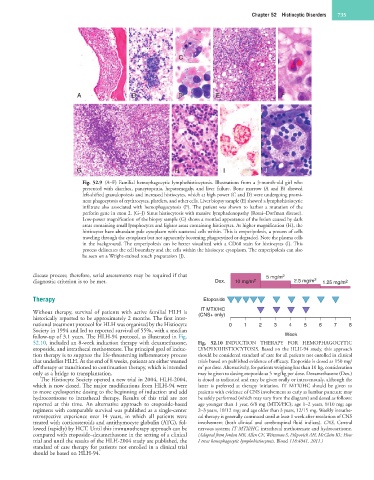
                            Fig.  52.9  (A–F) Familial hemophagocytic lymphohistiocytosis. Illustrations from a 3-month-old girl who
                            presented  with  diarrhea,  pancytopenia,  hepatomegaly,  and  liver  failure.  Bone  marrow  (A  and  B)  showed
                            left-shifted granulopoiesis and increased histiocytes, which at high power (C and D) were undergoing promi-
                            nent phagocytosis of erythrocytes, platelets, and other cells. Liver biopsy sample (E) showed a lymphohistiocytic
                            infiltrate  also  associated  with  hemophagocytosis  (F). The  patient  was  shown  to  harbor  a  mutation  of  the
                            perforin gene in exon 2. (G–J) Sinus histiocytosis with massive lymphadenopathy (Rosai–Dorfman disease).
                            Low-power magnification of the biopsy sample (G) shows a mottled appearance of the lesion caused by dark
                            areas containing small lymphocytes and lighter areas containing histiocytes. At higher magnification (H), the
                            histiocytes have abundant pale cytoplasm with scattered cells within. This is emperipolesis, a process of cells
                            traveling through the cytoplasm but not apparently becoming phagocytized or degraded. Note the plasma cells
                            in the background. The emperipolesis can be better visualized with a CD68 stain for histiocytes (I). This
                            process delineates the cell boundary and the cells within the histiocyte cytoplasm. The emperipolesis can also
                            be seen on a Wright-stained touch preparation (J).


            disease process; therefore, serial assessments may be required if that      5 mg/m 2
            diagnostic criterion is to be met.                         Dex.   10 mg/m 2          2.5 mg/m 2  1.25 mg/m 2

            Therapy                                                 Etoposide
                                                                   IT MTX/HC
            Without  therapy,  survival  of  patients  with  active  familial  HLH  is   (CNS+ only)
            historically reported to be approximately 2 months. The first inter-
            national treatment protocol for HLH was organized by the Histiocyte   0  1  2  3    4   5    6    7    8
            Society in 1994 and led to reported survival of 55%, with a median
            follow-up of 3.1 years. The HLH-94 protocol, as illustrated in Fig.               Week
            52.10, included an 8-week induction therapy with dexamethasone,   Fig.  52.10  INDUCTION  THERAPY  FOR  HEMOPHAGOCYTIC
            etoposide, and intrathecal methotrexate. The principal goal of induc-  LYMPHOHISTIOCYTOSIS. Based on the HLH-94 study, this approach
            tion therapy is to suppress the life-threatening inflammatory process   should be considered standard of care for all patients not enrolled in clinical
            that underlies HLH. At the end of 8 weeks, patients are either weaned   trials based on published evidence of efficacy. Etoposide is dosed as 150 mg/
                                                                   2
            off therapy or transitioned to continuation therapy, which is intended   m  per dose. Alternatively, for patients weighing less than 10 kg, consideration
            only as a bridge to transplantation.                  may be given to dosing etoposide as 5 mg/kg per dose. Dexamethasone (Dex.)
              The Histiocyte Society opened a new trial in 2004, HLH-2004,   is dosed as indicated and may be given orally or intravenously, although the
            which is now closed. The major modifications from HLH-94 were   latter  is  preferred  at  therapy  initiation.  IT  MTX/HC  should  be  given  to
            to move cyclosporine dosing to the beginning of induction and add   patients with evidence of CNS involvement as early as lumbar puncture may
            hydrocortisone  to  intrathecal  therapy.  Results  of  this  trial  are  not   be safely performed (which may vary from the diagram) and dosed as follows:
            reported  at  this  time.  An  alternative  approach  to  etoposide-based   age younger than 1 year, 6/8 mg (MTX/HC); age 1–2 years, 8/10 mg; age
            regimens with comparable survival was published as a single-center   2–3 years, 10/12 mg; and age older than 3 years, 12/15 mg. Weekly intrathe-
            retrospective  experience  over  14  years,  in  which  all  patients  were   cal therapy is generally continued until at least 1 week after resolution of CNS
            treated with corticosteroids and antithymocyte globulin (ATG), fol-  involvement  (both  clinical  and  cerebrospinal  fluid  indices).  CNS,  Central
            lowed (rapidly) by HCT. Until this immunotherapy approach can be   nervous system; IT MTX/HC, intrathecal methotrexate and hydrocortisone.
            compared with etoposide–dexamethasone in the setting of a clinical   (Adapted from Jordan MB, Allen CE, Weitzman S, Filipovich AH, McClain KL: How
            trial and until the results of the HLH-2004 study are published, the   I treat hemophagocytic lymphohistiocytosis. Blood 118:4041, 2011.)
            standard of care therapy for patients not enrolled in a clinical trial
            should be based on HLH-94.

