


Page 849 - Hematology_ Basic Principles and Practice ( PDFDrive )
P. 849
732    Part VI  Non-Malignant Leukocytes


                  Diagnostic Criteria for Hemophagocytic      HLH is one of intense, prolonged systemic inflammation rather than
          TABLE   Lymphohistiocytosis, Established for the Conduct of   unusual  or  severe  infections.  Although  this  inflammation  may  be
          52.4    the Hemophagocytic Lymphohistiocytosis-2004 Trial  triggered by infection or vaccination, the inflammation itself (and not
                                                              apparently the sometimes benign or transient infection) appears to
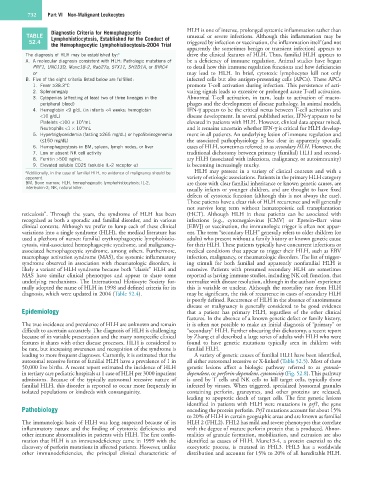
         The diagnosis of HLH may be established by: a        drive the clinical features of HLH. Thus, familial HLH appears to
          A.  A molecular diagnosis consistent with HLH: Pathologic mutations of   be  a  deficiency  of  immune  regulation.  Animal  studies  have begun
            PRF1, UNC13D, Munc18-2, Rab27a, STX11, SH2D1A, or BIRC4  to detail how this immune regulation functions and how deficiencies
            or                                                may  lead  to  HLH.  In  brief,  cytotoxic  lymphocytes  kill  not  only
          B.  Five of the eight criteria listed below are fulfilled:  infected cells but also antigen-presenting cells (APCs). These APCs
            1.  Fever ≥38.3°C                                 promote T-cell activation during infection. This persistence of acti-
            2.  Splenomegaly                                  vating signals leads to excessive or prolonged acute T-cell activation.
            3.  Cytopenias (affecting at least two of three lineages in the   Abnormal T-cell  activation,  in  turn,  leads  to  activation  of  macro-
              peripheral blood)                               phages and the development of disease pathology. In animal models,
            4.  Hemoglobin <9 g/dL (in infants <4 weeks: hemoglobin   IFN-γ appears to be the critical nexus between T-cell activation and
              <10 g/dL)                                       disease development. In several published series, IFN-γ appears to be
              Platelets <100 × 10 /mL                         elevated in patients with HLH. However, clinical data appear mixed,
                            3
              Neutrophils <1 × 10 /mL                         and it remains uncertain whether IFN-γ is critical for HLH develop-
                            3
            5.  Hypertriglyceridemia (fasting ≥265 mg/dL) or hypofibrinogenemia   ment in all patients. An underlying lesion of immune regulation and
              (≤150 mg/dL)                                    the  associated  pathophysiology  is  less  clear  in  apparently  sporadic
            6.  Hemophagocytosis in BM, spleen, lymph nodes, or liver  cases of HLH, sometimes referred to as secondary HLH. However, the
            7.  Low or absent NK cell activity                traditional dichotomy between primary (familial) HLH and second-
            8.  Ferritin >500 ng/mL                           ary HLH (associated with infections, malignancy, or autoimmunity)
            9.  Elevated soluble CD25 (soluble IL-2 receptor α)  is becoming increasingly murky.
         a Additionally, in the case of familial HLH, no evidence of malignancy should be   HLH  may  present  in  a  variety  of  clinical  contexts  and  with  a
         apparent.                                            variety of etiologic associations. Patients in the primary HLH category
         BM, Bone marrow; HLH, hemophagocytic lymphohistiocytosis; IL-2,   are those with clear familial inheritance or known genetic causes, are
         interleukin-2; NK, natural killer.                   usually infants or younger children, and are thought to have fixed
                                                              defects of cytotoxic function (although this is not always the case).
                                                              These patients have a clear risk of HLH recurrence and will generally
                                                              not  survive  long  term  without  hematopoietic  cell  transplantation
        reticulosis”.  Through  the  years,  the  syndrome  of  HLH  has  been   (HCT).  Although  HLH  in  these  patients  can  be  associated  with
        recognized as both a sporadic and familial disorder, and in various   infections  (e.g.,  cytomegalovirus  [CMV]  or  Epstein–Barr  virus
        clinical contexts. Although we prefer to lump each of these clinical   [EBV]) or vaccination, the immunologic trigger is often not appar-
        variations into a single syndrome (HLH), the medical literature has   ent. The term “secondary HLH” generally refers to older children (or
        used a plethora of names: familial erythrophagocytic lymphohistio-  adults) who present without a family history or known genetic cause
        cytosis, viral-associated hemophagocytic syndrome, and malignancy-  for their HLH. These patients typically have concurrent infections or
        associated hemophagocytic syndrome, among others. Furthermore,   medical conditions that appear to trigger their HLH, such as EBV
        macrophage activation syndrome (MAS), the systemic inflammatory   infection, malignancy, or rheumatologic disorders. The list of trigger-
        syndrome observed in  association  with rheumatologic  disorders, is   ing  stimuli  for  both  familial  and  apparently  nonfamilial  HLH  is
        likely a variant of HLH syndrome because both “classic” HLH and   extensive.  Patients  with  presumed  secondary  HLH  are  sometimes
        MAS  have  similar  clinical  phenotypes  and  appear  to  share  some   reported as having immune studies, including NK cell function, that
        underlying  mechanisms. The  International  Histiocyte  Society  for-  normalize with disease resolution, although in the authors’ experience
        mally adopted the name of HLH in 1998 and defined criteria for its   this is variable or unclear. Although the mortality rate from HLH
        diagnosis, which were updated in 2004 (Table 52.4).   may be significant, the risk of recurrence in cases of secondary HLH
                                                              is poorly defined. Recurrence of HLH in the absence of autoimmune
                                                              disease  or  malignancy  is  generally  considered  to  be  good  evidence
        Epidemiology                                          that  a  patient  has  primary  HLH,  regardless  of  the  other  clinical
                                                              features. In the absence of a known genetic defect or family history,
        The true incidence and prevalence of HLH are unknown and remain   it is often not possible to make an initial diagnosis of “primary” or
        difficult to ascertain accurately. The diagnosis of HLH is challenging   “secondary” HLH. Further obscuring this dichotomy, a recent report
        because of its variable presentation and the many nonspecific clinical   by Zhang et al described a large series of adults with HLH who were
        features it shares with other disease processes. HLH is considered to   found  to  have  genetic  mutations  typically  seen  in  children  with
        be rare, but increasing awareness and recognition of the syndrome is   familial HLH.
        leading to more frequent diagnoses. Currently, it is estimated that the   A variety of genetic causes of familial HLH have been identified,
        autosomal recessive forms of familial HLH have a prevalence of 1 in   all either autosomal recessive or X-linked (Table 52.5). Most of these
        50,000 live births. A recent report estimated the incidence of HLH   genetic  lesions  affect  a  biologic  pathway  referred  to  as  granule-
        in tertiary care pediatric hospitals at 1 case of HLH per 3000 inpatient   dependent, or perforin-dependent, cytotoxicity (Fig. 52.8). This pathway
        admissions.  Because  of  the  typically  autosomal  recessive  nature  of   is used by T cells and NK cells to kill target cells, typically those
        familial HLH, this disorder is reported to occur more frequently in   infected by viruses. When triggered, specialized lysosomal granules
        isolated populations or kindreds with consanguinity.  containing  perforin,  granzymes,  and  other  proteins  are  released,
                                                              leading  to  apoptotic  death  of  target  cells. The  first  genetic  lesions
                                                              identified in patients with HLH were mutations in prf1, the gene
        Pathobiology                                          encoding the protein perforin. Prf1 mutations account for about 15%
                                                              to 20% of HLH in certain geographic areas and are known as familial
        The immunologic basis of HLH was long suspected because of its   HLH 2 (FHL2). FHL2 has mild and severe phenotypes that correlate
        inflammatory  nature  and  the  finding  of  cytotoxic  deficiencies  and   with the degree of mature perforin protein that is produced. Abnor-
        other immune abnormalities in patients with HLH. The first confir-  malities of granule formation, mobilization, and extrusion are also
        mation that HLH is an immunodeficiency came in 1999 with the   identified as causes of HLH. Munc13-4, a protein essential to the
        discovery of perforin mutations in affected patients. However, unlike   exocytotic  process,  is  mutated  in  FHL3.  FHL3  has  a  worldwide
        other  immunodeficiencies,  the  principal  clinical  characteristic  of   distribution and accounts for 15% to 20% of all hereditable HLH.

