


Page 865 - Hematology_ Basic Principles and Practice ( PDFDrive )
P. 865
748    Part VI  Non-Malignant Leukocytes


         A                                   B                 C              D            E

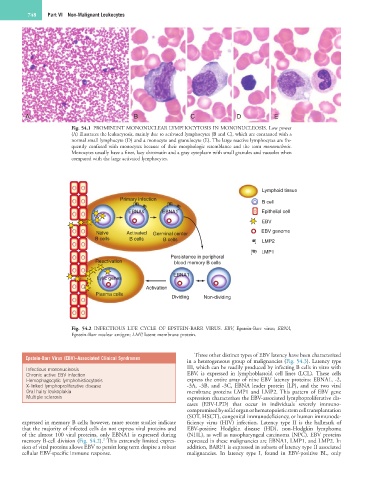
                        Fig. 54.1  PROMINENT MONONUCLEAR LYMPHOCYTOSIS IN MONONUCLEOSIS. Low power
                        (A) illustrates the leukocytosis, mainly due to activated lymphocytes (B and C), which are contrasted with a
                        normal small lymphocyte (D) and a monocyte and granulocyte (E). The large reactive lymphocytes are fre-
                        quently  confused  with  monocytes  because  of  their  morphologic  resemblance  and  the  term  mononucleosis.
                        Monocytes usually have a finer, lacy chromatin and a gray cytoplasm with small granules and vacuoles when
                        compared with the large activated lymphocytes.


                                                                                       Lymphoid tissue
                                        Primary infection
                                                                                       B cell
                                           EBNAs      EBNA1                            Epithelial cell

                                                                                       EBV
                                Naive     Activated  Germinal center                   EBV genome
                                B cells    B cells    B cells                          LMP2
                                                                                       LMP1

                                Reactivation              Persistence in peripheral
                                                          blood memory B cells
                                                          EBNA1
                                 Lytic genes
                                                 Activation
                                Plasma cells
                                                         Dividing   Non-dividing


                        Fig.  54.2  INFECTIOUS  LIFE  CYCLE  OF  EPSTEIN-BARR  VIRUS.  EBV,  Epstein-Barr  virus;  EBNA,
                        Epstein-Barr nuclear antigen; LMP, latent membrane protein.


                                                                 Three other distinct types of EBV latency have been characterized
         Epstein-Barr Virus (EBV)–Associated Clinical Syndromes
                                                              in a heterogeneous group of malignancies (Fig. 54.3). Latency type
          Infectious mononucleosis                            III, which can be readily produced by infecting B cells in vitro with
          Chronic active EBV infection                        EBV,  is  expressed  in  lymphoblastoid  cell  lines  (LCL). These  cells
          Hemophagocytic lymphohistiocytosis                  express the entire array of nine EBV latency proteins: EBNA1, -2,
          X-linked lymphoproliferative disease                -3A,  -3B,  and  -3C,  EBNA  leader  protein  (LP),  and  the  two  viral
          Oral hairy leukoplakia                              membrane  proteins  LMP1  and  LMP2. This  pattern  of  EBV  gene
          Multiple sclerosis                                  expression characterizes the EBV-associated lymphoproliferative dis-
                                                              eases  (EBV-LPD)  that  occur  in  individuals  severely  immuno-
                                                              compromised by solid organ or hematopoietic stem cell transplantation
                                                              (SOT, HSCT), congenital immunodeficiency, or human immunode-
        expressed in memory B cells; however, more recent studies indicate   ficiency  virus  (HIV)  infection.  Latency  type  II  is  the  hallmark  of
        that the majority of infected cells do not express viral proteins and   EBV-positive  Hodgkin  disease  (HD),  non-Hodgkin  lymphoma
        of the almost 100 viral proteins, only EBNA1 is expressed during   (NHL), as well as nasopharyngeal carcinoma (NPC). EBV proteins
                                   2
        memory B-cell division (Fig. 54.2).  This extremely limited expres-  expressed in these malignancies are EBNA1, LMP1, and LMP2. In
        sion of viral proteins allows EBV to persist long term despite a robust   addition, BARF1 is expressed in subsets of latency type II associated
        cellular EBV-specific immune response.                malignancies.  In  latency  type  I,  found  in  EBV-positive  BL,  only

