


Page 867 - Hematology_ Basic Principles and Practice ( PDFDrive )
P. 867
750    Part VI  Non-Malignant Leukocytes


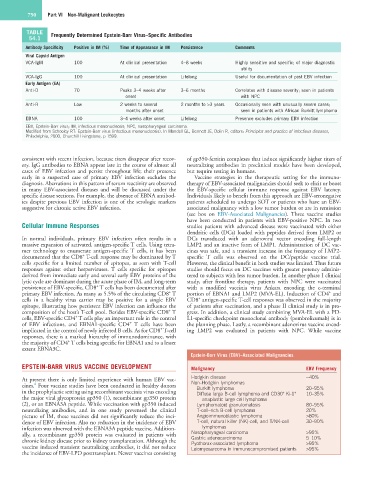
          TABLE   Frequently Determined Epstein-Barr Virus–Specific Antibodies
          54.1
         Antibody Specificity  Positive in IM (%)  Time of Appearance in IM  Persistence  Comments
         Viral Capsid Antigen
         VCA-IgM         100            At clinical presentation  4–8 weeks   Highly sensitive and specific; of major diagnostic
                                                                                utility
         VCA-IgG         100            At clinical presentation  Lifelong    Useful for documentation of past EBV infection
         Early Antigen (EA)
         Anti-D          70             Peaks 3–4 weeks after   3–6 months    Correlates with disease severity; seen in patients
                                          onset                                 with NPC
         Anti-R          Low            2 weeks to several   2 months to >3 years  Occasionally seen with unusually severe cases;
                                          months after onset                    seen in patients with African Burkitt lymphoma
         EBNA            100            3–4 weeks after onset  Lifelong       Presence excludes primary EBV infection
         EBV, Epstein-Barr virus; IM, infectious mononucleosis; NPC, nasopharyngeal carcinoma.
         Modified from Schooley RT: Epstein-Barr virus (infectious mononucleosis). In Mandell GL, Bennett JE, Dolin R, editors: Principles and practice of infectious diseases,
         Philadelphia, 2000, Churchill Livingstone, p 1599.


        consistent with recent infection, because titers disappear after recov-  of gp350-ferritin complexes that induce significantly higher titers of
        ery. IgG antibodies to EBNA appear late in the course of almost all   neutralizing  antibodies  in  preclinical  models  have  been  developed,
        cases  of  EBV  infection  and  persist  throughout  life;  their  presence   but require testing in humans.
        early  in  a  suspected  case  of  primary  EBV  infection  excludes  the   Vaccine  strategies  in  the  therapeutic  setting  for  the  immuno-
        diagnosis. Aberrations in this pattern of serum reactivity are observed   therapy of EBV-associated malignancies should seek to elicit or boost
        in  many  EBV-associated  diseases  and  will  be  discussed  under  the   the  EBV-specific  cellular  immune  response  against  EBV  latency.
        specific disease sections. For example, the absence of EBNA antibod-  Individuals likely to benefit from this approach are EBV-seronegative
        ies despite previous EBV infection is one of the serologic markers   patients scheduled to undergo SOT or patients who have an EBV-
        suggestive for chronic active EBV infection.          associated malignancy with a low tumor burden or are in remission
                                                              (see  box  on  EBV-Associated  Malignancies).  Three  vaccine  studies
                                                              have  been  conducted  in  patients  with  EBV-positive  NPC.  In  two
        Cellular Immune Responses                             studies  patients  with  advanced  disease  were  vaccinated  with  either
                                                              dendritic cells (DCs) loaded with peptides derived from LMP2 or
        In  normal  individuals,  primary  EBV  infection  often  results  in  a   DCs  transduced  with  an  adenoviral  vector  encoding  full-length
        massive expansion of activated, antigen-specific T cells. Using tetra-  LMP2 and an inactive form of LMP1. Administration of DC vac-
        mer  technology  to  enumerate  antigen-specific T  cells,  it  has  been   cines was safe, and a transient increase in the frequency of LMP2-
                            +
        documented that the CD8  T-cell response may be dominated by T   specific  T  cells  was  observed  on  the  DC/peptide  vaccine  trial.
        cells specific for a limited number of epitopes, as seen with T-cell   However, the clinical benefit in both studies was limited. Thus future
        responses  against  other  herpesviruses.  T  cells  specific  for  epitopes   studies should focus on DC vaccines with greater potency adminis-
        derived from immediate early and several early EBV proteins of the   tered to subjects with less tumor burden. In another phase I clinical
        lytic cycle are dominant during the acute phase of IM, and long-term   study,  after  frontline  therapy,  patients  with  NPC  were  vaccinated
                                 +
        persistence of EBV-specific, CD8  T cells has been documented after   with  a  modified  vaccinia  virus  Ankara  encoding  the  c-terminal
                                                        +
                                                                                                             +
        primary EBV infection. As many as 5.5% of the circulating CD8  T   portion of EBNA1 and LMP2 (MVA-EL). Induction of CD4  and
                                                                  +
        cells  in  a  healthy  virus  carrier  may  be  positive  for  a  single  EBV   CD8  antigen-specific T-cell responses was observed in the majority
        epitope, illustrating how persistent EBV infection can influence the   of patients after vaccination, and a phase II clinical study is in pro-
                                                        +
        composition of the host’s T-cell pool. Besides EBV-specific CD8  T   gress. In addition, a clinical study combining MVA-EL with a PD-
                          +
        cells, EBV-specific CD4  T cells play an important role in the control   L1-specific checkpoint monoclonal antibody (pembrolizumab) is in
                                           +
        of  EBV  infections,  and  EBNA1-specific  CD4   T  cells  have  been   the planning phase. Lastly, a recombinant adenovirus vaccine encod-
                                                      +
        implicated in the control of newly infected B cells. As for CD8  T-cell   ing  LMP2  was  evaluated  in  patients  with  NPC.  While  vaccine
        responses, there is a marked hierarchy of immunodominance, with
                       +
        the majority of CD4  T cells being specific for EBNA1 and to a lesser
        extent EBNA3C.
                                                               Epstein-Barr Virus (EBV)–Associated Malignancies
        EPSTEIN-BARR VIRUS VACCINE DEVELOPMENT                  Malignancy                           EBV Frequency
        At present there is only limited experience with human EBV vac-  Hodgkin disease             ~40%
                                                                Non-Hodgkin lymphomas
            8
        cines.  Four vaccine studies have been conducted in healthy donors     Burkitt lymphoma      20–95%
        in the prophylactic setting using recombinant vaccinia virus encoding     Diffuse large B-cell lymphoma and CD30  Ki-1   +  10–35%
                                                                                             +
        the major viral glycoprotein gp350 (1), recombinant gp350 protein   anaplastic large cell lymphoma
        (2), or an EBNA3A peptide. While vaccination with gp350 induced     Lymphomatoid granulomatosis  80–95%
        neutralizing  antibodies,  and  in  one  study  prevented  the  clinical     T-cell–rich B-cell lymphoma  20%
        picture of IM, these vaccines did not significantly reduce the inci-    Angioimmunoblastic lymphoma  >80%
        dence of EBV infection. Also no reduction in the incidence of EBV     T-cell, natural killer (NK)-cell, and T/NK-cell   30–90%
        infection was observed with the EBNA3A peptide vaccine. Addition-  lymphomas
        ally,  a  recombinant  gp350  protein  was  evaluated  in  patients  with   Nasopharyngeal carcinoma  >95%
                                                                                                     5–10%
                                                                Gastric adenocarcinoma
        chronic kidney disease prior to kidney transplantation. Although the   Pyothorax-associated lymphoma  >95%
        vaccine induced transient neutralizing antibodies, it did not reduce   Leiomyosarcoma in immunocompromised patients  >95%
        the incidence of EBV-LPD posttransplant. Newer vaccines consisting

