


Page 98 - Hematology_ Basic Principles and Practice ( PDFDrive )
P. 98
Chapter 7  Signaling Transduction and Metabolomics  69


                                                               Ligand


                                                                                      Plasma
                                  ECM                                                membrane

                                      Integrin                         7 transmembrane spanning
                                      signaling  Transmembrane            receptor signaling
                                                 receptor
                                                 signaling
                                                               Nuclear
                                                               receptor
                                            Short term  ROS                        Short term
                                             biological                             biological
                                             response                               response
                                                                           Long term
                                          Transcription
                                            factors                        biological
                                                                           response
                                                         Genes
                                                   Nucleus
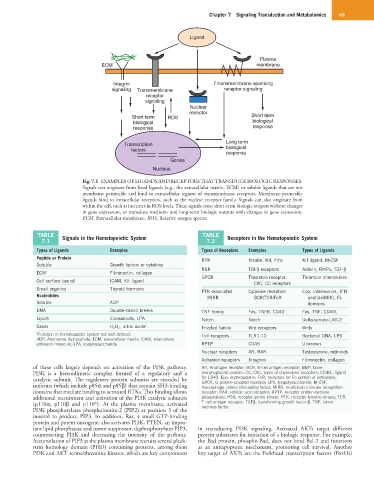
                            Fig. 7.1  EXAMPLES OF LIGANDS AND RECEPTORS THAT TRANSDUCE BIOLOGIC RESPONSES.
                            Signals can originate from fixed ligands (e.g., the extracellular matrix, ECM) or soluble ligands that are not
                            membrane permeable and bind to extracellular regions of transmembrane receptors. Membrane-permeable
                            ligands bind to intracellular receptors, such as the nuclear receptor family. Signals can also originate from
                            within the cell, such as increases in ROS levels. These signals cause short-term biologic outputs without changes
                            in gene expression, or transduce medium- and long-term biologic outputs with changes in gene expression.
                            ECM, Extracellular membrane; ROS, Reactive oxygen species.

             TABLE   Signals in the Hematopoietic System           TABLE   Receptors in the Hematopoietic System
               7.1                                                   7.2
             Types of Ligands        Examples                      Types of Receptors  Examples     Types of Ligands
             Peptide or Protein                                    RTK            Insulin, Kit, Fms  Kit ligand, M-CSF
             Soluble                 Growth factors or cytokine
                                                                   RSK            TGFβ receptors    Activin, BMPs, TGF-β
             ECM                     Fibronectin, collagen
                                                                   GPCR           Thrombin receptor,   Thrombin chemokines
             Cell surface bound      ICAM, Kit ligand
                                                                                    CXC, CC receptors
             Small organics          Thyroid hormone               PTK-associated   Cytokine receptors   Epo, interleukins, IFN
             Nucleotides                                             MIRR           BCR/TCR/FcR       peptide/MHC, Fc
             Soluble                 ADP                                                              domains
             DNA                     Double-strand breaks          TNF family     Fas, TNFR, CD40   Fas, TNF, CD40L
             Lipids                  Eicosanoids, LPA              Notch          Notch             Delta-serrate-LAG-2
             Gases                   H 2 O 2 , nitric oxide a      Frizzled family  Wnt receptors   Wnts
             a Function in hematopoietic system not well defined.  Toll receptors  TLR1-10          Bacterial DNA, LPS
             ADP, Adenosine diphosphate; ECM, extracellular matrix; ICAM, intercellular
             adhesion molecule; LPA, lipopolysaccharide.           RPTP           CD45              Unknown
                                                                   Nuclear receptors  AR, RAR       Testosterone, retinoids
                                                                   Adhesion receptors  Integrins    Fibronectin, collagen
            of  these  cells  largely  depends  on  activation  of  the  PI3K  pathway.   AR, Androgen receptor; BCR, B-cell antigen receptor; BMP, bone
            PI3K  is  a  heterodimeric  complex  formed  of  a  regulatory  and  a   morphogenetic protein; CC, CXC, types of chemokine receptors; CD40L, ligand
            catalytic  subunit. The  regulatory  protein  subunits  are  encoded  by   for CD40; Epo, erythropoietin; FcR, receptors for Fc portion of antibodies;
                                                                   GPCR, G protein–coupled receptor; LPS, lipopolysaccharide; M-CSF,
            isoforms (which include p85α and p85β) that contain SH3-binding   macrophage colony-stimulating factor; MIRR, multichain immune recognition
            domains that mediate binding to activated RTKs. This binding allows   receptor; RAR, retinoic acid receptor; RPTP, receptor protein-tyrosine
            additional recruitment and activation of the PI3K catalytic subunits   phosphatase; RSK, receptor serine kinase; RTK, receptor tyrosine kinase; TCR,
            (p110α,  p110β  and  p110*).  At  the  plasma  membrane,  activated   T-cell antigen receptor; TGFβ, transforming growth factor β; TNF, tumor
                                                                   necrosis factor.
            PI3K phosphorylates phosphoinosite-2 (PIP2) at position 3 of the
            inositol  to  produce  PIP3.  In  addition,  Ras,  a  small  GTP-binding
            protein and potent oncogene, also activates PI3K. PTEN, an impor-
            tant lipid phosphatase and tumor suppressor, dephosphorylates PIP3,   in  transducing  PI3K  signaling.  Activated  AKTs  target  different
            counteracting  PI3K  and  decreasing  the  intensity  of  the  pathway.   protein substrates for initiation of a biologic response. For example,
            Accumulation of PIP3 at the plasma membrane recruits several pleck-  the Bad protein, phospho-Bad, does not bind Bcl-2 and functions
            strin  homology  domain  (PHD)  containing  proteins,  among  them   as  an  antiapoptotic  mechanism,  promoting  cell  survival.  Another
            PDK and AKT serine/threonine kinases, which are key components   key target of AKTs are the Forkhead transcription factors (FoxOs)

