


Page 94 - Hematology_ Basic Principles and Practice ( PDFDrive )
P. 94
Chapter 6  Protein Architecture: Relationship of Form and Function  65


                         Inactive                   Active                             Trx-like domain

            Extracellular


             Cytoplasmic                   TM6
                 TM5      TM6               TM5
                                                                    Gβγ


                                                 Gα s
                                                                                                       UQ


                                                                             Membrane  TM4                       TM5


                                                                                                            TM1


                                                                                           TM3
                                                                                                   TM2

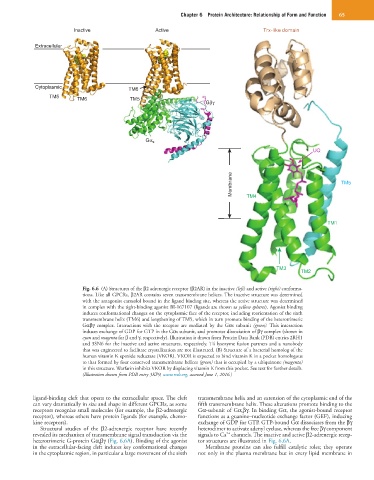
                            Fig. 6.6  (A) Structures of the β2 adrenergic receptor (β2AR) in the inactive (left) and active (right) conforma-
                            tions. Like all GPCRs, β2AR contains seven transmembrane helices. The inactive structure was determined
                            with the antagonist carazolol bound in the ligand binding site, whereas the active structure was determined
                            in complex with the tight-binding agonist BI-167107 (ligands are shown as yellow spheres). Agonist binding
                            induces conformational changes on the cytoplasmic face of the receptor, including reorientation of the sixth
                            transmembrane helix (TM6) and lengthening of TM5, which in turn promote binding of the heterotrimeric
                            Gαβγ  complex.  Interactions  with  the  receptor  are  mediated  by  the  Gαs  subunit  (green). This  interaction
                            induces exchange of GDP for GTP in the Gαs subunit, and promotes dissociation of βγ complex (shown in
                            cyan and magenta for β and γ, respectively). Illustration is drawn from Protein Data Bank (PDB) entries 2RH1
                            and 3SN6 for the inactive and active structures, respectively. T4 lysozyme fusion partners and a nanobody
                            that was engineered to facilitate crystallization are not illustrated. (B) Structure of a bacterial homolog of the
                            human vitamin K epoxide reductase (VKOR). VKOR is expected to bind vitamin K in a pocket homologous
                            to that formed by four conserved transmembrane helices (green) that is occupied by a ubiquinone (magenta)
                            in this structure. Warfarin inhibits VKOR by displacing vitamin K from this pocket. See text for further details.
                            (Illustration drawn from PDB entry 3KP9, www.rcsb.org, accessed June 1, 2016.)


            ligand-binding cleft that opens to the extracellular space. The cleft   transmembrane helix and an extension of the cytoplasmic end of the
            can vary dramatically in size and shape in different GPCRs, as some   fifth transmembrane helix. These alterations promote binding to the
            receptors recognize small molecules (for example, the β2-adrenergic   Gα-subunit of Gα sβγ. In binding Gα, the agonist-bound receptor
            receptor), whereas others have protein ligands (for example, chemo-  functions as a guanine–nucleotide exchange factor (GEF), inducing
            kine receptors).                                      exchange of GDP for GTP. GTP-bound Gα dissociates from the βγ
              Structural  studies  of  the  β2-adrenergic  receptor  have  recently   heterodimer to activate adenyl cyclase, whereas the free βγ component
                                                                           2+
            revealed its mechanism of transmembrane signal transduction via the   signals to Ca  channels. The inactive and active β2-adrenergic recep-
            heterotrimeric G-protein Gα s βγ (Fig. 6.6A). Binding of the agonist   tor structures are illustrated in Fig. 6.6A.
            in the extracellular-facing cleft induces key conformational changes   Membrane  proteins  can  also  fulfill  catalytic  roles;  they  operate
            in the cytoplasmic region, in particular a large movement of the sixth   not only in the plasma membrane but in every lipid membrane in

