


Page 93 - Hematology_ Basic Principles and Practice ( PDFDrive )
P. 93
64    Part I  Molecular and Cellular Basis of Hematology


                                                             SH3

                           N-lobe
                                                  C-helix
                              P-loop
                                                  Activation
                                                    loop


                           C-lobe                              SH2
                                                                                       Kinase
                          A                                B

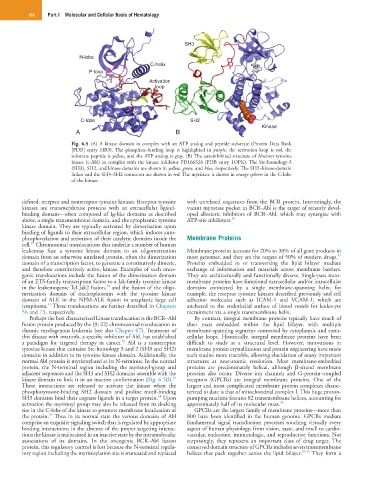
                        Fig. 6.5  (A) A kinase domain in complex with an ATP analog and peptide substrate (Protein Data Bank
                        [PDB]  entry  1IR3). The  phosphate-binding  loop  is  highlighted  in  purple,  the  activation  loop  is  red,  the
                        substrate peptide is yellow, and the ATP analog is gray. (B) The autoinhibited structure of Abelson tyrosine
                        kinase (c-Abl) in complex with the kinase inhibitor PD166326 (PDB entry 1OPK). The Src-homology-3
                        (SH3), SH2, and kinase domains are shown in yellow, green, and blue, respectively. The SH2–kinase-domain
                        linker and the SH3–SH2 connector are shown in red. The myristate is shown in orange spheres in the C-lobe
                        of the kinase.


        defined: receptor and nonreceptor tyrosine kinases. Receptor tyrosine   with unrelated sequences from the BCR protein. Interestingly, the
        kinases  are  transmembrane  proteins  with  an  extracellular  ligand-  vacant myristate pocket in BCR–Abl is the target of recently devel-
        binding domain—often composed of Ig-like domains as described   oped  allosteric  inhibitors  of  BCR–Abl,  which  may  synergize  with
        above, a single transmembrane domain, and the cytoplasmic tyrosine   ATP-site inhibitors. 36
        kinase  domain. They  are  typically  activated  by  dimerization  upon
        binding of ligands to their extracellular region, which induces auto-
        phosphorylation and activation of their catalytic domains inside the   Membrane Proteins
           29
        cell.  Chromosomal translocations that underlie a number of human
        leukemias  fuse  a  tyrosine  kinase  domain  to  an  oligomerization   Membrane proteins account for 20% to 30% of all gene products in
                                                                                                               37
        domain from an otherwise unrelated protein, often the dimerization   most genomes, and they are the targets of 50% of modern drugs.
        domain of a transcription factor, to generate a constitutively dimeric,   Proteins  embedded  in  or  transversing  the  lipid  bilayer  mediate
        and therefore constitutively active, kinase. Examples of such onco-  exchange  of  information  and  materials  across  membrane  barriers.
        genic translocations include the fusion of the dimerization domain   They are architecturally and functionally diverse. Single-pass trans-
        of an ETS-family transcription factor to a Jak-family tyrosine kinase   membrane proteins have functional extracellular and/or intracellular
                                    30
        in the leukemogenic Tel-Jak2 fusion,  and the fusion of the oligo-  domains  connected  by  a  single  membrane-spanning  helix;  for
        merization  domain  of  nucleophosmin  with  the  tyrosine  kinase   example, the receptor tyrosine kinases described previously and cell
        domain  of  ALK  in  the  NPM-ALK  fusion  in  anaplastic  large  cell   adhesion  molecules  such  as  ICAM-1  and  VCAM-1,  which  are
                 31
        lymphoma.  These translocations are further described in Chapters   anchored  to  the  endothelial  surface  of  blood  vessels  for  leukocyte
        56 and 73, respectively.                              recruitment via a single transmembrane helix.
           Perhaps the best characterized kinase translocation is the BCR–Abl   By contrast, integral membrane proteins typically have much of
        fusion protein produced by the (9 : 22) chromosomal translocation in   their  mass  embedded  within  the  lipid  bilayer,  with  multiple
        chronic myelogenous leukemia (see also Chapter 67). Treatment of   membrane-spanning segments connected by cytoplasmic and extra-
        this disease with imatinib, a specific inhibitor of Abl, has established   cellular  loops.  Historically,  integral  membrane  proteins  have  been
                                         32
        a  paradigm  for  targeted  therapy  in  cancer.   Abl  is  a  nonreceptor   difficult  to  study  at  a  structural  level.  However,  innovations  in
        tyrosine kinase that contains Src-homology 3 and 2 (SH3 and SH2)   membrane protein crystallization and protein engineering have made
        domains in addition to its tyrosine kinase domain. Additionally, the   such studies more tractable, allowing elucidation of many important
        normal Abl protein is myristoylated at its N-terminus. In the normal   structures  at  near-atomic  resolution.  Most  membrane-embedded
        protein,  the  N-terminal  region  including  the  myristoyl-group  and   proteins  are  predominately  helical,  although  β-strand  membrane
        adjacent sequences and the SH3 and SH2 domains assemble with the   proteins  also  occur.  Diverse  ion  channels  and  G-protein–coupled
                                                         33
        kinase domain to lock it in an inactive conformation (Fig. 6.5B).    receptors  (GPCRs)  are  integral  membrane  proteins.  One  of  the
        These  interactions  are  released  to  activate  the  kinase  when  the   largest and most complicated membrane protein complexes charac-
        phosphotyrosine-binding  SH2  domain  and  proline  motif-binding   terized to date is that of mitochondrial complex I. This huge proton-
                                                     34
        SH3 domains bind their cognate ligands in a target protein.  Upon   pumping machine features 82 transmembrane helices, accounting for
        activation the myristoyl group may also be released from its docking   approximately half of its molecular mass. 38
        site in the C-lobe of the kinase to promote membrane localization of   GPCRs are the largest family of membrane proteins—more than
                 35
        the protein.  Thus in its normal state the various domains of Abl   800  have  been  identified  in  the  human  genome.  GPCRs  mediate
        comprise an exquisite signaling switch that is regulated by appropriate   fundamental  signal  transduction  processes  touching  virtually  every
        binding interactions; in the absence of the proper targeting interac-  aspect of human physiology, from vision, taste, and smell to cardio-
        tions the kinase is maintained in an inactive state by the intramolecular   vascular, endocrine, immunologic, and reproductive functions. Not
        associations  of  its  domains.  In  the  oncogenic  BCR–Abl  fusion   surprisingly,  they  represent  an  important  class  of  drug  target. The
        protein, this regulatory control is lost because the N-terminal regula-  conserved domain structure of GPCRs includes seven transmembrane
        tory region including the myristoylation site is truncated and replaced   helices that pack together across the lipid bilayer. 39,40  They form a

