


Page 111 - Williams Hematology ( PDFDrive )
P. 111
86  Part II:  The Organization of the Lymphohematopoietic Tissues  Chapter 6:  The Organization and Structure of Lymphoid Tissues  87


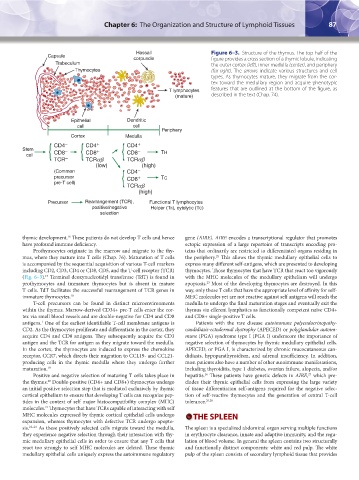
                                                        Hassall                  Figure 6–3.  Structure of the thymus. The top half of the
                          Capsule
                                                       corpuscle                 figure provides a cross section of a thymic lobule, indicating
                             Trabeculum                                          the outer cortex (left), inner medulla (center), and periphery
                                   Thymocytes                                    (far right). The  arrows indicate various structures and cell
                                                                                 types. As thymocytes mature, they migrate from the cor-
                                                                                 tex toward the medullary region and acquire phenotypic
                                                                   T lymphocytes  features that are outlined at the bottom of the figure, as
                                                                     (mature)    described in the text (Chap. 74).


                                  Epithelial         Dendritic
                                    cell               cell
                                                                 Periphery
                                  Cortex            Medulla
                   cell {   CD4 –      CD4 +         CD4 +
                  Stem      CD8 –    {  CD8 +      {  CD8 –     TH
                            TCR –      TCRαβ         TCR αβ
                                          (low)           (high)
                            (Common                  CD4 –
                            precursor              {  CD8 +     TC
                            pre-T cell)
                                                     TCR αβ
                                                         (high)
                          Precursor    Rearrangement (TCR),  Functional T lymphocytes
                                         positive/negative   Helper (Th), cytolytic (TC)
                                            selection


                  thymic development.  These patients do not develop T cells and hence   gene (AIRE). AIRE encodes a transcriptional regulator that promotes
                                 16
                  have profound immune deficiency.                      ectopic expression of a large repertoire of transcripts encoding pro-
                     Prothymocytes originate in the marrow and migrate to the thy-  teins that ordinarily are restricted to differentiated organs residing in
                  mus, where they mature into T cells (Chap. 76). Maturation of T cells   the periphery.   This  allows  the thymic medullary epithelial cells to
                                                                                   25
                  is accompanied by the sequential acquisition of various T-cell markers   express many different self-antigens, which are presented to developing
                  including CD2, CD3, CD4 or CD8, CD5, and the T-cell receptor (TCR)   thymocytes. Those thymocytes that have TCR that react too vigorously
                  (Fig. 6–3).  Terminal deoxynucleotidyl transferase (TdT) is found in   with the MHC molecules of the medullary epithelium will undergo
                         17
                  prothymocytes and immature  thymocytes  but is absent  in mature   apoptosis.  Most of the developing thymocytes are destroyed. In this
                                                                                23
                  T cells. TdT facilitates the successful rearrangement of TCR genes in   way, only those T cells that have the appropriate level of affinity for self-
                  immature thymocytes. 18                               MHC molecules yet are not reactive against self antigens will reach the
                     T-cell precursors can be found in distinct microenvironments   medulla to undergo the final maturation stages and eventually exit the
                  within the thymus. Marrow-derived CD34+ pre-T cells enter the cor-  thymus via efferent lymphatics as functionally competent naïve CD4+
                  tex via small blood vessels and are double-negative for CD4 and CD8   and CD8+ single-positive T cells.
                  antigens.  One of the earliest identifiable T-cell membrane antigens is   Patients with the rare disease  autoimmune polyendocrinopathy-
                        1
                  CD2. As the thymocytes proliferate and differentiate in the cortex, they   candidiasis-ectodermal dystrophy (APECED) or polyglandular autoim-
                  acquire CD4 and CD8 antigens. They subsequently acquire the CD3   mune (PGA) syndrome type I (PGA I) underscore the importance of
                  antigen and the TCR for antigen as they migrate toward the medulla.   negative selection of thymocytes by thymic medullary epithelial cells.
                  In the cortex, the thymocytes are induced to express the chemokine   APECED, or PGA I, is characterized by chronic mucocutaneous can-
                  receptor, CCR7, which directs their migration to CCL19- and CCL21-   didiasis, hypoparathyroidism, and adrenal insufficiency. In addition,
                  producing cells in the thymic medulla where they undergo further   most patients also have a number of other autoimmune manifestations,
                  maturation. 19                                        including thyroiditis, type 1 diabetes, ovarian failure, alopecia, and/or
                     Positive and negative selection of maturing T cells takes place in   hepatitis.  These patients have genetic defects in AIRE,  which pre-
                                                                                                                  27
                                                                               26
                  the thymus.  Double-positive (CD4+ and CD8+) thymocytes undergo   cludes their thymic epithelial cells from expressing the large variety
                          20
                  an initial positive selection step that is mediated exclusively by thymic   of tissue differentiation self-antigens required for the negative selec-
                  cortical epithelium to ensure that developing T cells can recognize pep-  tion of self-reactive thymocytes and the generation of central T-cell
                  tides in the context of self major histocompatibility complex (MHC)   tolerance. 25,28
                  molecules.  Thymocytes that have TCRs capable of interacting with self
                         21
                  MHC molecules expressed by thymic cortical epithelial cells undergo     THE SPLEEN
                  expansion, whereas thymocytes with defective TCR undergo apopto-
                  sis. 22–24  As these positively selected cells migrate toward the medulla,   The spleen is a specialized abdominal organ serving multiple functions
                  they experience negative selection through their interaction with thy-  in erythrocyte clearance, innate and adaptive immunity, and the regu-
                  mic medullary epithelial cells in order to ensure that any T cells that   lation of blood volume. In general the spleen contains two structurally
                  react  too  strongly  to  self  MHC  molecules  are  deleted.  These  thymic   and functionally distinct components: white and red pulp. The white
                  medullary epithelial cells uniquely express the autoimmune regulatory   pulp of the spleen consists of secondary lymphoid tissue that provides


          Kaushansky_chapter 06_p0085-0096.indd   87                                                                    17/09/15   5:53 pm

