


Page 113 - Williams Hematology ( PDFDrive )
P. 113
88  Part II:  The Organization of the Lymphohematopoietic Tissues  Chapter 6:  The Organization and Structure of Lymphoid Tissues  89


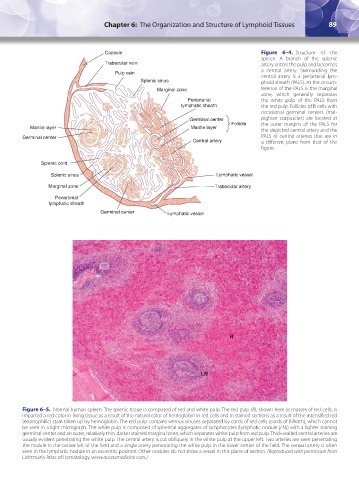
                                             Capsule                                              Figure 6–4.  Structure of the
                                                                                                  spleen. A branch of the splenic
                                             Trabecular vein                                      artery enters the pulp and becomes
                                                                                                  a central artery. Surrounding the
                                                 Pulp vein                                        central artery is a periarterial lym-
                                                         Splenic sinus                            phoid sheath (PALS). At the circum-
                                                               Marginal zone                      ference of the PALS is the marginal
                                                                                                  zone, which generally separates
                                                                         Periarterial             the white pulp of the PALS from
                                                                       lymphatic sheath           the red pulp. Follicles of B cells with
                                                                                                  occasional germinal centers (mal-
                                                                          Germinal center         pighian corpuscles) are located at
                                                                                        Follicle  the outer margins of the PALS for
                    Mantle layer                                          Mantle layer
                                                                                                  the depicted central artery and the
                  Germinal center                                                                 PALS of central arteries that are in
                                                                           Central artery         a different plane from that of the
                                                                                                  figure.

                        Splenic cord
                           Splenic sinus                                           Lymphatic vessel

                           Marginal zone                                          Trabecular artery
                             Periarterial
                           lymphatic sheath
                                            Germinal center       Lymphatic vessel


                                                                                       R


                                                                              LN


                  Figure 6–5.  Normal human spleen. The splenic tissue is composed of red and white pulp. The red pulp (R), shown here as masses of red cells, is
                  imparted a red color in living tissue as a result of the natural color of hemoglobin in red cells and in stained sections as a result of the intensified red
                  (eosinophilic) stain taken up by hemoglobin. The red pulp contains venous sinuses separated by cords of red cells (cords of Billroth), which cannot
                  be seen in a light micrograph. The white pulp is composed of spherical aggregates of lymphocytes (lymphatic nodule [LN]) with a lighter staining
                  germinal center and an outer, relatively thin, darker stained marginal zone, which separates white pulp from red pulp. Thick-walled central arteries are
                  usually evident penetrating the white pulp. The central artery is cut obliquely in the white pulp at the upper left. Two arteries are seen penetrating
                  the nodule in the center-left of the field and a single artery penetrating the white pulp in the lower-center of the field. The central artery is often
                  seen in the lymphatic nodule in an eccentric position. Other nodules do not show a vessel in this plane of section. (Reproduced with permission from
                  Lichtman’s Atlas of Hematology, www.accessmedicine.com.)


          Kaushansky_chapter 06_p0085-0096.indd   89                                                                    17/09/15   5:53 pm

