


Page 1147 - Williams Hematology ( PDFDrive )
P. 1147
1122           Part VIII:  Monocytes and Macrophages                                                                                              Chapter 72:  Gaucher Disease and Related Lysosomal Storage Diseases            1123


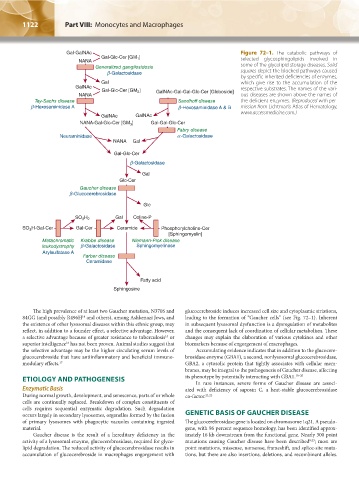
                              Gal-GalNAc                                                 Figure 72–1.  The  catabolic  pathways  of
                                          Gal-Glc-Cer [GM ]                              selected glycosphingolipids involved in
                                                      1
                                  NANA
                                        Generalized gangliosidosis                       some of the glycolipid storage diseases. Solid
                                                                                         squares depict the blocked pathways caused
                                                                                         by specific inherited deficiencies of enzymes,
                                          Gal                                            which give rise to the accumulation of the
                                 GalNAc                                                  respective substrates. The names of the vari-
                                          Gal-Glc-Cer [GM ]  GalNAc-Gal-Gal-Glc-Cer [Globoside]
                                                      2
                                  NANA                                                   ous diseases are shown above the names of
                    Tay-Sachs disease                               Sandhoff disease     the deficient enzymes. (Reproduced with per-
                                                                                         mission from Lichtman’s Atlas of Hematology,
                                                                                         www.accessmedicine.com.)
                                          GalNAc     GalNAc
                                   NANA-Gal-Glc-Cer [GM ]  Gal-Gal-Glc-Cer
                                                    3
                                                                   Fabry disease
                            Neuraminidase
                                              NANA  Gal
                                              Gal-Glc-Cer


                                                        Gal
                                                Glc-Cer
                                   Gaucher disease

                                                        Glc

                                    H
                                 SO 3 2        Gal   Coline-P
               SO H-Gal-Cer      Gal-Cer       Ceramide       Phosphorylcholine-Cer
                  3
                                                                [Sphingomyelin]
                      Metachromatic  Krabbe disease  Niemann-Pick disease
                      leukodystrophy                  Sphingomyelinase
                      Arylsulfatase A
                                    Farber disease
                                     Ceramidase


                                                       Fatty acid
                                              Sphingosine


                   The high prevalence of at least two Gaucher mutation, N370S and   glucocerebroside induces increased cell size and cytoplasmic striations,
               84GG (and possibly R496H  and others), among Ashkenazi Jews, and   leading to the formation of “Gaucher cells” (see Fig. 72–1). Inherent
                                   14
               the existence of other lysosomal diseases within this ethnic group, may   in subsequent lysosomal dysfunction is a dysregulation of metabolites
               reflect, in addition to a founder effect, a selective advantage. However,   and the consequent lack of coordination of cellular metabolism. These
               a selective advantage because of greater resistance to tuberculosis  or   changes may explain the elaboration of various cytokines and other
                                                               15
               superior intelligence  has not been proven. Animal studies suggest that   biomarkers because of engorgement of macrophages.
                              16
               the selective advantage may be the higher circulating serum levels of   Accumulating evidence indicates that in addition to the glucocere-
               glucocerebroside that have antiinflammatory and beneficial immuno-  brosidase enzyme (GBA1), a second, nonlysosomal glucocerebrosidase,
               modulary effects. 17                                   GBA2, a cytosolic protein that tightly associates with cellular mem-
                                                                      branes, may be integral to the pathogenesis of Gaucher disease, affecting
               ETIOLOGY AND PATHOGENESIS                              its phenotype by potentially interacting with GBA1. 18–20
                                                                          In  rare  instances,  severe  forms  of  Gaucher  disease  are  associ-
               Enzymatic Basis                                        ated with deficiency of saposin C, a heat-stable glucocerebrosidase
               During normal growth, development, and senescence, parts of or whole   co-factor. 21,22
               cells are continually replaced. Breakdown of complex constituents of
               cells requires sequential enzymatic degradation. Such degradation
               occurs largely in secondary lysosomes, organelles formed by the fusion   GENETIC BASIS OF GAUCHER DISEASE
               of primary lysosomes with phagocytic vacuoles containing ingested   The glucocerebrosidase gene is located on chromosome 1q21. A pseudo-
               material.                                              gene, with 96 percent sequence homology, has been identified approx-
                   Gaucher disease is the result of a hereditary deficiency in the   imately 16 kb downstream from the functional gene. Nearly 300 point
                                                                                                                8,23
               activity of a lysosomal enzyme, glucocerebrosidase, required for glyco-  mutations causing Gaucher disease have been described ; most are
               lipid degradation. The reduced activity of glucocerebrosidase results in   point mutations, missense, nonsense, frameshift, and splice-site muta-
               accumulation of glucocerebroside in macrophages engorgement with   tions, but there are also insertions, deletions, and recombinant alleles.


          Kaushansky_chapter 72_p1121-1134.indd   1122                                                                  9/17/15   3:53 PM

