


Page 1150 - Williams Hematology ( PDFDrive )
P. 1150
1124  Part VIII:  Monocytes and Macrophages  Chapter 72:  Gaucher Disease and Related Lysosomal Storage Diseases     1125


                    A                  B             C                                D                     E

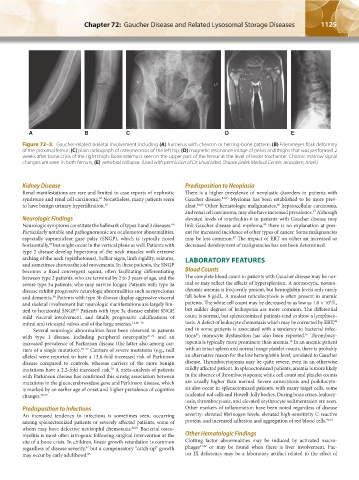
                  Figure 72–3.  Gaucher-related skeletal involvement including (A) humerus with chevron or herring-bone pattern; (B) Erlenmeyer flask deformity
                  of the proximal femur; (C) plain radiograph of osteonecrosis of the left hip; (D) magnetic resonance image of pelvis and thighs that was performed 2
                  weeks after bone crisis of the right thigh. Bone edema is seen in the upper part of the femur at the level of lesser trochanter. Chronic marrow signal
                  changes are seen in both femurs; (E) vertebral collapse. (Used with permission of Dr. Ehud Lebel, Shaare Zedek Medical Center, Jerusalem, Israel.)


                  Kidney Disease                                        Predisposition to Neoplasia
                  Renal manifestations are rare and limited to case reports of nephrotic   There is a higher prevalence of neoplastic disorders in patients with
                                            64
                  syndrome and renal cell carcinoma.  Nonetheless, many patients seem   Gaucher disease. 84,85  Myeloma has been established to be more prev-
                                                                                                       86
                  to have benign urinary hyperfiltration. 65            alent. 84,85  Other hematologic malignancies,  hepatocellular carcinoma,
                                                                        and renal cell carcinoma, may also have increased prevalence.  Although
                                                                                                                   87
                  Neurologic Findings                                   elevated levels of interleukin-6 in patients with Gaucher disease may
                                                                                                   88
                  Neurologic symptoms constitute the hallmark of types 2 and 3 diseases.    link Gaucher disease and myeloma,  there is no explanation at pres-
                                                                    66
                  Particularly notable and pathognomonic are oculomotor abnormalities,   ent for increased incidence of other types of cancer. Some malignancies
                  especially supranuclear gaze palsy (SNGP), which is typically noted   may be less common.  The impact of ERT on either an increased or
                                                                                        87
                           67
                  horizontally,  but might occur in the vertical plane as well. Patients with   decreased development of malignancies has not been determined.
                  type 2 disease develop hypertonia of the neck muscles with extreme
                  arching of the neck (opisthotonus), bulbar signs, limb rigidity, seizures,   LABORATORY FEATURES
                  and sometimes choreoathetoid movements. In these patients, the SNGP
                  becomes a fixed convergent squint, often facilitating differentiating   Blood Counts
                  between type 2 patients, who are terminal by 2 to 3 years of age, and the   The complete blood count in patients with Gaucher disease may be nor-
                  severe type 3a patients, who may survive longer. Patients with type 3a   mal or may reflect the effects of hypersplenism. A normocytic, normo-
                  disease exhibit progressive neurologic abnormalities such as myoclonus   chromic anemia is frequently present, but hemoglobin levels only rarely
                            68
                  and dementia.  Patients with type 3b disease display aggressive visceral   fall below 8 g/dL. A modest reticulocytosis is often present in anemic
                                                                                                                         9
                  and skeletal involvement but neurologic manifestations are largely lim-  patients. The white cell count may be decreased to as low as 1.0 × 10 /L,
                                    68
                  ited to horizontal SNGP.  Patients with type 3c disease exhibit SNGP,   but milder degrees of leukopenia are more common. The differential
                  mild visceral involvement, and fatally progressive calcifications of   count is normal, but splenectomized patients tend to show a lymphocy-
                                                                                                                          89
                  mitral and tricuspid valves and of the large arteries. 12,68–70  tosis. A defect of leukocyte chemotaxis which may be corrected by ERT,
                     Several neurologic abnormalities have been observed in patients   and in some patients is associated with a tendency to bacterial infec-
                                                                                                                 81
                                                                            80
                  with type 1 disease, including peripheral neuropathy 71,72  and an   tions ; monocyte dysfunction has also been reported.  Thrombocy-
                                                                                                           46
                  increased prevalence of Parkinson disease (the latter also among car-  topenia is typically more prominent than anemia.  In an anemic patient
                  riers of a single mutation). 73–77  Carriers of severe mutations (e.g., null   with an intact spleen and normal range platelet counts, there is probably
                  alleles) were reported to have a 13.6-fold increased risk of Parkinson   an alternative reason for the low hemoglobin level, unrelated to Gaucher
                  disease compared to controls, whereas carriers of the more benign   disease. Thrombocytopenia may be quite severe, even in an otherwise
                                               78
                  mutations have a 2.2-fold increased risk.  A meta-analysis of patients   mildly affected patient. In splenectomized patients, anemia is more likely
                  with Parkinson disease has confirmed this strong association between   in the absence of thrombocytopenia; white cell count and platelet counts
                  mutations in the glucocerebrosidase gene and Parkinson disease, which   are usually higher than normal. Severe anisocytosis and poikilocyto-
                  is marked by an earlier age of onset and higher prevalence of cognitive   sis also occur in splenectomized patients, with many target cells, some
                  changes. 78,79                                        nucleated red cells and Howell-Jolly bodies. During bone crises, leukocy-
                                                                        tosis, thrombocytosis, and elevated erythrocyte sedimentation are seen.
                  Predisposition to Infections                          Other markers of inflammation have been noted regardless of disease
                  An increased tendency to infections is sometimes seen, occurring   severity: elevated fibrinogen levels, elevated high-sensitivity C-reactive
                  among splenectomized patients or severely affected patients, some of   protein, and increased adhesion and aggregation of red blood cells. 90,91
                  whom may have defective neutrophil chemotaxis. 80,81  Bacterial osteo-
                  myelitis is most often iatrogenic following surgical intervention at the   Other Hematologic Findings
                  site of a bone crisis. In children, linear growth retardation is common   Clotting factor abnormalities may be induced by activated macro-
                                       82
                  regardless of disease severity,  but a compensatory “catch-up” growth   phages 41,42  or may be found when there is liver involvement. Fac-
                  may occur by early adulthood. 83                      tor IX deficiency may be a laboratory artifact related to the effect of


          Kaushansky_chapter 72_p1121-1134.indd   1125                                                                  9/17/15   3:53 PM

