


Page 1151 - Williams Hematology ( PDFDrive )
P. 1151
1126           Part VIII:  Monocytes and Macrophages                                                                                              Chapter 72:  Gaucher Disease and Related Lysosomal Storage Diseases            1127


               accumulated lipid on platelet membranes.  Factor XI deficiency is com-  Other biomarkers correlate better with the extent of glucocerebroside
                                             92
               mon among Ashkenazi Jewish patients because of its high coincidental   storage. The most widely used biomarker is chitotriosidase,  which
                                                                                                                   98
               prevalence in this ethnic group. 93                    is undetectable in healthy subjects (its physiologic role is unknown),
                   Bleeding tendency may also result from defective aggregation or   but is elevated, often several thousand-fold, in patients with Gaucher
               adhesion of platelets  and therefore platelet function and/or thromboe-  disease. Chitotriosidase measurement is useful for monitoring both
                              33
               lastography should be tested before surgical and dental procedures and   untreated patients, to assess stability versus deterioration, and treated
               labor. 44,94                                           patients, to assess response to therapy. A change in chitotriosidase levels
                                                                      rather than absolute values is used for monitoring. In approximately 6
               Biochemical and Immunologic Findings                   percent of people, it is undetectable, and for those patients, measure-
               In most patients, liver function tests are within normal limits but in con-  ments of chemokine CCL18/PARC which is predominantly produced
               junction with more severe disease, splenectomy, and/or comorbidities   by Gaucher cells, can be used. 99
               (hepatitic B and/or C, or autoimmune diseases) abnormal liver function   A potentially more sensitive and more specific biomarker has been
               tests may be seen. Because of the increased prevalence of cholelithiasis, 95,96    identified: the lyso-glucosylsphingosine (lyso-Gb1),  which may be
                                                                                                            100
               cholestatic findings may occur. Renal function tests are usually normal. 64  preferred as a more reproducible biomarker, using a more operator-
                   Many patients present with polyclonal gammopathies. Monoclonal   friendly assay.
               gammopathies are found in 1 to 20 percent of patients, particularly older   Serum iron levels may be low in patients because of iron deficiency
               patients. 79–82  Increased levels of autoantibodies have been reported,  and   related to bleeding or chronic inflammation. Deficiencies of vitamin B 12 101
                                                              97
               may indicate coincide with autoimmune diseases such as Hashimoto   and vitamin D  have been described, albeit these are also very common
                                                                                102
               thyroiditis, rheumatoid arthritis, or immune hemolytic anemia.  in the general population. Serum ferritin levels are usually elevated.
                   Biochemical abnormalities have been used as surrogate mark-
               ers in Gaucher disease. In the past, increased activities of serum acid   Gaucher Cells
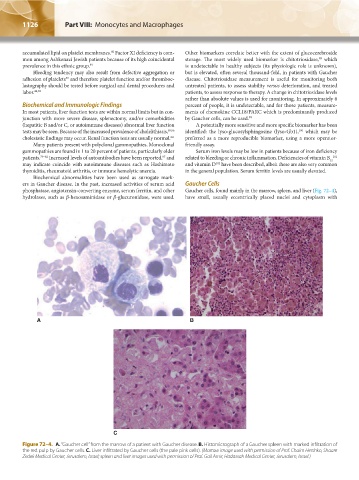
               phosphatase, angiotensin-converting enzyme, serum ferritin, and other   Gaucher cells, found mainly in the marrow, spleen, and liver (Fig. 72–4),
               hydrolases, such as β-hexosaminidase or β-glucuronidase, were used.   have small, usually eccentrically placed nuclei and cytoplasm with


                    A                                                   B


                                              C

               Figure 72–4.  A. “Gaucher cell” from the marrow of a patient with Gaucher disease. B. Histomicrograph of a Gaucher spleen with marked infiltration of
               the red pulp by Gaucher cells. C. Liver infiltrated by Gaucher cells (the pale pink cells). (Marrow image used with permission of Prof. Chaim Hershko, Shaare
               Zedek Medical Center, Jerusalem, Israel; spleen and liver images used with permission of Prof. Gail Amir, Hadassah Medical Center, Jerusalem, Israel.)


          Kaushansky_chapter 72_p1121-1134.indd   1126                                                                  9/17/15   3:53 PM

