


Page 1148 - Williams Hematology ( PDFDrive )
P. 1148
1122  Part VIII:  Monocytes and Macrophages  Chapter 72:  Gaucher Disease and Related Lysosomal Storage Diseases     1123


                  Some mutations result from recombinant events between the functional   endoplasmic reticulum. 31,32  The investigation of the proteotoxic effect
                  gene and its pseudogene.  Since 2000, approximately 20 of these mutated   of the misfolded mutant enzyme in the endoplasmic reticulum has led
                                   8
                  enzymes have undergone crystallography showing the divergence of lig-  to the development of the new therapeutic modality of pharmacologic
                  ands in the active site and with various degrees of glycosylation. 23  chaperones (PCs). PCs are targeted to stabilize the mutated glucocere-
                     Among Ashkenazi Jews, the predominant mutation is N370S   brosidase and allow its appropriate trafficking from endoplasmic reticu-
                  which accounts for approximately 75 percent of mutant alleles among   lum to Golgi and, finally, to the lysosome.
                  Jewish patients and approximately 30 percent of the alleles among
                  non-Jewish patients. Homozygosity for N370S is characterized by
                  relatively milder phenotypes (although the phenotype is very het-  CLINICAL FEATURES
                                             24
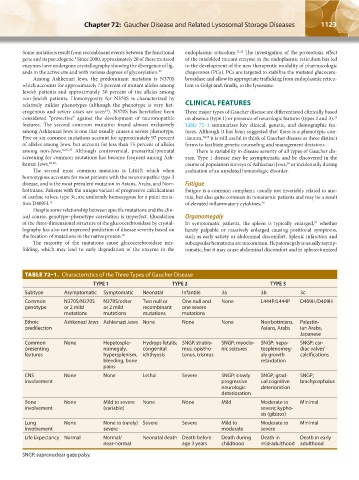
                  erogenous and severe cases are seen ). N370S has heretofore been   Three major types of Gaucher disease are differentiated clinically based
                  considered “protective” against the development of neuronopathic   on absence (type 1) or presence of neurologic features (types 2 and 3).
                                                                                                                          33
                  features. The  second  common  mutation found  almost  exclusively   Table 72–1 summarizes key clinical, genetic, and demographic fea-
                  among Ashkenazi Jews is one that usually causes a severe phenotype.   tures. Although it has been suggested that there is a phenotypic con-
                  Five or six common mutations account for approximately 97 percent   tinuum, 34,35  it is still useful to think of Gaucher disease as three distinct
                  of alleles among Jews, but account for less than 75 percent of alleles   forms to facilitate genetic counseling and management decisions.
                  among non-Jews. 8,25–27  Although controversial, premarital/prenatal   There is variability in disease severity of all types of Gaucher dis-
                  screening for common mutations has become frequent among Ash-  ease. Type 1 disease may be asymptomatic and be discovered in the
                  kenazi Jews. 28,29,                                   course of population surveys of Ashkenazi Jews,  or incidentally during
                                                                                                          28
                     The second most common mutation is L444P, which when   evaluation of an unrelated hematologic disorder.
                  homozygous accounts for most patients with the neuronopathic type 3
                  disease, and is the most prevalent mutation in Asians, Arabs, and Norr-  Fatigue
                  bottnians. Patients with the unique variant of progressive calcifications   Fatigue is a common complaint, usually not invariably related to ane-
                  of cardiac valves, type 3c, are uniformly homozygous for a point muta-  mia, but also quite common in nonanemic patients and may be a result
                  tion D409H. 12                                        of elevated inflammatory cytokines. 36
                     Despite some relationship between specific mutations and the clin-
                  ical course, genotype–phenotype correlation is imperfect. Elucidation   Organomegaly
                  of the three-dimensional structure of the glucocerebrosidase by crystal-  In symptomatic patients, the spleen is typically enlarged,  whether
                                                                                                                    37
                  lography has also not improved prediction of disease severity based on   barely palpable or massively enlarged causing positional symptoms,
                  the location of mutations in the native protein. 30   such as early satiety or abdominal discomfort. Splenic infarction and
                     The  majority  of  the  mutations  cause  glucocerebrosidase  mis-  subcapsular hematoma are uncommon. Hepatomegaly is usually asymp-
                  folding, which may lead to early degradation of the enzyme in the   tomatic, but it may cause abdominal discomfort and in splenectomized


                   TABLE 72–1.  Characteristics of the Three Types of Gaucher Disease
                                          TYPE 1                    TYPE 2                           TYPE 3
                   Subtype      Asymptomatic  Symptomatic  Neonatal    Infantile     3a           3b           3c
                   Common       N370S/N370S   N370S/other   Two null or   One null and   None     L444P/L444P  D409H/D409H
                   genotype     or 2 mild    or 2 mild    recombinant   one severe
                                mutations    mutations    mutations    mutations
                   Ethnic       Ashkenazi Jews Ashkenazi Jews None     None          None         Norrbottnians,   Palestin-
                   predilection                                                                   Asians, Arabs  ian Arabs,
                                                                                                               Japanese
                   Common       None         Hepatosple-  Hydrops fetalis;  SNGP, strabis-  SNGP; myoclo-  SNGP; hepa-  SNGP; car-
                   presenting                nomegaly,    congenital   mus, opistho-  nic seizures  tosplenomeg-  diac valves’
                   features                  hypersplenism,  ichthyosis  tonus, trismus           aly growth   calcifications
                                             bleeding, bone                                       retardation
                                             pains
                   CNS          None         None         Lethal       Severe        SNGP; slowly   SNGP; grad-  SNGP;
                   involvement                                                       progressive   ual cognitive   brachycephalus
                                                                                     neurologic   deterioration
                                                                                     deterioration
                   Bone         None         Mild to severe   None     None          Mild         Moderate to   Minimal
                   involvement               (variable)                                           severe; kypho-
                                                                                                  sis (gibbus)
                   Lung         None         None to (rarely)  Severe  Severe        Mild to      Moderate to   Minimal
                   involvement               severe                                  moderate     severe
                   Life Expectancy Normal    Normal/      Neonatal death Death before   Death during   Death in   Death in early
                                             near-normal               age 3 years   childhood    mid-adulthood  adulthood

                  SNGP, supranuclear gaze palsy.


          Kaushansky_chapter 72_p1121-1134.indd   1123                                                                  9/17/15   3:53 PM

