


Page 1149 - Williams Hematology ( PDFDrive )
P. 1149
1124           Part VIII:  Monocytes and Macrophages                                                                                              Chapter 72:  Gaucher Disease and Related Lysosomal Storage Diseases            1125


                          A                                          B

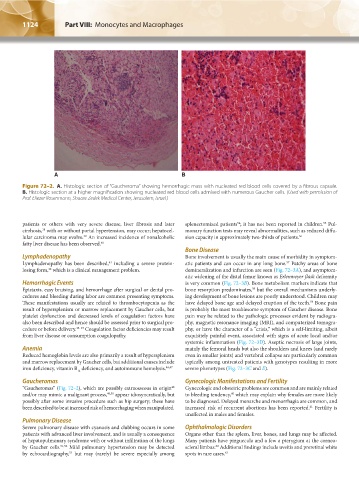
               Figure 72–2.  A. Histologic section of “Gaucheroma” showing hemorrhagic mass with nucleated red blood cells covered by a fibrous capsule.
               B. Histologic section at a higher magnification showing nucleated red blood cells admixed with numerous Gaucher cells. (Used with permission of
               Prof. Eliezer Rosenmann, Shaare Zedek Medical Center, Jerusalem, Israel.)


               patients or others with very severe disease, liver fibrosis and later     splenectomized patients ; it has not been reported in children.  Pul-
                                                                                                                    55
                                                                                       54
               cirrhosis,  with or without portal hypertension, may occur; hepatocel-  monary function tests may reveal abnormalities, such as reduced diffu-
                      38
               lular carcinoma may evolve.  An increased incidence of nonalcoholic   sion capacity in approximately two-thirds of patients. 56
                                    39
               fatty liver disease has been observed. 40
                                                                      Bone Disease
               Lymphadenopathy                                        Bone involvement is usually the main cause of morbidity in symptom-
               Lymphadenopathy has been described,  including a severe protein-   atic patients and can occur in any long bone.  Patchy areas of bone
                                                                                                        57
                                            41
               losing form,  which is a clinical management problem.  demineralization and infarction are seen (Fig. 72–3A), and asymptom-
                        42
                                                                      atic widening of the distal femur known as Erlenmeyer flask deformity
               Hemorrhagic Events                                     is very common (Fig. 72–3B). Bone metabolism markers indicate that
               Epistaxis, easy bruising, and hemorrhage after surgical or dental pro-  bone resorption predominates,  but the overall mechanisms underly-
                                                                                            58
               cedures and bleeding during labor are common presenting symptoms.   ing development of bone lesions are poorly understood. Children may
               These manifestations usually are related to thrombocytopenia as the   have delayed bone age and delayed eruption of the teeth.  Bone pain
                                                                                                                59
               result of hypersplenism or marrow replacement by Gaucher cells, but   is probably the most troublesome symptom of Gaucher disease. Bone
               platelet dysfunction and decreased levels of coagulation factors have   pain may be related to the pathologic processes evident by radiogra-
               also been described and hence should be assessed prior to surgical pro-  phy, magnetic resonance imaging (MRI), and computerized tomogra-
               cedure or before delivery. 43–45  Coagulation factor deficiencies may result   phy, or have the character of a “crisis,” which is a self-limiting, albeit
               from liver disease or consumption coagulopathy.        exquisitely painful event, associated with signs of acute local and/or
                                                                      systemic inflammation (Fig. 72–3D). Aseptic necrosis of large joints,
               Anemia                                                 mainly the femoral heads but also the shoulders and knees (and rarely
               Reduced hemoglobin levels are also primarily a result of hypersplenism   even in smaller joints) and vertebral collapse are particularly common
               and marrow replacement by Gaucher cells, but additional causes include   typically among untreated patients with genotypes resulting in more
               iron deficiency, vitamin B  deficiency, and autoimmune hemolysis. 46,47  severe phenotypes (Fig. 72–3C and E).
                                  12
               Gaucheromas                                            Gynecologic Manifestations and Fertility
               “Gaucheromas” (Fig. 72–2), which are possibly extraosseous in origin    Gynecologic and obstetric problems are common and are mainly related
                                                                 48
               and/or may mimic a malignant process, 49,50  appear idiosyncratically, but   to bleeding tendency,  which may explain why females are more likely
                                                                                     60
               possibly after some invasive procedure such as hip surgery; these have   to be diagnosed. Delayed menarche and menorrhagia are common, and
               been described to be at increased risk of hemorrhaging when manipulated.  increased risk of recurrent abortions has been reported.  Fertility is
                                                                                                                61
                                                                      unaffected in males and females.
               Pulmonary Disease
               Severe pulmonary disease with cyanosis and clubbing occurs in some   Ophthalmologic Disorders
               patients with advanced liver involvement, and is usually a consequence   Organs other than the spleen, liver, bones, and lungs may be affected.
               of hepatopulmonary syndrome with or without infiltration of the lungs   Many patients have pinguecula and a few a pterygium at the corneo-
               by Gaucher cells. 51,52  Mild pulmonary hypertension may be detected   scleral limbus.  Additional findings include uveitis and preretinal white
                                                                                62
               by echocardiography,  but may (rarely) be severe especially among   spots in rare cases. 63
                               53


          Kaushansky_chapter 72_p1121-1134.indd   1124                                                                  9/17/15   3:53 PM

