


Page 1154 - Williams Hematology ( PDFDrive )
P. 1154
1128  Part VIII:  Monocytes and Macrophages  Chapter 72:  Gaucher Disease and Related Lysosomal Storage Diseases     1129


                  neurodegeneration in infants.  The first adult patients identified had   PATHOLOGY AND CLINICAL MANIFESTATIONS
                                        147
                  massive hepatosplenomegaly but no neurologic involvement. The   The most characteristic histopathologic feature of the various forms of
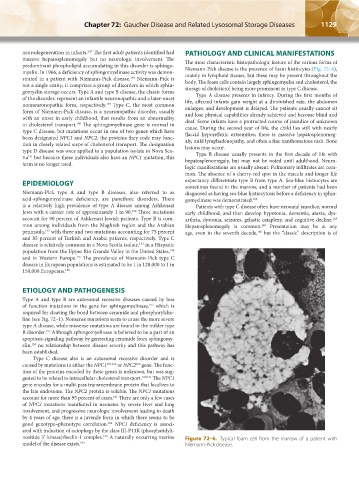
                  predominant phospholipid accumulating in this disorder is sphingo-  Niemann-Pick disease is the presence of foam histiocytes (Fig. 72–6),
                  myelin. In 1966, a deficiency of sphingomyelinase activity was demon-  mainly in lymphoid tissues, but these may be present throughout the
                  strated in a patient with Niemann-Pick disease.  Niemann-Pick is   body. The foam cells contain largely sphingomyelin and cholesterol, the
                                                      148
                  not a single entity; it comprises a group of disorders in which sphin-  storage of cholesterol being more prominent in type C disease.
                  gomyelin storage occurs. Type A and type B disease, the classic forms   Type A disease presents in infancy. During the first months of
                  of the disorder, represent an infantile neuronopathic and a later-onset   life, affected infants gain weight at a diminished rate, the abdomen
                                              149
                  nonneuronopathic form, respectively.  Type C, the most common   enlarges, and development is delayed. The patients usually cannot sit
                  form of Niemann-Pick disease, is a neuronopathic disorder, usually   and lose physical capabilities already achieved and become blind and
                  with an onset in early childhood, that results from an abnormality   deaf. Some infants have a protracted course of jaundice of unknown
                                    150
                  in cholesterol transport.  The sphingomyelinase gene is normal in    cause. During the second year of life, the child lies still with nearly
                  type C disease, but mutations occur in one of two genes which have   flaccid hyporeflexic extremities; there is massive hepatosplenomeg-
                  been designated NPC1 and NPC2; the proteins they code may func-  aly, mild lymphadenopathy, and often a fine xanthomatous rash. Bone
                  tion in closely related steps of cholesterol transport. The designation   lesions may occur.
                  type D disease was once applied to a population isolate in Nova Sco-  Type B disease usually presents in the first decade of life with
                    151
                  tia  but because these individuals also have an NPC1 mutation, this   hepatosplenomegaly,  but  may  not  be  noted  until  adulthood.  Neuro-
                  term is no longer used.
                                                                        logic manifestations are usually absent. Pulmonary infiltrates are com-
                                                                        mon. The absence of a cherry-red spot in the macula and longer life
                  EPIDEMIOLOGY                                          expectancy differentiate type B from type A. Sea-blue histiocytes are
                                                                        sometimes found in the marrow, and a number of patients had been
                  Niemann-Pick type A and type B diseases, also referred to as   diagnosed as having sea-blue histiocytosis before a deficiency in sphin-
                  acid-sphingomyelinase  deficiency, are  panethnic  disorders.  There   gomyelinase was demonstrated. 165
                  is a relatively high prevalence of type A disease among Ashkenazi   Patients with type C disease often have neonatal jaundice, normal
                  Jews with a carrier rate of approximately 1 in 90.  Three mutations   early childhood, and then develop hypotonia, dementia, ataxia, dys-
                                                       152
                  account for 90 percent of Ashkenazi Jewish patients. Type B is com-  arthria, dystonia, seizures, gelastic cataplexy, and cognitive decline.
                                                                                                                          165
                  mon among individuals from the Maghreb region and the Arabian   Hepatosplenomegaly is common.  Presentation may be at any
                                                                                                  149
                  peninsula,  with three and two mutations accounting for 75 percent   age, even in the seventh decade,  but the “classic” description is of
                         153
                                                                                                 165
                  and 85 percent of Turkish and Arabic patients, respectively. Type C
                  disease is relatively common in a Nova Scotia isolate,  in a Hispanic
                                                         151
                  population from the Upper Rio Grande Valley in the United States,
                                                                   154
                  and in Western Europe.  The prevalence of Niemann-Pick type C
                                    155
                  disease in European populations is estimated to be 1 in 120,000 to 1 in
                  150,000 Europeans. 156
                  ETIOLOGY AND PATHOGENESIS
                  Type A and type B are autosomal recessive diseases caused by loss
                  of  function  mutations  in  the  gene  for  sphingomyelinase,   which  is
                                                            157
                  required for cleaving the bond between ceramide and phosphorylcho-
                  line (see Fig. 72–1). Nonsense mutations seem to cause the more severe
                  type A disease, while missense mutations are found in the milder type
                          157
                  B disorder.  Although sphingomyelinase is believed to be a part of an
                  apoptosis-signaling pathway by generating ceramide from sphingomy-
                  elin,  no relationship between disease severity and this pathway has
                     158
                  been established.
                     Type C disease also is an autosomal recessive disorder and is
                                                        160
                  caused by mutations in either the NPC1 159,160  or NPC2  gene. The func-
                  tion of the proteins encoded by these genes is unknown, but was sug-
                  gested to be related to intracellular cholesterol transport. 160,161  The NPC1
                  gene encodes for a multi-pass transmembrane protein that localizes to
                  the late endosome. The NPC2 protein is soluble. The NPC1 mutations
                  account for more than 95 percent of cases.  There are only a few cases
                                                161
                  of  NPC2 mutations manifested in neonates by severe liver and lung
                  involvement, and progressive neurologic involvement leading to death
                  by 4 years of age; there is a juvenile form in which there seems to be
                  good genotype–phenotype correlation.   NPC1 deficiency is associ-
                                              162
                  ated with induction of autophagy by the class III-P13K (phosphatidyli-
                  nositide 3′-kinase)/beclin-1 complex.  A naturally occurring murine   Figure 72–6.  Typical foam cell from the marrow of a patient with
                                             163
                  model of the disease exists. 164                      Niemann-Pick disease.


          Kaushansky_chapter 72_p1121-1134.indd   1129                                                                  9/17/15   3:53 PM

