


Page 1153 - Williams Hematology ( PDFDrive )
P. 1153
1128           Part VIII:  Monocytes and Macrophages                                                                                              Chapter 72:  Gaucher Disease and Related Lysosomal Storage Diseases            1129


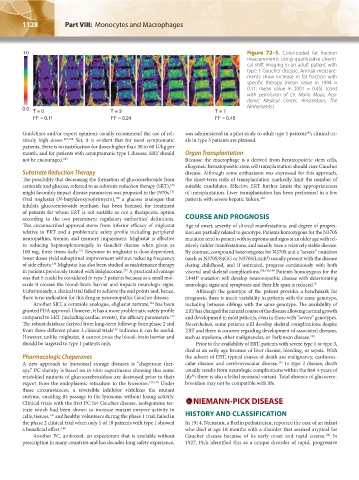
                1.0                                                                        Figure 72–5.  Color-coded fat fraction
                                                                                           measurements using quantitative chemi-
                                                                                           cal shift imaging in an adult patient with
                                                                                           type 1 Gaucher disease. Annual measure-
                                                                                           ments show increase in fat fraction with
                                                                                           specific therapy (mean value in 1994 =
                                                                                           0.11; mean value in 2001 = 0.45). (Used
                                                                                           with permission of Dr. Mario Maas, Aca-
                                                                                           demic Medical Center, Amsterdam, The
               0.0  T = 0                    T = 3                              T = 7      Netherlands.)
                   FF = 0.11                 FF = 0.24                          FF = 0.45


               Guidelines and/or expert opinions usually recommend the use of rel-  was administered in a pilot study to adult type 1 patients ; clinical tri-
                                                                                                               141
               atively high doses. 127,128  Yet, it is evident that for most symptomatic   als in type 3 patients are planned.
               patients, there is no justification for doses higher than 30 to 60 U/kg per
               month, and for patients with asymptomatic type 1 disease, ERT should   Organ Transplantation
               not be encouraged. 129                                 Because the macrophage is a derived from hematopoietic stem cells,
                                                                      allogeneic hematopoietic stem cell transplantation should cure Gaucher
               Substrate Reduction Therapy                            disease. Although some enthusiasm was expressed for this approach,
               The possibility that decreasing the formation of glucocerebroside from   the short-term risks of transplantation markedly limit the number of
                                                                 130
               ceramide and glucose, referred to as substrate reduction therapy (SRT),    suitable candidates. Effective ERT further limits the appropriateness
               might favorably impact disease parameters was proposed in the 1970s.    of transplantation. Liver transplantation has been performed in a few
                                                                 131
               Oral miglustat (N-butyldeoxynojirimycin),  a glucose analogue that   patients with severe hepatic failure. 142
                                               130
               inhibits  glucocerebroside  synthase, has  been  licensed  for treatment
               of patients for whom ERT is not suitable or not a therapeutic option
               according to the two preeminent regulatory authorities’ definitions.   COURSE AND PROGNOSIS
               This circumscribed approval stems from inferior efficacy of miglustat   Age of onset, severity of clinical manifestations, and degree of progres-
               relative to ERT and a problematic safety profile including peripheral   sion are partially related to genotype. Patients homozygous for the N370S
               neuropathies, tremor, and memory impairment. Miglustat is effective   mutation tend to present with symptoms and signs at an older age with rel-
               in reducing hepatosplenomegaly in Gaucher disease when given as     atively milder manifestations, and usually have a relatively stable disease.
                                  132
               100 mg, three times daily.  Response to miglustat is dose-dependent;   By contrast, compound heterozygotes for N370S and a “severe” mutation
               lower doses yield suboptimal improvement without reducing frequency   (such as N370S/84GG or N370S/L444P) usually present with the disease
               of side effects.  Miglustat has also been studied as maintenance therapy   during childhood, and if untreated, progress continuously with both
                         133
                                                 133
               in patients previously treated with imiglucerase.  A practical advantage   visceral and skeletal complications. 108,143,144  Patients homozygous for the
               was that it could be considered in type 3 patients because as a small mol-  L444P mutation will develop neuronopathic disease with deteriorating
               ecule it crosses the blood–brain barrier and impacts neurologic signs.   neurologic signs and symptoms and their life span is reduced. 65
               Unfortunately, a clinical trial failed to achieve the end points and, hence,   Although the genotype of the patient provides a benchmark for
               there is no indication for this drug in neuronopathic Gaucher disease.  prognosis, there is much variability in patients with the same genotype,
                                                          134
                   Another SRT, a ceramide analogue, eliglustat tartrate,  has been   including between siblings with the same genotype. The availability of
               granted FDA approval. However, it has a more problematic safety profile   ERT has changed the natural course of the disease allowing normal growth
               compared to ERT (including cardiac events), the efficacy parameters.    and development in most patients, even in those with “severe” genotypes.
                                                                 135
               The robust database derived from long-term followup from phase 2 and   Nevertheless, some patients still develop skeletal complications despite
               from three different phase 3 clinical trials  indicates it can be useful.   ERT and there is concern regarding development of associated diseases,
                                              136
               However, unlike miglustat, it cannot cross the blood–brain barrier and   such as myeloma, other malignancies, or Parkinson disease. 120
               should be targeted to type 1 patients only.                Prior to the availability of ERT, patients with severe type 1 or type 3,
                                                                      died at an early age because of liver disease, bleeding, or sepsis. With
               Pharmacologic Chaperones                               the advent of ERT, typical causes of death are malignancy, cardiovas-
                                                                                                     145
               A new approach to lysosomal storage diseases is “chaperone ther-  cular disease, and cerebrovascular disease.  In type 2 disease, death
               apy.” PC therapy is based on in vitro experiments showing that some   usually results from neurologic complications within the first 4 years of
                                                                        65
               misfolded mutants of glucocerebrosidase are destroyed prior to their   life ; there is also a lethal neonatal variant. Total absence of glucocere-
               export from the endoplasmic reticulum to the lysosome. 137,138  Under   brosidase may not be compatible with life.
               these circumstances, a reversible inhibitor stabilizes the mutant
               enzyme, enabling its passage to the lysosome without losing activity.
               Clinical trials with the first PC for Gaucher disease, isofagomine tar-     NIEMANN-PICK DISEASE
               trate which had been shown to increase mutant enzyme activity in
                         139
               cells, tissues,  and healthy volunteers during the phase 1 trial, failed in   HISTORY AND CLASSIFICATION
               the phase 2 clinical trial when only 1 of 18 patients with type 1 showed   In 1914, Niemann, a Berlin pediatrician, reported the case of an infant
               a beneficial effect. 140                               who died at age 18 months with a disorder that seemed atypical for
                   Another PC, ambroxol, an expectorant that is available without   Gaucher disease because of its early onset and rapid course.  In
                                                                                                                     146
               prescription in many countries and has decades-long safety experience,   1927, Pick identified this as a unique disorder of rapid, progressive


          Kaushansky_chapter 72_p1121-1134.indd   1128                                                                  9/17/15   3:53 PM

