


Page 1163 - Williams Hematology ( PDFDrive )
P. 1163
1138           Part IX:  Lymphocytes and Plasma Cells


                   A                        B                        C                        D


                   E                        F                        G               H
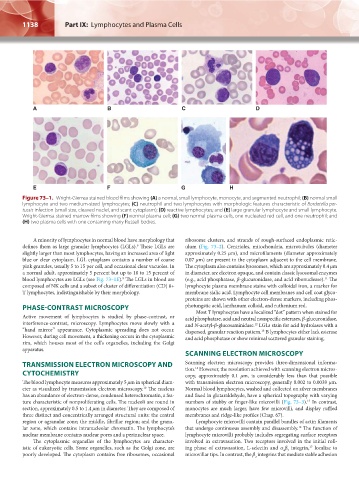
               Figure 73–1.  Wright-Giemsa stained blood films showing (A) a normal, small lymphocyte, monocyte, and segmented neutrophil; (B) normal small
               lymphocyte and two medium-sized lymphocytes; (C) neutrophil and two lymphocytes with morphologic features characteristic of Bordetella per-
               tussis infection (small size, cleaved nuclei, and scant cytoplasm); (D) reactive lymphocytes; and (E) large granular lymphocyte and small lymphocyte.
               Wright-Giemsa stained marrow films showing (F) normal plasma cell; (G) two normal plasma cells, one nucleated red cell, and one neutrophil; and
               (H) two plasma cells with one containing many Russell bodies.


                   A minority of lymphocytes in normal blood have morphology that   ribosome clusters, and strands of rough-surfaced endoplasmic retic-
               defines them as large granular lymphocytes (LGLs).  These LGLs are   ulum (Fig. 73–2). Centrioles, mitochondria, microtubules (diameter
                                                      9
               slightly larger than most lymphocytes, having an increased area of light   approximately 0.25 μm), and microfilaments (diameter approximately
               blue or clear cytoplasm. LGL cytoplasm contains a number of coarse   0.07 μm) are present in the cytoplasm adjacent to the cell membrane.
               pink granules, usually 5 to 15 per cell, and occasional clear vacuoles. In   The cytoplasm also contains lysosomes, which are approximately 0.4 μm
               a normal adult, approximately 5 percent but up to 10 to 15 percent of   in diameter, are electron opaque, and contain classic lysosomal enzymes
               blood lymphocytes are LGLs (see Fig. 73–1E).  The LGLs in blood are   (e.g., acid phosphatase, β-glucuronidase, and acid ribonuclease).  The
                                                                                                                     11
                                                 9
               composed of NK cells and a subset of cluster of differentiation (CD) 8+   lymphocyte plasma membrane stains with colloidal iron, a marker for
               T lymphocytes, indistinguishable by their morphology.  membrane sialic acid. Lymphocyte cell membranes and cell coat glyco-
                                                                      proteins are shown with other electron-dense markers, including phos-
               PHASE-CONTRAST MICROSCOPY                              photungstic acid, lanthanum colloid, and ruthenium red.
                                                                          Most T lymphocytes have a localized “dot” pattern when stained for
               Active movement of lymphocytes is studied by phase-contrast, or   acid phosphatase, acid and neutral nonspecific esterases, β-glucuronidase,
                 interference-contrast, microscopy. Lymphocytes move slowly with a   and N-acetyl-β-glucosaminidase.  LGLs stain for acid hydrolases with a
                                                                                             12
               “hand mirror” appearance. Cytoplasmic spreading does not occur.   dispersed, granular reaction pattern.  B lymphocytes either lack esterase
                                                                                                13
               However, during cell movement, a thickening occurs in the cytoplasmic   and acid phosphatase or show minimal scattered granular staining.
               rim, which houses most of the cell’s organelles, including the Golgi
               apparatus.
                                                                      SCANNING ELECTRON MICROSCOPY
               TRANSMISSION ELECTRON MICROSCOPY AND                   Scanning  electron microscopy provides three-dimensional informa-
                                                                         14
               CYTOCHEMISTRY                                          tion.  However, the resolution achieved with scanning electron micros-
                                                                      copy, approximately 0.1  μm, is considerably less than that possible
               The blood lymphocyte measures approximately 5 μm in spherical diam-  with transmission electron microscopy, generally 0.002 to 0.0039 μm.
                                                        10
               eter as visualized by transmission electron microscopy.  The nucleus   Normal blood lymphocytes, washed and collected on silver membranes
               has an abundance of electron-dense, condensed heterochromatin, a fea-  and fixed in glutaraldehyde, have a spherical topography with varying
                                                                                                               15
               ture characteristic of nonproliferating cells. The nucleoli are round in   numbers of stubby or finger-like microvilli (Fig. 73–3).  In contrast,
               section, approximately 0.5 to 1.4 μm in diameter. They are composed of   monocytes  are  much  larger,  have  few  microvilli,  and  display  ruffled
               three distinct and concentrically arranged structural units: the central   membranes and ridge-like profiles (Chap. 67).
               region or agranular zone; the middle, fibrillar region; and the granu-  Lymphocyte microvilli contain parallel bundles of actin filaments
                                                                                                            16
               lar  zone,  which  contains  intranucleolar  chromatin.  The  lymphocyte’s   that undergo continuous assembly and disassembly.  The function of
               nuclear membrane contains nuclear pores and a perinuclear space.  lymphocyte microvilli probably includes segregating surface receptors
                   The cytoplasmic organelles of the lymphocytes are character-  involved in extravasation. Two receptors involved in the initial roll-
               istic of eukaryotic cells. Some organelles, such as the Golgi zone, are   ing phase of extravasation, L-selectin and  α β  integrin,  localize  to
                                                                                                                17
                                                                                                       4 7
               poorly developed. The cytoplasm contains free ribosomes, occasional   microvillar tips. In contrast, the β  integrins that mediate stable adhesion
                                                                                             2


          Kaushansky_chapter 73_p1135-1148.indd   1138                                                                  9/21/15   4:43 PM

