


Page 1167 - Williams Hematology ( PDFDrive )
P. 1167
1142           Part IX:  Lymphocytes and Plasma Cells


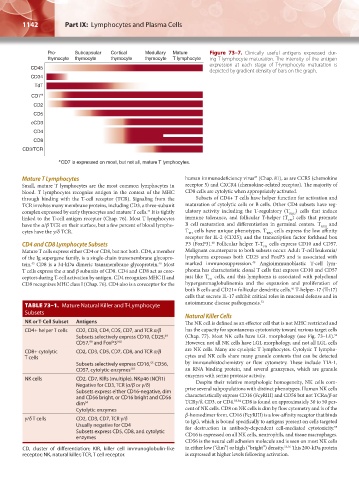
                        Pro-     Subcapsular  Cortical   Medullary  Mature    Figure 73–7.  Clinically useful antigens expressed dur-
                        thymocyte  thymocyte  thymocyte  thymocyte  T lymphocyte  ing T-lymphocyte maturation. The intensity of the antigen
                                                                              expression at each stage of  T-lymphocyte maturation is
                  CD45
                                                                              depicted by gradient density of bars on the graph.
                  CD34
                   TdT
                  CD7 ∗
                   CD2
                   CD5
                  cCD3
                   CD4
                   CD8
               CD3/TCR
                            ∗ CD7 is expressed on most, but not all, mature T lymphocytes.


               Mature T Lymphocytes                                   human immunodeficiency virus  (Chap. 81), as are CCR5 (chemokine
                                                                                             47
               Small, mature T lymphocytes are the most common lymphocytes in   receptor 5) and CXCR4 (chemokine-related receptor). The majority of
               blood. T lymphocytes recognize antigen in the context of the MHC   CD8 cells are cytolytic when appropriately activated.
               through binding with the T-cell receptor  (TCR). Signaling from the   Subsets of CD4+ T cells have helper function for activation and
               TCR involves many membrane proteins, including CD3, a three- subunit   maturation of cytolytic cells or B cells. Other CD4 subsets have reg-
               complex expressed by early thymocytes and mature T cells.  It is tightly   ulatory activity including the T-regulatory (T REG ) cells that induce
                                                         44
               linked to the T-cell antigen receptor (Chap. 76). Most T lymphocytes   immune tolerance, and follicular T-helper (T ) cells that promote
                                                                                                         FH
               have the α/β TCR on their surface, but a few percent of blood lympho-  B cell maturation and differentiation in germinal centers. T REG  and
               cytes have the γ/δ TCR.                                T  cells have unique phenotypes. T REG  cells express the low affinity
                                                                       FH
                                                                      receptor for IL-2 (CD25); and the transcription factor forkhead box
               CD4 and CD8 Lymphocyte Subsets                         P3 (FoxP3).  Follicular helper T-T  cells express CD10 and CD57.
                                                                               48
                                                                                                FH
               Mature T cells express either CD4 or CD8, but not both. CD4, a member   Malignant counterparts to both subsets occur. Adult T-cell leukemia/
               of the Ig supergene family, is a single-chain transmembrane glycopro-  lymphoma  expresses  both  CD25  and  FoxP3  and  is associated  with
                                                                                             49
               tein.  CD8 is a 34-kDa dimeric transmembrane glycoprotein.  Most    marked immunosuppression.  Angioimmunoblastic T-cell lym-
                                                             46
                  45
               T cells express the α and β subunits of CD8. CD4 and CD8 act as core-  phoma has characteristic clonal T cells that express CD10 and CD57
               ceptors during T-cell activation by antigen. CD4 recognizes MHC II and   just like T  cells, and this lymphoma is associated with polyclonal
                                                                              FH
               CD8 recognizes MHC class I (Chap. 76). CD4 also is a coreceptor for the   hypergammaglobulinemia and the expansion and proliferation of
                                                                      both B cells and CD21+ follicular dendritic cells.  T-helper-17 (Th17)
                                                                                                          50
                                                                      cells that secrete IL-17 exhibit critical roles in mucosal defense and in
                                                                      autoimmune disease pathogenesis. 51
                TABLE 73–1.  Mature Natural Killer and T-Lymphocyte
                Subsets
                                                                      Natural Killer Cells
                NK or T-Cell Subset  Antigens                         The NK cell is defined as an effector cell that is not MHC restricted and
                CD4+ helper T cells  CD2, CD3, CD4, CD5, CD7, and TCR α/β  has the capacity for spontaneous cytotoxicity toward various target cells
                                                                                                                        52
                                                               49
                                 Subsets selectively express CD10, CD25,    (Chap. 77). Most NK cells have LGL morphology (see Fig. 73–1E).
                                 CD57,  and FoxP3 100                 However, not all NK cells have LGL morphology, and not all LGL cells
                                      99
                CD8+ cytolytic    CD2, CD3, CD5, CD7, CD8, and TCR α/β  are NK cells. Many are cytolytic T lymphocytes. Cytolytic T lympho-
                T cells                                               cytes and NK cells share many granule contents that can be detected
                                 Subsets selectively express CD16,  CD56,   by immunohistochemistry or flow cytometry. These include TIA-1,
                                                          55
                                 CD57, cytolytic enzymes 101          an RNA binding protein, and several granzymes, which are granule
                                                                      enzymes with serine protease activity.
                NK cells         CD2, CD7, KIRs (multiple), NKp46 (NCR1)  Despite their relative morphologic homogeneity, NK cells com-
                                 Negative for CD3, TCR (α/β or γ/δ)   prise several subpopulations with distinct phenotypes. Human NK cells
                                 Subsets express either CD16-negative, dim
                                 and CD56 bright, or CD16 bright and CD56   characteristically express CD16 (FcγRIII) and CD56 but not TCRα/β or
                                 dim 54                               TCRγ/δ, CD3, or CD4. 53,54  CD8 is found on approximately 30 to 50 per-
                                 Cytolytic enzymes                    cent of NK cells. CD8 on NK cells is dim by flow cytometry and is of the
                                                                      β-homodimer form. CD16 (FcγRIII) is a low-affinity receptor that binds
                γ/δ T cells      CD2, CD3, CD7, TCR γ/δ               to IgG, which is bound specifically to antigens present on cells targeted
                                 Usually negative for CD4             for destruction in antibody-dependent cell-mediated cytotoxicity.
                                                                                                                        55
                                 Subsets express CD5, CD8, and cytolytic   CD16 is expressed on all NK cells, neutrophils, and tissue macrophages.
                                 enzymes
                                                                      CD56 is the neural cell adhesion molecule and is seen on most NK cells
               CD, cluster of differentiation; KIR, killer cell immunoglobulin-like   in either low (“dim”) or high (“bright”) density. 53,56  This 200-kDa protein
               receptor; NK, natural killer; TCR, T cell receptor.    is expressed at higher levels following activation.


          Kaushansky_chapter 73_p1135-1148.indd   1142                                                                  9/21/15   4:44 PM

