


Page 1164 - Williams Hematology ( PDFDrive )
P. 1164
Chapter 73:  The Structure of Lymphocytes and Plasma Cells           1139


                                                                 Ribosome
                                                                                                        Euchromatin
                                                                Lysosome
                                                                                                         Heterochromatin

                                                                Nucleolus
                                                                 Nucleus                                  Rough-surfaced
                                                                                                          endoplasmic reticulum
                                                                 Golgi
                                                                                                       Centriole
                                                                                                      Mitochondrion


                    A                                           B
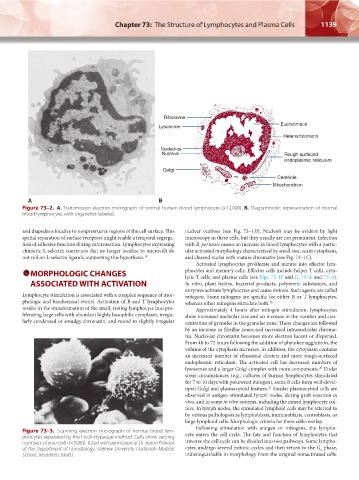
                  Figure 73–2.  A. Transmission electron micrograph of normal human blood lymphocyte (×12,000). B. Diagrammatic representation of normal
                  blood lymphocyte, with organelles labeled.


                  and diapedesis localize to nonprotrusive regions of the cell surface. This   nuclear outlines (see Fig. 73–1D). Nucleoli may be evident by light
                  spatial separation of surface receptors might enable a temporal segrega-  microscopy in these cells, but they usually are not prominent. Infection
                  tion of adhesive function during extravasation. Lymphocytes expressing   with B. pertussis causes an increase in blood lymphocytes with a partic-
                  chimeric L-selectin constructs that no longer localize to microvilli do   ular activated morphology characterized by small size, scant cytoplasm,
                  not roll on L-selectin ligands, supporting this hypothesis. 18  and cleaved nuclei with mature chromatin (see Fig. 73–1C).
                                                                            Activated lymphocytes proliferate and mature into effector lym-
                       MORPHOLOGIC CHANGES                              phocytes and memory cells. Effector cells include helper T cells, cyto-
                                                                        lytic T cells, and plasma cells (see Figs. 73-1F and G, 73–4, and 73–5).
                     ASSOCIATED WITH ACTIVATION                         In vitro, plant lectins, bacterial products, polymeric substances, and
                                                                        enzymes activate lymphocytes and cause mitosis. Such agents are called
                  Lymphocyte stimulation is associated with a complex sequence of mor-  mitogens. Some mitogens are specific for either B or T lymphocytes,
                  phologic and biochemical events. Activation of B and T lymphocytes   whereas other mitogens stimulate both. 19
                  results in the transformation of the small, resting lymphocyte into pro-  Approximately 4 hours after mitogen stimulation, lymphocytes
                  liferating large cells with abundant highly basophilic cytoplasm, irregu-  show increased nucleolar size and an increase in the number and con-
                  larly condensed or smudgy chromatin, and round to slightly irregular   centration of granules in the granular zone. These changes are followed
                                                                        by an increase in fibrillar zones and increased intranucleolar chroma-
                                                                        tin. Nucleolar chromatin becomes more electron lucent or dispersed.
                                                                        From 48 to 72 hours following the addition of phytohemagglutinin, the
                                                                        volume of the cytoplasm increases. In addition, the cytoplasm contains
                                                                        an increased number of ribosomal clusters and more rough-surfaced
                                                                        endoplasmic reticulum. The activated cell has increased numbers of
                                                                        lysosomes and a larger Golgi complex with more components.  Under
                                                                                                                     20
                                                                        some circumstances (e.g., cultures of human lymphocytes stimulated
                                                                        for 7 to 10 days with pokeweed mitogen), some B cells form well-devel-
                                                                        oped Golgi and plasmacytoid features.  Similar plasmacytoid cells are
                                                                                                    21
                                                                        observed in antigen-stimulated lymph nodes, during graft rejection in
                                                                        vivo, and in some in vitro systems, including the mixed lymphocyte cul-
                                                                        ture. In lymph nodes, the stimulated lymphoid cells may be referred to
                                                                        by various pathologists as lymphoblasts, immunoblasts, centroblasts, or
                                                                        large lymphoid cells. Morphologic criteria for these cells overlap.
                                                                            Following stimulation with antigen or mitogens, the lympho-
                  Figure  73–3.  Scanning electron micrograph of normal blood lym-  cyte enters the cell cycle. The fate and function of lymphocytes that
                  phocytes separated by the Ficoll-Hypaque method. Cells show varying
                  numbers of microvilli (×5000). (Used with permission of Dr. Aaron Polliack   traverse the cell cycle can be divided into two pathways. Some lympho-
                  of the Department of Hematology, Hebrew University Hadassah Medical   cytes undergo several mitotic cycles and then return to the G  phase,
                                                                                                                      0
                  School, Jerusalem, Israel.)                           indistinguishable in morphology from the original nonactivated cells.


          Kaushansky_chapter 73_p1135-1148.indd   1139                                                                  9/21/15   4:44 PM

