


Page 1165 - Williams Hematology ( PDFDrive )
P. 1165
1140           Part IX:  Lymphocytes and Plasma Cells


                                                                      Some of them then become memory cells, programmed to remember
                                                                      the stimulating antigen and thus respond more rapidly to reexposure
                                                                      to the original antigen. Alternatively, they become terminally differ-
                                                                      entiated effector lymphocytes, such as plasma cells or cytotoxic T cells
                                                                      (Chaps. 75 and 76).

                                                                           MICROSCOPY AND HISTOCHEMISTRY
                                                                         OF PLASMA CELLS

                                                                      MORPHOLOGIC STUDIES
                                                                      Plasma cells derive from small B lymphocytes after activation in the cor-
                                                                      rect environment. The characteristic feature of plasma cells is abundant
                                                                      cytoplasmic and secretory immunoglobulin (Ig). A fully mature plasma
                                                                      cell lacks surface Ig expression. Each plasma cell has the same clonal rear-
                                                                      rangement of its V(D)J (variable diversity joining) Ig genes as its predeces-
                                                                      sor B lymphocyte (Chap. 75). Several mitotic divisions may occur during
                                                                      cellular differentiation from the resting lymphocyte to the plasmablast to
                                                                      the immature plasma cell. Immature plasma cells can undergo successive
                                                                      waves of mitosis in the medullary cords of lymph nodes in response to
                                                                      antigen.  Cell transfer experiments demonstrated that these transformed
                                                                            22
                                                                      cells later mature into antibody-producing plasma cells. 23
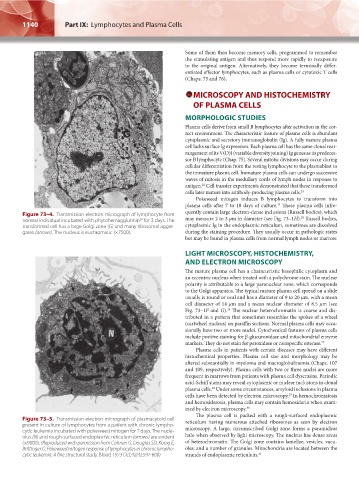
                                                                          Pokeweed mitogen induces B lymphocytes to transform into
                                                                      plasma cells after 7 to 10 days of culture.  These plasma cells infre-
                                                                                                     24
                                                                      quently contain large electron-dense inclusions (Russell bodies), which
               Figure 73–4.  Transmission electron micrograph of lymphocyte from                             25
                                                       20
               normal individual incubated with phytohemagglutinin  for 3 days. The   may measure 2 to 3 μm in diameter (see Fig. 73–1H).  Russell bodies,
               transformed cell has a large Golgi zone (G) and many ribosomal aggre-  cytoplasmic Ig in the endoplasmic reticulum, sometimes are dissolved
               gates (arrows). The nucleus is euchromatic (×7500).    during the staining procedure. They usually occur in pathologic states
                                                                      but may be found in plasma cells from normal lymph nodes or marrow.
                                                                      LIGHT MICROSCOPY, HISTOCHEMISTRY,
                                                                      AND ELECTRON MICROSCOPY
                                                                      The mature plasma cell has a characteristic basophilic cytoplasm and
                                                                      an eccentric nucleus when treated with a polychrome stain. The nuclear
                                                                      polarity is attributable to a large paranuclear zone, which corresponds
                                                                      to the Golgi apparatus. The typical mature plasma cell spread on a slide
                                                                      usually is round or oval and has a diameter of 9 to 20 μm, with a mean
                                                                      cell diameter of 14 μm and a mean nuclear diameter of 8.5 μm (see
                                                                      Fig. 73–1F and G).  The nuclear heterochromatin is coarse and dis-
                                                                                    26
                                                                      tributed in a pattern that sometimes resembles the spokes of a wheel
                                                                      (cartwheel nucleus) on paraffin sections. Normal plasma cells may occa-
                                                                      sionally have two or more nuclei. Cytochemical features of plasma cells
                                                                      include positive staining for β-glucuronidase and mitochondrial enzyme
                                                                      markers. They do not stain for peroxidase or nonspecific esterase. 27
                                                                          Plasma cells in patients with certain diseases may have different
                                                                      histochemical properties. Plasma cell size and morphology may be
                                                                      altered substantially in myeloma and macroglobulinemia (Chaps. 107
                                                                      and 109, respectively). Plasma cells with two or three nuclei are more
                                                                      frequent in marrows from patients with plasma cell dyscrasias. Periodic
                                                                      acid-Schiff stains may reveal cytoplasmic or nuclear inclusions in clonal
                                                                      plasma cells.  Under some circumstances, amyloid inclusions in plasma
                                                                               28
                                                                      cells have been detected by electron microscopy.  In hemochromatosis
                                                                                                         29
                                                                      and hemosiderosis, plasma cells may contain hemosiderin when exam-
                                                                      ined by electron microscopy. 30
                                                                          The plasma cell is packed with a rough-surfaced endoplasmic
               Figure 73–5.  Transmission electron micrograph of plasmacytoid cell   reticulum having numerous attached ribosomes as seen by electron
               present in culture of lymphocytes from a patient with chronic lympho-  microscopy. A large, circumscribed Golgi zone  forms a paranuclear
               cytic leukemia incubated with pokeweed mitogen for 7 days. The nucle-
               olus (N) and rough-surfaced endoplasmic reticulum (arrows) are evident   halo when observed by light microscopy. The nucleus has dense areas
               (×9000). (Reproduced with permission from Cohnen G, Douglas SD, Konig E,   of heterochromatin. The Golgi zone contains lamellae, vesicles, vacu-
               Brittinger G: Pokeweed mitogen response of lymphocytes in chronic lympho-  oles, and a number of granules. Mitochondria are located between the
               cytic leukemia: A fine structural study, Blood 1973 Oct;42(4):591-600)  strands of endoplasmic reticulum. 31


          Kaushansky_chapter 73_p1135-1148.indd   1140                                                                  9/21/15   4:44 PM

