


Page 1166 - Williams Hematology ( PDFDrive )
P. 1166
Chapter 73:  The Structure of Lymphocytes and Plasma Cells           1141


                     ANTIGENS OF HUMAN LYMPHOCYTES                      lymphoid organs; they are rare in the marrow.  These cells appar-
                                                                                                            38
                                                                        ently are enriched for cells that spontaneously produce polyreactive
                  B LYMPHOCYTE ANTIGENS                                 autoantibodies. 39–41
                  Figure  73–6  summarizes  the  expression  of  antigens  on  cells  of  the   Plasma Cells
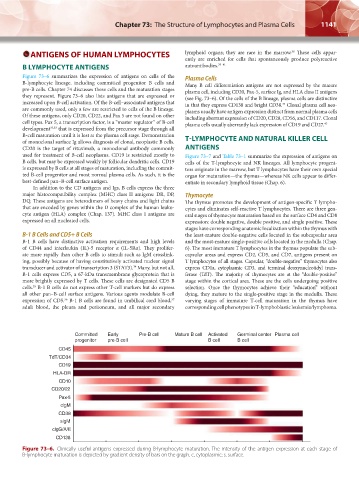
                  B-lymphocyte lineage, including committed progenitor B cells and   Many B cell differentiation antigens are not expressed by the mature
                  pre-B cells. Chapter 74 discusses these cells and the maturation stages   plasma cell, including CD20, Pax-5, surface Ig, and HLA class II antigens
                  they represent. Figure  73–6 also lists antigens that are expressed or   (see Fig. 73–6). Of the cells of the B lineage, plasma cells are distinctive
                  increased upon B-cell activation. Of the B-cell–associated antigens that   in that they express CD138 and bright CD38.  Clonal plasma cell neo-
                                                                                                         42
                  are commonly used, only a few are restricted to cells of the B lineage.   plasms usually have antigen expression distinct from normal plasma cells
                  Of these antigens, only CD20, CD22, and Pax 5 are not found on other   including aberrant expression of CD20, CD28, CD56, and CD117. Clonal
                  cell types. Pax 5, a transcription factor, is a “master regulator” of B-cell   plasma cells usually aberrantly lack expression of CD19 and CD27. 43
                  development 32,33  that is expressed from the precursor stage through all
                  B-cell maturation until it is lost at the plasma cell stage. Demonstration
                  of monoclonal surface Ig allows diagnosis of clonal, neoplastic B cells.   T-LYMPHOCYTE AND NATURAL KILLER CELL
                  CD20 is the target of rituximab, a monoclonal antibody commonly   ANTIGENS
                  used for treatment of B-cell neoplasms. CD19 is restricted mostly to     Figure 73–7 and Table 73–1 summarize the expression of antigens on
                  B cells, but may be expressed weakly by follicular dendritic cells. CD19   cells of the T-lymphocyte and NK lineages. All lymphocyte progeni-
                  is expressed by B cells at all stages of maturation, including the commit-  tors originate in the marrow, but T lymphocytes have their own special
                  ted B-cell progenitor and most normal plasma cells. As such, it is the   organ for maturation—the thymus—whereas NK cells appear to differ-
                  best-defined pan–B-cell surface antigen.              entiate in secondary lymphoid tissue (Chap. 6).
                     In addition to the CD antigens and Igs, B cells express the three
                  major  histocompatibility  complex  (MHC)  class  II  antigens:  DR,  DP,   Thymocyte
                  DQ. These antigens are heterodimers of heavy chains and light chains   The thymus promotes the development of antigen-specific T lympho-
                  that are encoded by genes within the D complex of the human leuko-  cytes and eliminates self-reactive T lymphocytes. There are three gen-
                  cyte antigen (HLA) complex (Chap. 137). MHC class I antigens are   eral stages of thymocyte maturation based on the surface CD4 and CD8
                  expressed on all nucleated cells.                     expression: double negative, double positive, and single positive. These
                                                                        stages have corresponding anatomic localization within the thymus with
                  B-1 B Cells and CD5+ B Cells                          the least-mature double-negative cells located in the subcapsular area
                  B-1  B  cells  have  distinctive  activation  requirements  and high  levels   and the most-mature single-positive cells located in the medulla (Chap.
                  of CD44 and interleukin (IL)-5 receptor  α (IL-5Rα). They prolifer-  6). The most immature T lymphocytes in the thymus populate the sub-
                  ate more rapidly than other B cells to stimuli such as IgM crosslink-  capsular areas and express CD2, CD5, and CD7, antigens present on
                  ing, possibly because of having constitutively activated nuclear signal   T lymphocytes of all stages. Capsular, “double-negative” thymocytes also
                  transducer and activator of transcription 3 (STAT3).  Many, but not all,    express CD1a, cytoplasmic CD3, and terminal deoxynucleotidyl trans-
                                                       34
                  B-1 cells express CD5, a 67-kDa transmembrane glycoprotein that is   ferase  (TdT).  The  majority  of thymocytes  are at  the  “double-positive”
                  more brightly expressed by T cells. These cells are designated CD5 B   stage within the cortical area. These are the cells undergoing positive
                  cells.  B-1 B cells do not express other T-cell markers but do express   selection. Once the thymocytes achieve their “education” without
                     35
                  all other pan–B-cell surface antigens. Various agents modulate B-cell   dying, they mature to the single-positive stage in the medulla. These
                  expression of CD5.  B-1 B cells are found in umbilical cord blood,    varying stages of immature T-cell maturation in the thymus have
                                                                    37
                                36
                  adult blood, the pleura and peritoneum, and all major secondary   corresponding cell phenotypes in T-lymphoblastic leukemia/lymphoma.


                                   Committed  Early      Pre-B cell  Mature B cell  Activated  Germinal center Plasma cell
                                   progenitor  pre-B cell                       B cell    B cell
                              CD45
                           TdT/CD34
                              CD19
                            HLA-DR
                              CD10
                            CD20/22
                              Pax-5
                               clgM
                              CD38
                              slgM
                            clgG/A/E
                             CD138

                  Figure 73–6.  Clinically useful antigens expressed during B-lymphocyte maturation. The intensity of the antigen expression at each stage of
                  B-lymphocyte maturation is depicted by gradient density of bars on the graph. c, cytoplasmic; s, surface.


          Kaushansky_chapter 73_p1135-1148.indd   1141                                                                  9/21/15   4:44 PM

