


Page 1192 - Williams Hematology ( PDFDrive )
P. 1192
1166  Part IX:  Lymphocytes and Plasma Cells  Chapter 75:  Functions of B Lymphocytes and Plasma Cells in Immunoglobulin Production     1167


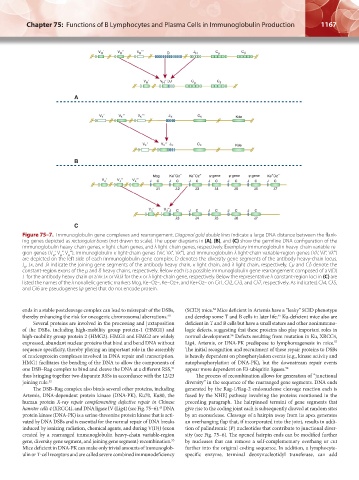
                  Figure 75–7.  Immunoglobulin gene complexes and rearrangement. Diagonal gold double lines indicate a large DNA distance between the flank-
                  ing genes depicted as rectangular boxes (not drawn to scale). The upper diagrams in (A), (B), and (C) show the germline DNA configuration of the
                  immunoglobulin heavy-chain genes, κ light-chain genes, and λ light-chain genes, respectively. Exemplary immunoglobulin heavy-chain variable-re-
                  gion genes (V ‘, V ‘‘, V ‘‘‘), immunoglobulin κ light-chain genes (Vκ‘, Vκ‘‘, Vκ‘‘‘), and immunoglobulin λ light-chain variable-region genes (Vλ‘, Vλ‘‘, Vλ‘‘‘)
                                 H
                              H
                            H
                  are depicted on the left side of each immunoglobulin gene complex. D denotes the diversity gene segments of the antibody heavy-chain locus.
                  J , Jκ, and Jλ indicate the joining gene segments of the antibody heavy chain, κ light chain, and λ light chain, respectively. Cμ and Cδ denote the
                  H
                  constant-region exons of the μ and δ heavy chains, respectively. Below each is a possible immunoglobulin gene rearrangement composed of a V(D)
                  J  for the antibody heavy chain or a Vκ Jκ or VλJλ for the κ or λ light-chain gene, respectively. Below the representative λ constant-region loci in (C) are
                  listed the names of the λ nonallelic genetic markers Mcg, Ke–Oz–, Ke–Oz+, and Ke+Oz– on Cλ1, Cλ2, Cλ3, and Cλ7, respectively. As indicated, Cλ4, Cλ5,
                  and Cλ6 are pseudogenes (ψ gene) that do not encode protein.
                                                                                  54
                  ends in a stable postcleavage complex can lead to misrepair of the DSBs,   (SCID) mice.  Mice deficient in Artemis have a “leaky” SCID phenotype
                                                                                                       55
                  thereby enhancing the risk for oncogenic chromosomal aberrations. 50  and develop some T and B cells in later life.  Ku-deficient mice also are
                     Several proteins are involved in the processing and juxtaposition   deficient in T and B cells but have a small stature and other nonimmuno-
                  of the DSBs, including high-mobility group protein-1 (HMG1) and   logic defects, suggesting that these proteins also play important roles in
                                                                                        56
                  high-mobility group protein 2 (HMG2). HMG1 and HMG2 are widely   normal development.  Defects resulting from mutation in Ku, XRCC4,
                  expressed, abundant nuclear proteins that bind and bend DNA without   Lig4, Artemis, or DNA-PK predispose to lymphomagenesis in mice.
                                                                                                                          57
                  sequence specificity, thereby playing an important role in the assembly   The initial recognition and recruitment of these repair proteins to DSBs
                  of nucleoprotein complexes involved in DNA repair and transcription.   is heavily dependent on phosphorylation events (e.g., kinase activity and
                  HMG1 facilitates the bending of the DNA to allow the components of   autophosphorylation of DNA-PK), but the downstream repair events
                  one DSB–Rag complex to bind and cleave the DNA at a different RSS,    appear more dependent on E3-ubiquitin ligases. 58
                                                                    51
                  thus bringing together two disparate RSSs in accordance with the 12/23   The process of recombination allows for generation of “junctional
                  joining rule. 52                                      diversity” in the sequence of the rearranged gene segments. DNA ends
                     The DSB–Rag complex also binds several other proteins, including   generated by the Rag-1/Rag-2 endonuclease cleavage reaction each is
                  Artemis, DNA-dependent protein kinase (DNA-PK), Ku70, Ku80, the   fused by the NHEJ pathway involving the proteins mentioned in the
                  human protein  X-ray repair complementing defective repair in Chinese   preceding paragraph. The hairpinned termini of gene segments that
                                                                43
                  hamster cells 4 (XRCC4), and DNA ligase IV (Lig4) (see Fig. 75–6).  DNA   give rise to the coding joint each is subsequently cleaved at random sites
                  protein kinase (DNA-PK) is a serine-threonine protein kinase that is acti-  by an exonuclease. Cleavage of a hairpin away from its apex generates
                  vated by DNA DSBs and is essential for the normal repair of DNA breaks   an overhanging flap that, if incorporated into the joint, results in addi-
                  induced by ionizing radiation, chemical agents, and during V(D)J (exon   tion of palindromic (P) nucleotides that contribute to junctional diver-
                  created by a rearranged immunoglobulin heavy-chain variable-region   sity (see Fig. 75–6). The opened hairpin ends can be modified further
                  gene, diversity gene segment, and joining gene segment) recombination.    by nucleases that can remove a self-complementary overhang or cut
                                                                    53
                  Mice deficient in DNA-PK can make only trivial amounts of immunoglob-  further into the original coding sequence. In addition, a lymphocyte-
                  ulin or T-cell receptors and are called severe combined immunodeficiency   specific enzyme, terminal deoxynucleotidyl transferase, can add


          Kaushansky_chapter 75_p1159-1174.indd   1167                                                                  9/21/15   12:11 PM

