


Page 1187 - Williams Hematology ( PDFDrive )
P. 1187
1162           Part IX:  Lymphocytes and Plasma Cells                                                                          Chapter 75:  Functions of B Lymphocytes and Plasma Cells in Immunoglobulin Production             1163


               Another nephritis associated with glomerular IgA deposits is
               Henoch-Schönlein purpura, a condition that most commonly presents
               with a characteristic pruritic skin rash, arthritis, and abdominal pain in
               children or young adults (Chap. 122).
               IgM
               In a normal adult, approximately 6 percent of the total plasma immu-
               noglobulins belong to the IgM class (see Tables  75–1 and 75–2). IgM
               molecules classically are termed macroglobulins because of their large
               molecular weight. Circulating IgM molecules contain 12 percent car-
               bohydrate and are formed through the linkage of five identical immu-
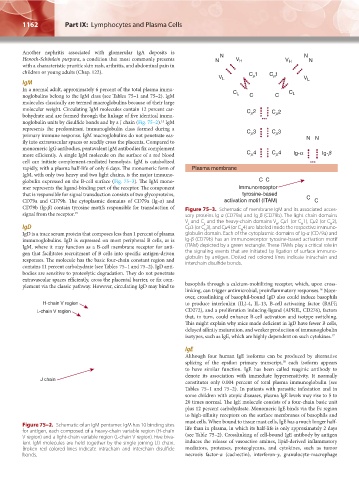
               noglobulin units by disulfide bonds and by a J chain (Fig. 75–2).  IgM
                                                              14
               represents the predominant immunoglobulin class formed during a
               primary immune response. IgM macroglobulins do not penetrate eas-
               ily into extravascular spaces or readily cross the placenta. Compared to
               monomeric IgG antibodies, pentavalent IgM antibodies fix complement
               more efficiently. A single IgM molecule on the surface of a red blood
               cell can initiate complement-mediated hemolysis. IgM is catabolized
               rapidly, with a plasma half-life of only 6 days. The monomeric form of
               IgM, with only two heavy and two light chains, is the major immuno-
               globulin expressed on the B-cell surface (Fig. 75–3). The IgM mono-
               mer represents the ligand-binding part of the receptor. The component
               that is responsible for signal transduction consists of two glycoproteins,
               CD79a and CD79b. The cytoplasmic domains of CD79a (Ig-α) and
               CD79b (Ig-β) contain tyrosine motifs responsible for transduction of   Figure 75–3.  Schematic of membrane IgM and its associated acces-
               signal from the receptor. 15                           sory proteins Ig-α (CD79a) and Ig-β (CD79b). The light-chain domains
                                                                      V  and C  and the heavy-chain domains V , Cμ1 (or C 1), Cμ2 (or C 2),
                                                                                                             H
                                                                            L
                                                                       L
                                                                                                                       H
                                                                                                    H
               IgD                                                    Cμ3 (or C 3), and Cμ4 (or C 4) are labeled inside the respective immuno-
                                                                                         H
                                                                            H
               IgD is a trace serum protein that composes less than 1 percent of plasma   globulin domain. Each of the cytoplasmic domains of Ig-α (CD79a) and
               immunoglobulins. IgD is expressed on most peripheral B cells, as is   Ig-β (CD79b) has an immunoreceptor tyrosine-based activation motif
               IgM, where it may function as a B-cell membrane receptor for anti-  (ITAM) depicted by a green rectangle. These ITAMs play a critical role in
               gen that facilitates recruitment of B cells into specific antigen-driven   the signaling events that are initiated by ligation of surface immuno-
               responses. The molecule has the basic four-chain constant region and   globulin by antigen. Dotted red colored lines indicate intrachain and
               contains 11 percent carbohydrate (see Tables  75–1 and 75–2). IgD anti-  interchain disulfide bonds.
               bodies are sensitive to proteolytic degradation. They do not penetrate
               extravascular spaces efficiently, cross the placental barrier, or fix com-
               plement via the classic pathway. However, circulating IgD may bind to   basophils through a calcium-mobilizing receptor, which, upon cross-
                                                                                                                   16
                                                                      linking, can trigger antimicrobial, proinflammatory responses.  More-
                                                                      over, crosslinking of basophil-bound IgD also could induce basophils
                      H-chain V region                                to produce interleukin (IL)-4, IL-13, B-cell activating factor (BAFF,
                    L-chain V region                                  CD272), and a proliferation inducing-ligand (APRIL, CD276), factors
                                                                      that, in turn, could enhance B-cell activation and isotype switching.
                                                                      This might explain why mice made deficient in IgD have fewer B cells,
                                                                      delayed affinity maturation, and weaker production of immunoglobulin
                                                                      isotypes, such as IgE, which are highly dependent on such cytokines. 17
                                                                      IgE
                                                                      Although four human IgE isoforms can be produced by alternative
                                                                                                       18
                                                                      splicing of the epsilon primary transcript,  each isoform appears
                                                                      to have similar function. IgE has been called reaginic antibody to
                                                                      denote  its  association with  immediate  hypersensitivity.  It normally
                     J chain
                                                                      constitutes only 0.004 percent of total plasma immunoglobulin (see
                                                                      Tables   75–1 and 75–2). In patients with parasitic infestation and in
                                                                      some children with atopic diseases, plasma IgE levels may rise to 5 to
                                                                      20 times normal. The IgE molecule consists of a four-chain basic unit
                                                                      plus 12 percent carbohydrate. Monomeric IgE binds via the Fc region
                                                                      to high-affinity receptors on the surface membranes of basophils and
                                                                      mast cells. When bound to tissue mast cells, IgE has a much longer half-
               Figure 75–2.  Schematic of an IgM pentamer. IgM has 10 binding sites   life than in plasma, in which its half-life is only approximately 2 days
               for antigen, each composed of a heavy-chain variable region (H-chain
               V region) and a light-chain variable region (L-chain V region). Five biva-  (see Table  75–2). Crosslinking of cell-bound IgE antibody by antigen
               lent IgM molecules are held together by the single joining (J) chain.    induces the release of vasoactive amines, lipid-derived inflammatory
               Broken red colored lines indicate intrachain and interchain disulfide   mediators, proteases, proteoglycans, and cytokines, such as tumor
               bonds.                                                 necrosis  factor-α  (cachectin),  interferon-γ,  granulocyte-macrophage


          Kaushansky_chapter 75_p1159-1174.indd   1162                                                                  9/21/15   12:10 PM

