


Page 1191 - Williams Hematology ( PDFDrive )
P. 1191
1166           Part IX:  Lymphocytes and Plasma Cells                                                                          Chapter 75:  Functions of B Lymphocytes and Plasma Cells in Immunoglobulin Production             1167


                                                                      thus  deleting  the  κ light-chain constant-region  exon.  Many  of the
                                                                                                              38
                                                                      proximal IGKV genes in the so-named p region are in the opposite ori-
                                                                      entation of the IGKJ segments, requiring that the V exons in this region
                                                                      undergo  inversion  during  immunoglobulin  gene  rearrangement.  A
                                                                      650-bp sequence corresponding to DNase I hypersensitive sites HS1–2
                                                                      within the IGKV-IGKJ intervening region binds a CCCTC-binding fac-
                                                                      tor, which directs locus contraction and long-range IGKV gene usage;
                                                                      its deletion results in a sevenfold increase in proximal IGKV gene usage
                                                                      along with approximately 50 percent reduction in overall locus con-
                                                                            39
                                                                      traction.  Subsequent to κ light-chain gene rearrangement, one of the
                                                                      41 functional Vλ exons can rearrange with any one of the four func-
                                                                      tional JλCλ exons to generate a gene that can encode a λ light chain
                                                                      (Fig. 75–7C).
                                                                          Somatic V-region gene recombination involves introduction of
                                                                      double-strand DNA breaks at RSS, juxtaposition of the broken ends,
                                                                      and then religation through a process called  nonhomologous  DNA
                                                                      end-joining (NHEJ). The first cleavage step requires a specialized het-
                                                                      erodimeric endonuclease complex comprised of Rag-1 and Rag-2 (see
                                                                      Fig. 75–6). Rag-1 and Rag-2 are encoded by adjacent genes located on
                                                                      the short arm of chromosome 11 (11p13–p12). Mice with either RAG
                                                                      gene knocked out cannot undergo immunoglobulin or T-cell receptor
                                                                      gene rearrangements and consequently fail to produce mature B or
                                                                      T lymphocytes.  Mutations that impair, but do not completely abolish,
                                                                                 40
                                                                      the function of Rag-1 or Rag-2 in humans result in a form of combined
                                                                      immune deficiency termed Omenn syndrome. 41
                                                                          The process of somatic DNA recombination is initiated when the
                                                                      Rag (recombination activating gene) endonuclease introduces DNA
                                                                      double-strand breaks (DSBs) at the border of two recombining gene
                                                                                              42
                                                                      segments and their flanking RSSs.  DNA cleavage by Rag leads to four
                                                                      broken DNA ends that are repaired and joined through a process called
                                                                      NHEJ to form coding and signal joints. 43,44  Occasionally these DSBs can
                                                                      be repaired aberrantly, leading to the formation of chromosomal lesions
                                                                      such as translocations, deletions, or inversions, 45,46  often found in B-cell
                                                                      neoplasms. If the breakpoints of these chromosomal lesions lie near
                                                                      potential oncogenes or tumor-suppressor genes, they can lead to cellu-
                                                                      lar transformation and lymphoid tumors. The mechanism of DNA rear-
                                                                      rangement is similar for the heavy- and light-chain loci. However, only
                                                                      one joining event is needed to generate a light-chain gene, whereas two
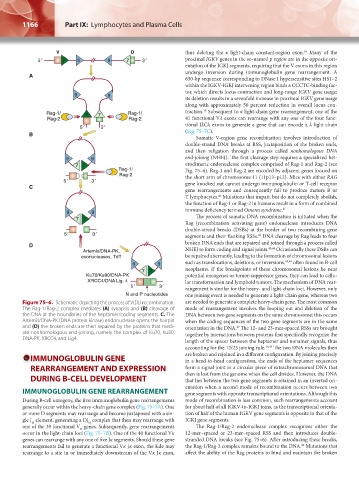
               Figure 75–6.  Schematic depicting the process of V(D)J recombination.   are needed to generate a complete heavy-chain gene. The most common
               The Rag-1/Rag-2 complex mediates (A) synapsis and (B) cleavage of   mode of rearrangement involves the looping out and deletion of the
               the DNA at the boundaries of the heptamer/coding segments. C. The   DNA between two gene segments on the same chromosome; this occurs
               Artemis/DNA-PK (DNA protein kinase) endonuclease opens the hairpin   when the coding sequences of the two gene segments are in the same
               and (D) the broken ends are then repaired by the proteins that medi-  orientation in the DNA.  The 12- and 23-mer-spaced RSSs are brought
                                                                                       47
               ate nonhomologous end-joining, namely the complex of Ku70, Ku80,   together by interactions between proteins that specifically recognize the
               DNA-PK, XRCC4, and Lig4.
                                                                      length of the spacer between the heptamer and nonamer signals, thus
                                                                      accounting for the 12/23 joining rule. 36,48  The two DNA molecules then
                    IMMUNOGLOBULIN GENE                               are broken and rejoined in a different configuration. By joining precisely
                                                                      in a head-to-head configuration, the ends of the heptamer sequences
                  REARRANGEMENT AND EXPRESSION                        form a signal joint in a circular piece of extrachromosomal DNA that
                  DURING B-CELL DEVELOPMENT                           then is lost from the genome when the cell divides. However, the DNA
                                                                      that lies between the two gene segments is retained in an inverted ori-
                                                                      entation when a second mode of recombination occurs between two
               IMMUNOGLOBULIN GENE REARRANGEMENT                      gene segments with opposite transcriptional orientations. Although this
               During B-cell ontogeny, the first immunoglobulin gene rearrangements   mode of recombination is less common, such rearrangements account
               generally occur within the heavy-chain gene complex (Fig. 75–7A). One   for about half of all IGKV-to-IGKJ joins, as the transcriptional orienta-
               or more D segments may rearrange and become juxtaposed with a sin-  tion of half of the human IGKV gene segments is opposite to that of the
               gle J  element, generating a DJ  complex that then may rearrange with   IGKJ gene segments.
                                      H
                   H
               one of the 39 functional V  genes. Subsequently, gene rearrangements   The Rag-1/Rag-2 endonuclease complex recognizes either the
                                   H
               occur in the light-chain loci (Fig. 75–7B). One of the 40 functional Vκ   12-mer–spaced or 23-mer–spaced RSS and then introduces double-
               genes can rearrange with any one of five Jκ segments. Should these gene   stranded DNA breaks (see Fig. 75–6). After introducing these breaks,
                                                                                                             49
               rearrangements fail to generate a functional Vκ Jκ exon, the Kde may   the Rag-1/Rag-2 complex remains bound to the DNA.  Mutations that
               rearrange to a site in or immediately downstream of the Vκ Jκ exon,   affect the ability of the Rag proteins to bind and maintain the broken


          Kaushansky_chapter 75_p1159-1174.indd   1166                                                                  9/21/15   12:11 PM

