


Page 1288 - Williams Hematology ( PDFDrive )
P. 1288
1262  Part IX:  Lymphocytes and Plasma Cells                        Chapter 82:  Mononucleosis Syndromes             1263


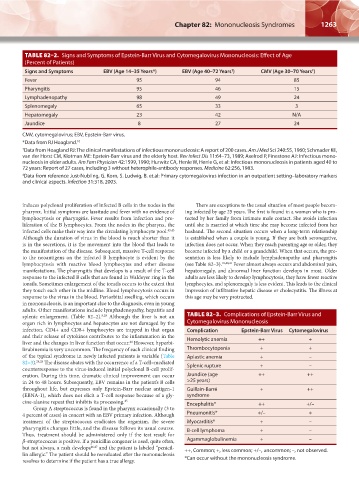
                   TABLE 82–2.  Signs and Symptoms of Epstein-Barr Virus and Cytomegalovirus Mononucleosis: Effect of Age
                   (Percent of Patients)
                                                                                        †
                   Signs and Symptoms        EBV (Age 14–35 Years*)    EBV (Age 40–72 Years )     CMV (Age 30–70 Years )
                                                                                                                   ‡
                   Fever                                95                        94                         85
                   Pharyngitis                          95                        46                         15
                   Lymphadenopathy                      98                        49                         24
                   Splenomegaly                         65                        33                         3
                   Hepatomegaly                         23                        42                        N/A
                   Jaundice                              8                        27                         24

                  CMV, cytomegalovirus; EBV, Epstein-Barr virus.
                  *Data from RJ Hoagland. 10
                  † Data from Hoagland RJ: The clinical manifestations of infectious mononucleosis: A report of 200 cases. Am J Med Sci 240:55, 1960; Schmader KE,
                  van der Horst CM, Klotman ME: Epstein-Barr virus and the elderly host. Rev Infect Dis 11:64–73, 1989; Axelrod P, Finestone AJ: Infectious mono-
                  nucleosis in older adults. Am Fam Physician 42:1599, 1990; Hurwitz CA, Henle W, Henle G, et al: Infectious mononucleosis in patients aged 40 to
                  72 years: Report of 27 cases, including 3 without heterophile-antibody responses. Medicine 62:256, 1983.
                  ‡ Data from reference Just-Nubling, G. Korn, S. Ludwig, B. et.al: Primary cytomegalovirus infection in an outpatient setting–laboratory markers
                  and clinical aspects. Infection 31:318, 2003.


                  induces polyclonal proliferation of infected B cells in the nodes in the   There are exceptions to the usual situation of most people becom-
                  pharynx. Initial symptoms are lassitude and fever with no evidence of   ing infected by age 25 years. The first is found in a woman who is pro-
                  lymphocytosis or pharyngitis. Fever results from infection and pro-  tected by her family from intimate male contact. She avoids infection
                  liferation of the B lymphocytes. From the nodes in the pharynx, the   until she is married at which time she may become infected from her
                  infected cells make their way into the circulating lymphocyte pool. 42,43    husband. The second situation occurs when a long-term relationship
                  Although the duration of virus in the blood is much shorter than it   is established when a couple is young. If they are both seronegative,
                  is in the secretions, it is the movement into the blood that leads to   infection does not occur. When they reach parenting age or older, they
                  the manifestation of the disease. Subsequent, massive T-cell response   become infected by a child or a grandchild. When that occurs, the pre-
                  to the neoantigens on the infected B lymphocyte is evident by the   sentation is less likely to include lymphadenopathy and pharyngitis
                  lymphocytosis with reactive blood lymphocytes and other disease   (see Table  82–3). 18,40,41  Fever almost always occurs and abdominal pain,
                  manifestations. The pharyngitis that develops is a result of the T-cell   hepatomegaly, and abnormal liver function develops in most. Older
                  response to the infected B cells that are found in Waldeyer ring in the   adults are less likely to develop lymphocytosis, they have fewer reactive
                  tonsils. Sometimes enlargement of the tonsils occurs to the extent that   lymphocytes, and splenomegaly is less evident. This leads to the clinical
                  they touch each other in the midline. Blood lymphocytosis occurs in   impression of infiltrative hepatic disease or cholecystitis. The illness at
                  response to the virus in the blood. Periorbital swelling, which occurs   this age may be very protracted.
                  in mononucleosis, is an important clue to the diagnosis, even in young
                  adults. Other manifestations include lymphadenopathy, hepatitis and
                  splenic enlargement. (Table   82–2). 8,28  Although the liver is not an   TABLE 82–3.  Complications of Epstein-Barr Virus and
                  organ rich in lymphocytes and hepatocytes are not damaged by the   Cytomegalovirus Mononucleosis
                  infection, CD4+ and CD8+ lymphocytes are trapped in that organ   Complication  Epstein-Barr Virus  Cytomegalovirus
                  and their release of cytokines contributes to the inflammation in the   Hemolytic anemia  ++    +
                  liver and the changes in liver function that occur.  However, hyperbi-
                                                      44
                  lirubinemia is very uncommon. The frequency of each clinical finding   Thrombocytopenia  +      +
                  of the typical syndrome in newly infected patients is variable (Table   Aplastic anemia  +      –
                  82–3). 28,29  The disease abates with the occurrence of a T-cell–mediated   Splenic rupture  +  –
                  counterresponse to the virus-induced initial polyclonal B-cell prolif-
                  eration. During this time, dramatic clinical improvement can occur   Jaundice (age    ++       ++
                  in 24 to 48 hours. Subsequently, EBV remains in the patient’s B cells   >25 years)
                  throughout life, but expresses only Epstein-Barr nuclear antigen-1   Guillain-Barré   +        ++
                  (EBNA-1), which does not elicit a T-cell response because of a gly-  syndrome
                  cine-alanine repeat that inhibits its processing. 45   Encephalitis*           ++              +/–
                     Group A streptococcus is found in the pharynx occasionally (3 to
                  4 percent of cases) in concert with an EBV primary infection. Although   Pneumonitis*  +/–      +
                  treatment  of  the  streptococcus  eradicates  the  organism,  the  severe   Myocarditis*  +    –
                  pharyngitis changes little, and the disease follows its usual course.   B-cell lymphoma  +      –
                  Thus,  treatment should be administered only if the test result for
                  β-streptococcus is positive. If a penicillin congener is used, quite often,   Agammaglobulinemia  +  –
                  but not always, a rash develops 46,47  and the patient is labeled “penicil-  ++, Common; +, less common; +/–, uncommon; –, not observed.
                  lin allergic.” The patient should be reevaluated after the mononucleosis
                  resolves to determine if the patient has a true allergy.  *Can occur without the mononucleosis syndrome.


          Kaushansky_chapter 82_p1261-1272.indd   1263                                                                  9/18/15   10:04 AM

