


Page 1289 - Williams Hematology ( PDFDrive )
P. 1289
1264           Part IX:  Lymphocytes and Plasma Cells                                                                                                                           Chapter 82:  Mononucleosis Syndromes             1265


               LABORATORY FINDINGS                                    not appear until the recovery phase of the illness. For those patients
               Antibody Responses                                     suspected of having infectious mononucleosis but who do not develop
                                                                      heterophile antibody, detection of IgG and IgM antibody to VCA with
               By week three of a mononucleosis caused by primary EBV infection, an   the absence of EBNA-1 antibody leads to the diagnosis.  A real-time
                                                                                                               49
               heterophile antibody response will occur in approximately 85 percent of   positive polymerase chain reaction (PCR) is sometimes useful. 50
               patients. The test is called the monospot test and may be falsely negative,
               especially in young children. 36,48                    Reactive Lymphocytosis
                   The infection of B cells results in their production of a variety of anti-  Expansion of cytotoxic T lymphocytes produces lymphocytosis. Reac-
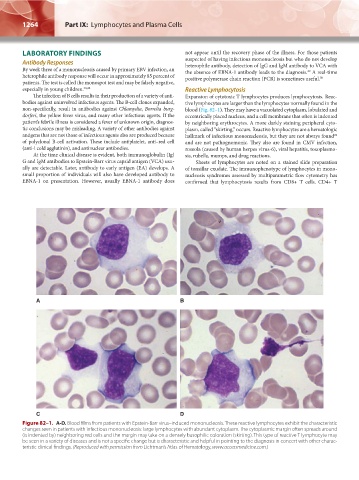
               bodies against uninvolved infectious agents. The B-cell clones expanded,   tive lymphocytes are larger than the lymphocytes normally found in the
               non-specifically, result in antibodies against  Chlamydia,  Borrelia burg-  blood (Fig. 82–1). They may have a vacuolated cytoplasm, lobulated and
               dorferi, the yellow fever virus, and many other infectious agents. If the   eccentrically placed nucleus, and a cell membrane that often is indented
               patient’s febrile illness is considered a fever of unknown origin, diagnos-  by neighboring erythrocytes. A more darkly staining peripheral cyto-
               tic conclusions may be misleading. A variety of other antibodies against   plasm, called “skirting,” occurs. Reactive lymphocytes are a hematologic
               antigens that are not those of infectious agents also are produced because   hallmark of infectious mononucleosis, but they are not always found
                                                                                                                        29
               of polyclonal B-cell activation. These include antiplatelet, anti–red cell   and are not pathognomonic. They also are found in CMV infection,
               (anti-i cold agglutinin), and antinuclear antibodies.  roseola (caused by human herpes virus-6), viral hepatitis, toxoplasmo-
                   At the time clinical disease is evident, both immunoglobulin (Ig)   sis, rubella, mumps, and drug reactions.
               G and IgM antibodies to Epstein-Barr virus capsid antigen (VCA) usu-  Sheets of lymphocytes are noted on a stained slide preparation
               ally are detectable. Later, antibody to early antigen (EA) develops. A   of tonsillar exudate. The immunophenotype of lymphocytes in mono-
               small proportion of individuals will also have developed antibody to   nucleosis syndromes assessed by multiparametric flow cytometry has
               EBNA-1 on presentation. However, usually EBNA-1 antibody does   confirmed that lymphocytosis results from CD8+ T cells. CD4+ T


                    A                                               B


                    C                                               D
               Figure 82–1.  A-D. Blood films from patients with Epstein-Barr virus–induced mononucleosis. These reactive lymphocytes exhibit the characteristic
               changes seen in patients with infectious mononucleosis: large lymphocytes with abundant cytoplasm. The cytoplasmic margin often spreads around
               (is indented by) neighboring red cells and the margin may take on a densely basophilic coloration (skirting). This type of reactive T lymphocyte may
               be seen in a variety of diseases and is not a specific change but is characteristic and helpful in pointing to the diagnosis in concert with other charac-
               teristic clinical findings. (Reproduced with permission from Lichtman’s Atlas of Hematology, www.accessmedicine.com.)


          Kaushansky_chapter 82_p1261-1272.indd   1264                                                                  9/18/15   10:05 AM

