


Page 1291 - Williams Hematology ( PDFDrive )
P. 1291
1266           Part IX:  Lymphocytes and Plasma Cells                                                                                                                           Chapter 82:  Mononucleosis Syndromes             1267


                                                                            103
                                                                                                                 104
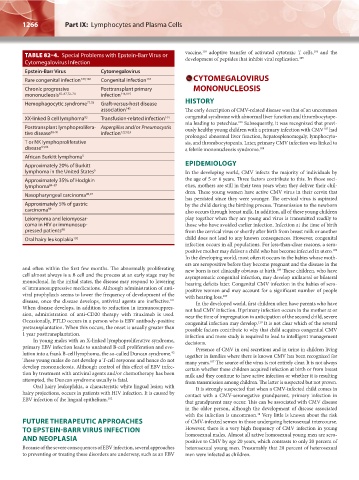
                TABLE 82–4.  Special Problems with Epstein-Barr Virus or   vaccine,  adoptive transfer of activated cytotoxic T cells,  and the
                                                                      development of peptides that inhibit viral replication.
                                                                                                            105
                Cytomegalovirus Infection
                Epstein-Barr Virus        Cytomegalovirus
                Rare congenital infection 129,130  Congenital infection 110    CYTOMEGALOVIRUS
                Chronic progressive       Posttransplant primary         MONONUCLEOSIS
                mononucleosis 65–67,72–74  infection 114,115
                Hemophagocytic syndrome 77,78  Graft-versus-host disease   HISTORY
                                          association 143             The early description of CMV-related disease was that of an uncommon
                XX-linked B cell lymphoma 92  Transfusion-related infection 144  congenital syndrome with abnormal liver function and thrombocytope-
                                                                      nia leading to petechiae.  Subsequently, it was recognized that previ-
                                                                                        106
                Posttransplant lymphoprolifera- Aspergillus and/or Pneumocystis   ously healthy young children with a primary infection with CMV  had
                                                                                                                    107
                tive disease 88–91        infection 122,123
                                                                      prolonged abnormal liver function, hepatosplenomegaly, lymphocyto-
                T or NK lymphoproliferative                           sis, and thrombocytopenia. Later, primary CMV infection was linked to
                disease 94,95                                         a febrile mononucleosis syndrome. 108
                African Burkitt lymphoma 5
                Approximately 20% of Burkitt                          EPIDEMIOLOGY
                lymphoma in the United States 5                       In the developing world, CMV infects the majority of individuals by
                Approximately 35% of Hodgkin                          the age of 5 or 6 years. Three factors contribute to this. In those soci-
                lymphoma 84–87                                        eties, mothers are still in their teen years when they deliver their chil-
                                                                      dren. These young women have active CMV virus in their cervix that
                Nasopharyngeal carcinoma 96,97
                                                                      has persisted since they were younger. The cervical virus is aspirated
                Approximately 5% of gastric                           by the child during the birthing process. Transmission to the newborn
                carcinoma 99                                          also occurs through breast milk. In addition, all of these young children
                Leiomyoma and leiomyosar-                             play together when they are young and virus is transmitted readily to
                coma in HIV or immunosup-                             those who have avoided earlier infection. Infection at the time of birth
                pressed patients 98                                   from the cervical virus or shortly after birth from breast milk or another
                Oral hairy leukoplakia 102                            child does not lead to any known consequences. However, congenital
                                                                      infection occurs in all populations. For less-than-clear reasons, a sero-
                                                                      positive mother may deliver a child who has become infected in utero.
                                                                                                                       109
                                                                      In the developing world, most often it occurs in the babies whose moth-
                                                                      ers are seropositive before they become pregnant and the disease in the
               and often within the first few months. The abnormally proliferating   new born is not clinically obvious at birth.  These children, who have
                                                                                                     109
               cell almost always is a B cell and the process at an early stage may be   asymptomatic congenital infection, may develop unilateral or bilateral
               monoclonal. In the initial states, the disease may respond to lowering   hearing deficits later. Congenital CMV infection in the babies of sero-
               of immunosuppressive medications. Although administration of anti-  positive women and may account for a significant number of people
               viral prophylaxis seems to lower the frequency of development of the   with hearing loss. 109
                                                                 101
               disease, once the disease develops, antiviral agents are ineffective.    In the developed world, first children often have parents who have
               When disease develops, in addition to reduction in immunosuppres-  not had CMV infection. If primary infection occurs in the mother at or
               sion, administration of anti-CD20 therapy with rituximab is used.   near the time of impregnation in anticipation of the second child, severe
               Occasionally, PTLD occurs in a person who is EBV antibody-positive   congenital infection may develop.  It is not clear which of the several
                                                                                              110
               pretransplantation. When this occurs, the onset is usually greater than   possible factors contribute to why that child acquires congenital CMV
               1 year posttransplantation.                            infection and more study is required to lead to intelligent management
                   In young males with an X-linked lymphoproliferative syndrome,   decisions.
               primary EBV infection leads to unabated B-cell proliferation and evo-  Presence of CMV in oral secretions and in urine in children living
               lution into a frank B-cell lymphoma, the so-called Duncan syndrome.    together in families where there is known CMV has been recognized for
                                                                 92
               These young males do not develop a T-cell response and hence do not   many years.  The source of the virus is not entirely clear. It is not always
                                                                              107
               develop mononucleosis. Although control of this effect of EBV infec-  certain whether these children acquired infection at birth or from breast
               tion by treatment with antiviral agents and/or chemotherapy has been   milk and they continue to have active infection or whether it is resulting
               attempted, the Duncan syndrome usually is fatal.       from transmission among children. The latter is suspected but not proven.
                   Oral hairy leukoplakia, a characteristic white lingual lesion with   It is strongly suspected that when a CMV-infected child comes in
               hairy projections, occurs in patients with HIV infection. It is caused by   contact with a CMV-seronegative grandparent, primary infection in
               EBV infection of the lingual epithelium. 102           that grandparent may occur. This can be associated with CMV disease
                                                                      in the older person, although the development of disease associated
                                                                                              18
                                                                      with the infection is uncommon.  Very little is known about the risk
               FUTURE THERAPEUTIC APPROACHES                          of CMV-infected semen in those undergoing heterosexual intercourse.
               TO EPSTEIN-BARR VIRUS INFECTION                        However, there is a very high frequency of CMV infection in young
               AND NEOPLASIA                                          homosexual males. Almost all active homosexual young men are sero-
                                                                      positive to CMV by age 20 years, which contrasts to only 20 percent of
               Because of the severe consequences of EBV infection, several approaches   heterosexual young men. Presumably that 20 percent of heterosexual
               to preventing or treating these disorders are underway, such as an EBV   men were infected as children.


          Kaushansky_chapter 82_p1261-1272.indd   1266                                                                  9/18/15   10:05 AM

