


Page 1292 - Williams Hematology ( PDFDrive )
P. 1292
1266  Part IX:  Lymphocytes and Plasma Cells                        Chapter 82:  Mononucleosis Syndromes             1267


                  CLINICAL MANIFESTATIONS                               COMPLICATIONS
                  In most cases, the new infection with CMV is clinically silent. However,   Hemolytic anemia and thrombocytopenia occur in primary CMV infec-
                  some newly infected individuals will develop high fever (40°C often),   tion and are other findings that may lead the clinician initially to con-
                  weight loss, and associated malaise and myalgia.  Abnormal liver func-  sider a diagnosis of lymphoma. There are a variety of pathogenic factors,
                                                    111
                  tion and a palpable spleen similar to that seen with EBV occur. A left   which explain these hematologic changes. The most prominent neuro-
                  shift in the differential white count may occur initially, evidenced by   logic complication is Guillain-Barré syndrome and, less commonly,
                  a higher proportion of band neutrophils. The incidence of lymphade-  transverse myelitis and aseptic meningitis (see Table  82–3). Antibody
                  nopathy is much higher in the young then in the older person with pri-  that develops to CMV-infected cells cross reacts with GM  antigen that
                                                                                                                  2
                  mary CMV. Infection occurs in the older individual because they have   may explain the development of Guillain-Barré syndrome. 66,67  This anti-
                  not been infected during their younger years (Tables  82–2 and 82–3 list   body can be absorbed with CMV-infected fibroblasts but not by unin-
                  additional clinical and laboratory findings). Because no classic mani-  fected fibroblasts.
                  festation, such as severe exudative pharyngitis, develops, CMV is not   Because it is not the B cell that is the target of infection, but the
                  considered in the differential diagnosis. Instead, it is assumed that the   monocyte–macrophage lineage, 112,113  evolution to unrestrained B-cell
                  patient has a bacterial infection and antibiotics are administered. How   replication, lymphoma, and PTLD do not occur.
                  frequently this occurs  is  uncertain  but  administration  of a  β-lactam
                  antibiotic may be associated with development of a rash and the mis-  CYTOMEGALOVIRUS IN TRANSPLANTATION
                  taken impression that the recipient is allergic to penicillin. Because the
                  disease occurs in the older population, including those older than age   CMV does not predispose to hematologic malignancy. However, it plays
                  50 years, the causes of fever of unknown origin often are pursued in an   a critical role in all of the transplantation settings, with some very sim-
                  expensive evaluation prior to the diagnosis. A number of the laboratory   ilar findings in lung and allogeneic hematopoietic stem cell transplants.
                  and physical findings raise many diagnostic possibilities. Development   It is rare in autologous hematopoietic stem cell transplantations, but can
                  of antinuclear factor and thrombocytopenia (Table 82–5) often errone-  occur and be a serious infection (Chap. 23 discusses CMV infection in
                  ously leads to the diagnosis of a collagen vascular disease. The presence   allogeneic hematopoietic stem cell transplantation).
                  of splenomegaly raises the question of lymphoma.          In all solid-organ transplantations, there are three potential types
                                                                        of infection that can occur because of CMV. 114–116  The monocyte–
                                                                        macrophage cells in all solid organs, for example, heart, kidney, pan-
                  LABORATORY FINDINGS                                   creas, and liver of CMV-seropositive individuals, harbor CMV that can
                  The cell that becomes infected initially is not the B lymphocyte but   be reactivated. The CMV-seronegative recipient who receives an organ
                                                                        from a CMV-positive donor can develop a primary infection when the
                  a cell in the monocyte–macrophage lineage and it is that cell or cells   CMV reactivates from the donor organ. Because this occurs when the
                  to which the T-lymphocyte responds. 112,113  Lymphocytosis that devel-  recipient is receiving immunosuppression, this is the most serious clin-
                  ops is indistinguishable from that of EBV-induced disease. In some   ical problem. 115,116  The classic situation occurs when a parent, who is
                  patients, neutrophilia with band forms occurs early in the infection.   older and has developed infection in the past, donates a kidney or a
                  In addition, because the incubation period is 30 to 40 days, IgG and   segment of their liver containing CMV to their child.  A second pos-
                                                                                                               116
                  IgM antibodies to CMV have already developed when the disease first   sibility is that the CMV in the seropositive recipient, even when the
                  becomes manifest. The PCR of a blood sample for CMV usually is pos-  donor is CMV-seronegative, can be reactivated. Because it is the recip-
                  itive, and CMV can be isolated from specimens of urine or saliva. Liver   ient’s own latent CMV that is reactivated, the clinical manifestations of
                  function abnormalities (see Tables  82–2 and 82–3) include bilirubin   infection usually are mild or absent.  The third occurs when both the
                                                                                                  116
                                                                    18
                  elevation. Jaundice may occur in up to 25 percent of these ill patients.    donor and the recipient are both CMV-seropositive. Clinical disease can
                  Prolonged illness and severe fatigue is quite common in this subset of   sometimes occur, but its severity is difficult to predict. Clinical disease
                  ill individuals.                                      consists of fever, liver function abnormalities, and inflammatory bowel
                                                                        changes. Prior to the availability of antiviral agents, most patients who
                                                                        developed primary CMV infection did well.  In solid-organ transplan-
                                                                                                        116
                                                                        tation patients, in the majority of situations, immunosuppressive ther-
                                                                        apy starts with the transplantation and then is maintained for prolonged
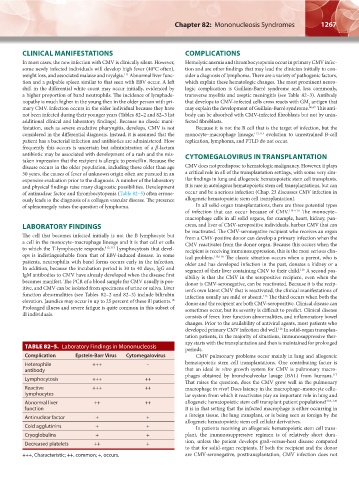
                   TABLE 82–5.  Laboratory Findings in Mononucleosis    periods.
                   Complication     Epstein-Barr Virus  Cytomegalovirus     CMV pulmonary problems occur mainly in lung and allogeneic
                   Heterophile           +++               –            hematopoietic stem cell transplantations. One contributing factor is
                   antibody                                             that an ideal  in vitro growth system for CMV is pulmonary macro-
                                                                        phages obtained by bronchoalveolar lavage (BAL) from humans.
                                                                                                                          117
                   Lymphocytosis         +++               ++
                                                                        That raises the question, does the CMV grow well in the pulmonary
                   Reactive              +++               ++           macrophage in vivo? Does latency in the macrophage–monocyte cellu-
                   lymphocytes                                          lar system from which it reactivates play an important role in lung and
                   Abnormal liver         ++               ++           allogeneic hematopoietic stem cell transplant patient populations? 118–120
                   function                                             It is in that setting that the infected macrophage is either occurring in
                   Antinuclear factor     +                +            a foreign tissue, the lung transplant, or is being seen as foreign by the
                                                                        allogeneic hematopoietic stem cell cellular derivatives.
                   Cold agglutinins       +                +                In patients receiving an allogeneic hematopoietic stem cell trans-
                   Cryoglobulins          +                +            plant,  the  immunosuppressive  regimen  is  of  relatively  short  dura-
                   Decreased platelets    ++               +            tion, unless the patient develops graft-versus-host disease compared
                                                                        to that for solid-organ recipients. If both the recipient and the donor
                  +++, Characteristic; ++, common; +, occurs.           are CMV-seronegative, posttransplantation, CMV infection does not


          Kaushansky_chapter 82_p1261-1272.indd   1267                                                                  9/18/15   10:05 AM

