


Page 1308 - Williams Hematology ( PDFDrive )
P. 1308
1282  Part X:  Malignant Myeloid Diseases  Chapter 83:  Classification and Clinical Manifestations of the Clonal Myeloid Disorders  1283


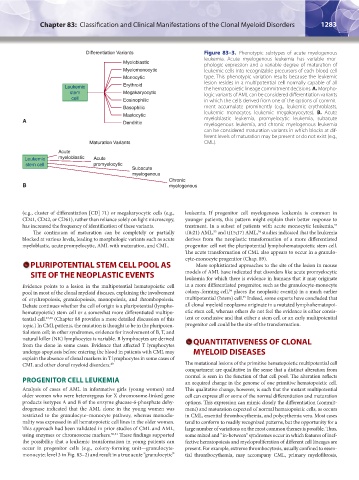
                                       Differentiation Variants                Figure 83–3.  Phenotypic subtypes of acute myelogenous
                                                                               leukemia. Acute myelogenous leukemia has variable mor-
                                                    Myeloblastic               phologic expression and a variable degree of maturation of
                                                    Myelomonocytic             leukemic cells into recognizable precursors of each blood cell
                                                    Monocytic                  type. This phenotypic variation results because the leukemic
                                Leukemic            Erythroid                  lesion resides in a multipotential cell normally capable of all
                                                                               the hematopoietic lineage commitment decisions. A. Morpho-
                                  stem              Megakaryocytic             logic variants of AML can be considered differentiation variants
                                  cell              Eosinophilic               in which the cells derived from one of the options of commit-
                                                    Basophilic                 ment accumulate prominently (e.g., leukemic erythroblasts,
                                                    Mastocytic                 leukemic monocytes, leukemic megakaryocytes).  B. Acute
                  A                                 Dendritic                  myeloblastic leukemia, promyelocytic leukemia, subacute
                                                                               myelogenous leukemia, and chronic myelogenous leukemia
                                                                               can be considered maturation variants in which blocks at dif-
                                                                               ferent levels of maturation may be present or do not exist (e.g.,
                                        Maturation Variants                    CML).
                              Acute
                   Leukemic   myeloblastic  Acute
                   stem cell              promyelocytic
                                                       Subacute
                                                       myelogenous
                                                                   Chronic
                  B                                                myelogenous


                  (e.g., cluster of differentiation [CD] 71) or megakaryocytic cells (e.g.,   leukemia. If progenitor cell myelogenous leukemia is common in
                  CD41, CD42, or CD61), rather than reliance solely on light microscopy,   younger patients, this pattern might explain their better response to
                                                                                                                          52
                  has increased the frequency of identification of these variants.  treatment. In a subset of patients with acute monocytic leukemia,
                     The continuum of maturation can be completely or partially   t(8;21) AML,  and t(15;17) AML,  studies indicated that the leukemia
                                                                                  53
                                                                                                 54
                  blocked at various levels, leading to morphologic variants such as acute   derives from the neoplastic transformation of a more differentiated
                  myeloblastic, acute promyelocytic, AML with maturation, and CML.  progenitor cell not the pluripotential lymphohematopoietic stem cell.
                                                                        The acute transformation of CML also appears to occur in a granulo-
                                                                        cyte-monocyte progenitor (Chap. 89).
                        PLURIPOTENTIAL STEM CELL POOL AS                    More sophisticated approaches to the site of the lesion in mouse
                     SITE OF THE NEOPLASTIC EVENTS                      models of AML have indicated that disorders like acute promyelocytic
                                                                        leukemia for which there is evidence in humans that it may originate
                  Evidence points to a lesion in the multipotential hematopoietic cell   in a more differentiated progenitor, such as the granulocyte-monocyte
                                                                                       54
                  pool in most of the clonal myeloid diseases, explaining the involvement   colony-forming cell,  places the neoplastic event(s) in a much earlier
                                                                                            55
                  of  erythropoiesis, granulopoiesis,  monopoiesis, and  thrombopoiesis.   multipotential (?stem) cell.  Indeed, some experts have concluded that
                  Debate continues whether the cell of origin is a pluripotential (lympho-  all clonal myeloid neoplasms originate in a mutated lymphohematopoi-
                  hematopoietic) stem cell or a somewhat more differentiated multipo-  etic stem cell, whereas others do not feel the evidence is either consis-
                  tential cell. 47,48  (Chapter 88 provides a more detailed discussion of this   tent or conclusive and that either a stem cell or an early multipotential
                  topic.) In CML patients, the mutation is thought to be in the pluripoten-  progenitor cell could be the site of the transformation.
                  tial stem cell; in other syndromes, evidence for involvement of B, T, and
                  natural killer (NK) lymphocytes is variable. B lymphocytes are derived      QUANTITATIVENESS OF CLONAL
                  from the clone in some cases. Evidence that affected T lymphocytes
                  undergo apoptosis before entering the blood in patients with CML may   MYELOID DISEASES
                  explain the absence of clonal markers in T lymphocytes in some cases of
                  CML and other clonal myeloid disorders. 49            The mutational lesions of the primitive hematopoietic multipotential cell
                                                                        compartment are qualitative in the sense that a distinct alteration from
                  PROGENITOR CELL LEUKEMIA                              normal is seen in the function of that cell pool. The alteration reflects
                                                                        an acquired change in the genome of one primitive hematopoietic cell.
                  Analysis of cases of AML in informative girls (young women) and   This qualitative change, however, is such that the mutant multipotential
                  older women who were heterozygous for X chromosome-linked gene   cell can express all or some of the normal differentiation and maturation
                  products isotypes A and B of the enzyme glucose-6-phosphate dehy-  options. This expression can mimic closely the differentiation (commit-
                  drogenase  indicated  that  the  AML  clone  in  the  young  women  was   ment) and maturation expected of normal hematopoietic cells, as occurs
                  restricted to the granulocyte–monocyte pathway, whereas monoclo-  in CML, essential thrombocythemia, and polycythemia vera. Most cases
                  nality was expressed in all hematopoietic cell lines in the older women.   tend to conform to readily recognized patterns, but the opportunity for a
                  This approach had been validated in prior studies of CML and AML,   large number of variations on the most common themes is possible. Thus,
                  using enzymes or chromosome markers. 50,51  These findings supported   some mixed and “in-between” syndromes occur in which features of inef-
                  the possibility that a leukemic transformation in young patients can   fective hematopoiesis and myeloproliferation of different cell lineages are
                  occur in progenitor cells  (e.g.,  colony-forming  unit—granulocyte-  present. For example, extreme thrombocytosis, usually confined to essen-
                  monocyte; level 3 in Fig. 83–2) and result in a true acute “granulocytic”   tial  thrombocythemia,  may  accompany  CML,  primary  myelofibrosis,


          Kaushansky_chapter 83_p1273-1290.indd   1283                                                                  9/21/15   11:13 AM

