


Page 1307 - Williams Hematology ( PDFDrive )
P. 1307
1282           Part X:  Malignant Myeloid Diseases                                                                                 Chapter 83:  Classification and Clinical Manifestations of the Clonal Myeloid Disorders       1283


                               Level            Hematopoiesis                           Lymphopoiesis
                                5          Mature, functional blood cells         Mature, functional lymphocytes


                                4            Hematopoietic precursors                Lymphocyte precursors

                                3            Committed progenitors of                Committed progenitors of
                                            erythrocytes, granulocytes,               B-lymphocyte types,
                                          monocytes, and megakaryocytes          T-lymphocyte classes, and NK cells

                                2                Hematopoietic                          Lymphopoietic
                                               multipotential cells                    multipotential cells


                                1                                 Pluripotential stem cells
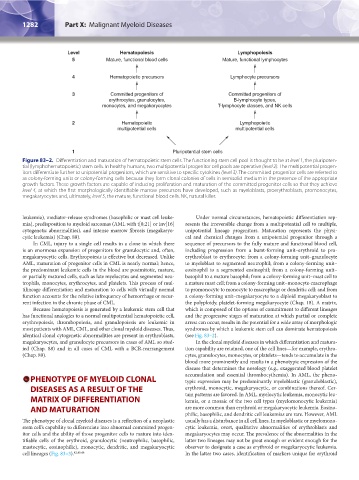
               Figure 83–2.  Differentiation and maturation of hematopoietic stem cells. The functioning stem cell pool is thought to be at level 1, the pluripoten-
               tial (lymphohematopoietic) stem cells. In healthy humans, two multipotential progenitor cell pools are operative (level 2). The multipotential progen-
               itors differentiate further to unipotential progenitors, which are sensitive to specific cytokines (level 3). The committed progenitor cells are referred to
               as colony-forming units or colony-forming cells because they form clonal colonies of cells in semisolid medium in the presence of the appropriate
               growth factors. These growth factors are capable of inducing proliferation and maturation of the committed progenitor cells so that they achieve
               level 4, at which the first morphologically identifiable marrow precursors have developed, such as myeloblasts, proerythroblasts, promonocytes,
               megakaryocytes and, ultimately, level 5, the mature, functional blood cells. NK, natural killer.


               leukemia), mediator-release syndromes (basophilic or mast cell leuke-  Under normal circumstances, hematopoietic differentiation rep-
               mia), predisposition to myeloid sarcomas (AML with t[8;21] or inv[16]   resents the irreversible change from a multipotential cell to multiple,
               cytogenetic abnormalities), and intense marrow fibrosis (megakaryo-  unipotential lineage progenitors. Maturation represents the physi-
               cytic leukemia) (Chap. 88).                            cal and chemical changes from a unipotential progenitor through a
                   In CML, injury to a single cell results in a clone in which there   sequence of precursors to the fully mature and functional blood cell,
               is an enormous expansion of progenitors for granulocytic and, often,   including progression from a burst-forming unit–erythroid to pro-
               megakaryocytic cells. Erythropoiesis is effective but decreased. Unlike   erythroblast to erythrocyte; from a colony-forming unit–granulocyte
               AML, maturation of progenitor cells in CML is nearly normal; hence,   to myeloblast to segmented neutrophil; from a colony-forming unit–
               the predominant leukemic cells in the blood are postmitotic, mature,   eosinophil to a segmented eosinophil; from a colony-forming unit–
               or partially matured cells, such as late myelocytes and segmented neu-  basophil to a mature basophil; from a colony-forming unit–mast cell to
               trophils, monocytes, erythrocytes, and platelets. This process of mul-  a mature mast cell; from a colony-forming unit–monocyte-macrophage
               tilineage differentiation and maturation to cells with virtually normal   to promonocyte to monocyte to macrophage or dendritic cell; and from
               function accounts for the relative infrequency of hemorrhage or recur-  a colony-forming unit–megakaryocyte to a diploid megakaryoblast to
               rent infection in the chronic phase of CML.            the polyploidy, platelet-forming megakaryocyte (Chap. 18). A matrix,
                   Because hematopoiesis is generated by a leukemic stem cell that   which is composed of the options of commitment to different lineages
               has functional analogies to a normal multipotential hematopoietic cell,   and the progressive stages of maturation at which partial or complete
               erythropoiesis, thrombopoiesis, and granulopoiesis are leukemic in   arrest can occur, results in the potential for a wide array of morphologic
               most patients with AML, CML, and other clonal myeloid diseases. Thus,   syndromes by which a leukemic stem cell can dominate hematopoiesis
               identical clonal cytogenetic abnormalities are present in erythroblasts,   (see Fig. 83–2).
               megakaryocytes, and granulocyte precursors in cases of AML so stud-  In the clonal myeloid diseases in which differentiation and matura-
               ied (Chap. 88) and in all cases of CML with a BCR-rearrangement   tion capability are retained, one of the cell lines—for example, erythro-
               (Chap. 89).                                            cytes, granulocytes, monocytes, or platelets—tends to accumulate in the
                                                                      blood more prominently and results in a phenotypic expression of the
                                                                      disease that determines the nosology (e.g., exaggerated blood platelet
                     PHENOTYPE OF MYELOID CLONAL                      accumulation and essential thrombocythemia). In AML, the pheno-
                                                                      typic expression may be predominantly myeloblastic (granuloblastic),
                  DISEASES AS A RESULT OF THE                         erythroid, monocytic, megakaryocytic, or combinations thereof. Cer-
                  MATRIX OF DIFFERENTIATION                           tain patterns are favored. In AML, myelocytic leukemia, monocytic leu-
                                                                      kemia, or a mosaic of the two cell types (myelomonocytic leukemia)
                  AND MATURATION                                      are more common than erythroid or megakaryocytic leukemia. Eosino-
                                                                      philic, basophilic, and dendritic cell leukemias are rare. However, AML
               The phenotype of clonal myeloid diseases is a reflection of a neoplastic   usually has a disturbance in all cell lines. In myeloblastic or myelomono-
               stem cell’s capability to differentiate into abnormal committed progen-  cytic leukemia, overt, qualitative abnormalities of erythroblasts and
               itor cells and the ability of those progenitor cells to mature into iden-  megakaryocytes may occur. The prevalence of the abnormalities in the
               tifiable cells of the erythroid, granulocytic (neutrophilic, basophilic,   latter two lineages may not be great enough or evident enough for the
               mastocytic, eosinophilic), monocytic, dendritic, and megakaryocytic   observer to designate a case as erythroid or megakaryocytic leukemia.
               cell lineages (Fig. 83–3). 42,45,46                    In the latter two cases, identification of markers unique for erythroid


          Kaushansky_chapter 83_p1273-1290.indd   1282                                                                  9/21/15   11:13 AM

