


Page 1309 - Williams Hematology ( PDFDrive )
P. 1309
1284           Part X:  Malignant Myeloid Diseases                                                                                 Chapter 83:  Classification and Clinical Manifestations of the Clonal Myeloid Disorders       1285


               or clonal bicytopenia with thrombocytosis. Erythrocytosis may rarely               Normal cells reduced
               accompany CML. Atypical myeloproliferative syndromes or other clonal   Normal      or unapparent
               myeloid diseases may have mixtures of anemia, granulocytopenia, and   hematopoiesis
               thrombocytosis or of anemia, granulocytosis, and thrombocytopenia
               rather than pancytopenia. Qualitative abnormalities of red cell, granu-  Blocked by leukemic cells
               locyte, or platelet structure or function may be more or less prominent
               in a given patient. For example, qualitative abnormalities of erythroblast         Leukemic cells predominate
               development may result in acquired  α-thalassemia (acquired hemo-  Leukemic        (~1 trillion cells)
               globin H disease), especially in patients with primary myelofibrosis, or   hematopoiesis
               occasionally other clonal myeloid diseases. In AML, unusual patterns of   A
               phenotypic expression occur frequently. For example, prominent leuke-
               mic erythroblasts and monocytes or eosinophils and monocytes may be                Normal cells
               seen in patients. So much opportunity for variation in disease expression   Normal  markedly reduced or unapparent
               exists among patients with AML that observation of patients in whom the   hematopoiesis
               phenotype of their leukemic cells is identical to the phenotype of other
               patients is unusual. Choice of treatment is little affected by these varia-        Blocked by cytotoxic drugs
               tions. Decisions about whether to treat and which drugs to use are greatly
               influenced by whether a patient has a chronic, subacute, or acute clonal
               myeloid disease; by the rate of progression of the disease; by the extent of       Leukemic cells unapparent
                                                                        Leukemic
               the leukemic blast cell infiltrate; by the cytogenetic findings; and by the   hematopoiesis  (<1 billion cells)
               severity of the cytopenias. The experienced diagnostician and therapist
               usually can identify variants as a clonal myeloid disorder and can manage   Latrogenic aplastic pancytopenia provides opportunity
               the disorder as dictated by their manifestations regardless of their precise   for reemergence of normal hematopoiesis
               subclassification.                                     B

                                                                                                  Normal cells
                     INTERPLAY OF CLONAL AND                                                      repopulate marrow and blood
                  POLYCLONAL HEMATOPOIESIS                               Normal
                                                                       hematopoiesis
               Although  potentially  curative  chemotherapy  of  myelogenous  leuke-  Blocked
               mia was introduced in the mid-20th century to kill “the last leukemic
               cell,” two important factors were not explicitly appreciated. The first
               was whether residual normal stem cells coexisted in marrow to restore   Leukemic
               polyclonal (normal) hematopoiesis if ablation of the leukemia was   hematopoiesis  Leukemic cells unapparent
               accomplished. The second was whether, given the estimates of 1 trillion   C
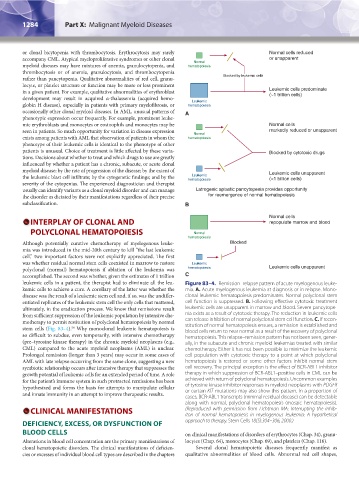
               leukemic cells in a patient, the therapist had to eliminate all the leu-  Figure 83–4.  Remission–relapse pattern of acute myelogenous leuke-
               kemic cells to achieve a cure. A corollary of the latter was whether the   mia. A. Acute myelogenous leukemia at diagnosis or in relapse. Mono-
               disease was the result of a leukemic stem cell and, if so, was the undiffer-  clonal leukemic hematopoiesis predominates. Normal polyclonal stem
               entiated replicates of the leukemic stem cell the only cells that mattered,   cell function is suppressed. B. Following effective cytotoxic treatment
               ultimately, in the eradication process. We know that remissions result   leukemic cells are unapparent in marrow and blood. Severe pancytope-
               from sufficient suppression of the leukemic population by intensive che-  nia exists as a result of cytotoxic therapy. The reduction in leukemic cells
               motherapy to permit restitution of polyclonal hematopoiesis by normal   can release inhibition of normal polyclonal stem cell function. C. If recon-
               stem cells (Fig. 83–4).  Why monoclonal leukemic hematopoiesis is   stitution of normal hematopoiesis ensues, a remission is established and
                                56
                                                                      blood cells return to near normal as a result of the recovery of polyclonal
               so difficult to subdue, even temporarily, with intensive chemotherapy   hematopoiesis. This relapse–remission pattern has not been seen, gener-
               (pre–tyrosine kinase therapy) in the chronic myeloid neoplasms (e.g.,   ally, in the subacute and chronic myeloid leukemias treated with similar
               CML) compared to the acute myeloid neoplasms (AML) is unclear.   chemotherapy. Either it has not been possible to minimize the leukemic
               Prolonged remission (longer than 3 years) may occur in some cases of   cell population with cytotoxic therapy to a point at which polyclonal
               AML with late relapse occurring from the same clone, suggesting a new   hematopoiesis is restored or some other factors inhibit normal stem
               symbiotic relationship occurs after intensive therapy that suppresses the   cell recovery. The principal exception is the effect of BCR-ABL1 inhibitor
               growth potential of leukemic cells for an extended period of time. A role   therapy in which suppression of BCR-ABL1–positive cells in CML can be
               for the patient’s immune system in such protracted remissions has been   achieved with return of polyclonal hematopoiesis. Uncommon examples
               hypothesized and forms the basis for attempts to manipulate cellular   of tyrosine kinase inhibitor responses in myeloid neoplasms with PDGFR
               and innate immunity in an attempt to improve therapeutic results.  or certain KIT mutations may also show this pattern. In a proportion of
                                                                      cases, BCR-ABL1 transcripts (minimal residual disease) can be detectable
                                                                      along with normal, polyclonal hematopoiesis (mosaic hematopoiesis).
                     CLINICAL MANIFESTATIONS                          (Reproduced with permission from Lichtman MA: Interrupting the inhib-
                                                                      iton of normal hematopoiesis in myelogenous leukemia: A  hypothetical
               DEFICIENCY, EXCESS, OR DYSFUNCTION OF                  approach to therapy. Stem Cells 18(5):304–306, 2000.)
               BLOOD CELLS                                            on clinical manifestations of disorders of erythrocytes (Chap. 34), granu-
               Alterations in blood cell concentration are the primary manifestations of   locytes (Chap. 64), monocytes (Chap. 69), and platelets (Chap. 116).
               clonal hematopoietic disorders. The clinical manifestations of deficien-  Several clonal hematopoietic diseases frequently manifest as
               cies or excesses of individual blood cell types are described in the chapters   qualitative abnormalities of blood cells. Abnormal red cell shapes,


          Kaushansky_chapter 83_p1273-1290.indd   1284                                                                  9/21/15   11:14 AM

