


Page 1311 - Williams Hematology ( PDFDrive )
P. 1311
1286           Part X:  Malignant Myeloid Diseases                                                                                 Chapter 83:  Classification and Clinical Manifestations of the Clonal Myeloid Disorders       1287


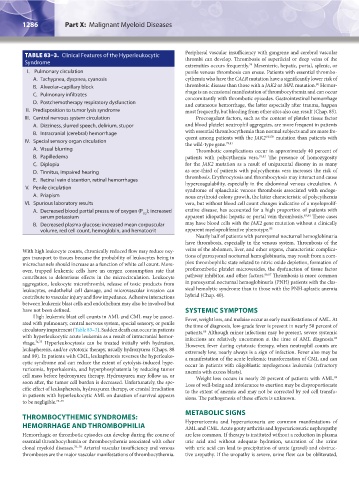
                TABLE 83–3.  Clinical Features of the Hyperleukocytic   Peripheral vascular insufficiency with gangrene and cerebral vascular
                                                                      thrombi can develop. Thrombosis of superficial or deep veins of the
                Syndrome
                                                                      extremities occurs frequently.  Mesenteric, hepatic, portal, splenic, or
                                                                                           79
                 I.  Pulmonary circulation                            penile venous thrombosis can ensue. Patients with essential thrombo-
                   A.  Tachypnea, dyspnea, cyanosis                   cythemia who have the CALR mutation have a significantly lower risk of
                                                                                                                  80
                   B.  Alveolar–capillary block                       thrombotic disease than those with a JAK2 or MPL mutation.  Hemor-
                   C.  Pulmonary infiltrates                          rhage is an occasional manifestation of thrombocythemia and can occur
                                                                      concomitantly with thrombotic episodes. Gastrointestinal hemorrhage
                   D.  Postchemotherapy respiratory dysfunction       and cutaneous hemorrhage, the latter especially after trauma, happen
                 II.  Predisposition to tumor lysis syndrome          most frequently, but bleeding from other sites also can result (Chap. 85).
                III.  Central nervous system circulation                  Procoagulant factors, such as the content of platelet tissue factor
                   A.  Dizziness, slurred speech, delirium, stupor    and blood platelet neutrophil aggregates, are more frequent in patients
                   B.  Intracranial (cerebral) hemorrhage             with essential thrombocythemia than normal subjects and are more fre-
                                                                                                 V617F
                IV.  Special sensory organ circulation                quent among patients with the JAK2   mutation than patients with
                                                                                    79,81
                                                                      the wild-type gene.
                   A.  Visual blurring                                    Thrombotic complications occur in approximately 40 percent of
                   B.  Papilledema                                    patients with polycythemia vera. 79,82  The presence of homozygosity
                   C.  Diplopia                                       for the JAK2 mutation as a result of uniparental disomy in as many
                   D.  Tinnitus, impaired hearing                     as one-third of patients with polycythemia vera increases the risk of
                   E.  Retinal vein distention, retinal hemorrhages   thrombosis. Erythrocytosis and thrombocytosis may interact and cause
                                                                      hypercoagulability, especially in the abdominal venous circulation. A
                V.  Penile circulation                                syndrome of splanchnic venous thrombosis associated with endoge-
                   A.  Priapism                                       nous erythroid colony growth, the latter characteristic of polycythemia
                VI.   Spurious laboratory results                     vera, but without blood cell count changes indicative of a myeloprolif-
                   A.  Decreased blood partial pressure of oxygen (P ); increased   erative disease, has accounted for a high proportion of patients with
                                                        O2
                     serum potassium                                  apparent idiopathic hepatic or portal vein thrombosis. 83,84  These cases
                   B.  Decreased plasma glucose; increased mean corpuscular   may have blood cells with the JAK2 gene mutation without a clinically
                     volume, red cell count, hemoglobin, and hematocrit  apparent myeloproliferative phenotype. 85
                                                                          Nearly half of patients with paroxysmal nocturnal hemoglobinuria
                                                                      have thrombosis, especially in the venous system. Thrombosis of the
               With high leukocyte counts, chronically reduced flow may reduce oxy-  veins of the abdomen, liver, and other organs, characteristic complica-
               gen transport to tissues because the probability of leukocytes being in   tions of paroxysmal nocturnal hemoglobinuria, may result from a com-
               microchannels should increase as a function of white cell count. More-  plex thrombophilic state related to nitric oxide depletion, formation of
               over, trapped leukemic cells have an oxygen consumption rate that   prothrombotic platelet microvesicles, the dysfunction of tissue factor
               contributes to deleterious effects in the microcirculation. Leukocyte   pathway inhibitor, and other factors. 86,87  Thrombosis is more common
               aggregation, leukocyte microthrombi, release of toxic products from   in paroxysmal nocturnal hemoglobinuria (PNH) patients with the clas-
               leukocytes, endothelial cell damage, and microvascular invasion can   sical hemolytic syndrome than in those with the PNH-aplastic anemia
               contribute to vascular injury and flow impedance. Adhesive interactions   hybrid (Chap. 40).
               between leukemic blast cells and endothelium may also be involved but
               have not been defined.                                 SYSTEMIC SYMPTOMS
                   High leukemic blast cell counts in AML and CML may be associ-  Fever, weight loss, and malaise occur as early manifestations of AML. At
               ated with pulmonary, central nervous system, special sensory, or penile   the time of diagnosis, low-grade fever is present in nearly 50 percent of
               circulatory impairment (Table 83–3). Sudden death can occur in patients   patients.  Although minor infections may be present, severe systemic
                                                                            88
               with hyperleukocytic acute leukemia as a result of intracranial hemor-  infections are relatively uncommon at the time of AML diagnosis.
                                                                                                                        89
               rhage. 74,75  Hyperleukocytosis can be treated initially with hydration,   However, fever during cytotoxic therapy, when neutrophil counts are
               leukapheresis, and/or cytotoxic therapy, usually hydroxyurea (Chaps. 88   extremely low, nearly always is a sign of infection. Fever also may be
               and 89). In patients with CML, leukapheresis reverses the hyperleuko-  a manifestation of the acute leukemic transformation of CML and can
               cytic syndrome and can reduce the extent of cytolysis-induced hype-  occur in patients with oligoblastic myelogenous leukemia (refractory
               ruricemia, hyperkalemia, and hyperphosphatemia by reducing tumor   anemia with excess blasts).
               cell mass before hydroxyurea therapy. Hydroxyurea may follow as, or   Weight loss occurs in nearly 20 percent of patients with AML.
                                                                                                                        89
               soon after, the tumor cell burden is decreased. Unfortunately, the spe-  Loss of well-being and intolerance to exertion may be disproportionate
               cific effect of leukapheresis, hydroxyurea therapy, or cranial irradiation   to the extent of anemia and may not be corrected by red cell transfu-
               in patients with hyperleukocytic AML on duration of survival appears   sions. The pathogenesis of these effects is unknown.
               to be negligible. 73–75
                                                                      METABOLIC SIGNS
               THROMBOCYTHEMIC SYNDROMES:
               HEMORRHAGE AND THROMBOPHILIA                           Hyperuricemia and hyperuricosuria are common manifestations of
                                                                      AML and CML. Acute gouty arthritis and hyperuricosuric nephropathy
               Hemorrhagic or thrombotic episodes can develop during the course of   are less common. If therapy is instituted without a reduction in plasma
               essential thrombocythemia or thrombocythemia associated with other   uric  acid  and  without  adequate  hydration,  saturation  of  the  urine
               clonal myeloid diseases. 76–78  Arterial vascular insufficiency and venous   with uric acid can lead to precipitation of urate (gravel) and obstruc-
               thromboses are the major vascular manifestations of thrombocythemia.   tive uropathy. If the uropathy is severe, urine flow can be obliterated,


          Kaushansky_chapter 83_p1273-1290.indd   1286                                                                  9/21/15   11:14 AM

