


Page 1333 - Williams Hematology ( PDFDrive )
P. 1333
1308           Part X:  Malignant Myeloid Diseases                                                                                                                              Chapter 85:  Essential Thrombocythemia           1309


                                                                                    JAK2
                                                                                    CALR

                                                                                    MPL

                                                                                    SH2B3
                                                                                    Unknown


                              100%
                             Proportion of mutated cases  50%
                              75%


                              25%

                               0%
                                     JAK2   CALR    MPL   SH2B3   TET2   ASXL1   EZH2   IDH1/2  DNMT3A  RNA
                                                                                                       splicing
                                                               Gene harboring mutations
                                           Essential thrombocythemia  Polycythemia vera  Primary myelofibrosis
                                           Acute myeloid leukemia   Myelodysplasia
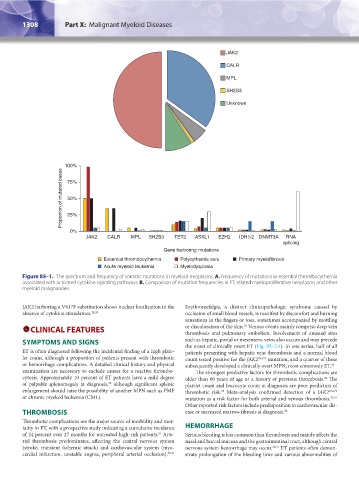
               Figure 85–1.  The spectrum and frequency of somatic mutations in myeloid neoplasms. A. Frequency of mutations in essential thrombocythemia
               associated with activated cytokine signaling pathways. B. Comparison of mutation frequencies in ET, related myeloproliferative neoplasms and other
               myeloid malignancies.


               JAK2 harboring a V617F substitution shows nuclear localization in the   Erythromelalgia, a distinct clinicopathologic syndrome caused by
               absence of cytokine stimulation. 28,29                 occlusion of small blood vessels, is manifest by discomfort and burning
                                                                      sensations in the fingers or toes, sometimes accompanied by mottling
                                                                                          32
                  CLINICAL FEATURES                                   or discoloration of the skin.  Venous events mainly comprise deep vein
                                                                      thrombosis and pulmonary embolism. Involvement of unusual sites
               SYMPTOMS AND SIGNS                                     such as hepatic, portal or mesenteric veins also occurs and may precede
                                                                      the onset of clinically overt ET (Fig. 85–2A). In one series, half of all
               ET is often diagnosed following the incidental finding of a high plate-  patients presenting with hepatic vein thrombosis and a normal blood
               let count, although a proportion of patients present with thrombotic   count tested positive for the JAK2 V617F  mutation, and a quarter of these
               or hemorrhage complications. A detailed clinical history and physical   subsequently developed a clinically overt MPN, most commonly ET. 33
               examination are necessary to exclude causes for a reactive thrombo-  The strongest predictive factors for thrombotic complications are
               cytosis. Approximately 10 percent of ET patients have a mild degree   older than 60 years of age or a history of previous thrombosis.  The
                                                                                                                     34
               of palpable splenomegaly at diagnosis,  although significant splenic   platelet count and leucocyte count at diagnosis are poor predictors of
                                            30
               enlargement should raise the possibility of another MPN such as PMF   thrombotic risk.  Meta-analysis confirmed detection of a  JAK2 V617F
                                                                                  35
               or chronic myeloid leukemia (CML).                     mutation as a risk factor for both arterial and venous thrombosis. 36,37
                                                                      Other reported risk factors include predisposition to cardiovascular dis-
               THROMBOSIS                                             ease or increased marrow fibrosis at diagnosis. 38
               Thrombotic complications are the major source of morbidity and mor-
               tality in ET, with a prospective study indicating a cumulative incidence   HEMORRHAGE
               of 24 percent over 27 months for untreated high-risk patients.  Arte-  Serious bleeding is less common than thrombosis and mainly affects the
                                                             31
               rial thrombosis predominates, affecting the central nervous system   nasal and buccal mucosa and the gastrointestinal tract, although central
               (stroke, transient ischemic attack) and cardiovascular system (myo-  nervous system hemorrhage may occur. 30,31  ET patients often demon-
               cardial infarction, unstable angina, peripheral arterial occlusion). 30,31    strate prolongation of the bleeding time and various abnormalities of


          Kaushansky_chapter 85_p1307-1318.indd   1308                                                                  9/21/15   11:08 AM

