


Page 1337 - Williams Hematology ( PDFDrive )
P. 1337
1312           Part X:  Malignant Myeloid Diseases                                                                                                                              Chapter 85:  Essential Thrombocythemia           1313


                                                                      number, the megakaryocytes are generally small and hypolobulated,  in
                                                                                                                      60
                TABLE 85–2.  Causes of Thrombocytosis                 contrast to the large hyperlobulated forms typical of ET. A raised plate-
                CLONAL THROMBOCYTOSIS                                 let count is also a feature of refractory anemia with ringed sideroblasts
                                                                      and thrombocytosis (RARS-T), and may be associated with thrombotic
                Essential thrombocythemia                             complications. Approximately half of patients with RARS-T harbor a
                Polycythemia vera                                     JAK2 V617F  mutation or, rarely, a mutation in MPL.
                Primary myelofibrosis
                Chronic myeloid leukemia                              PATHOGENETIC RELATIONSHIP OF
                Refractory anemia with ringed sideroblasts and thrombocytosis  ESSENTIAL THROMBOCYTHEMIA TO OTHER
                5q-minus syndrome                                     MYELOPROLIFERATIVE NEOPLASMS
                REACTIVE (SECONDARY) THROMBOCYTOSIS
                                                                      Polycythemia Vera
                Transient thrombocytosis                              The same JAK2 V617F  mutation is present in the vast majority of patients
                  Acute blood loss                                    with PV (Chap. 84) and in approximately half of those with ET, rais-
                  Recovery from thrombocytopenia (rebound thrombocytosis)  ing questions as to how a single mutation is commonly associated with
                  Acute infection or inflammation                     apparently distinct clinical phenotypes. Clones that are homozygous
                  Response to exercise                                for the JAK2 V617F  mutation (arising by a mitotic recombination event
                   Response to drugs (vincristine, epinephrine, all-trans-retinoic acid)  termed uniparental disomy; Fig. 85–5) are larger and more frequent in
                                                                                                    suggesting a role for increased
                                                                      patients with PV compared with ET,
                                                                                                62,63
                Sustained thrombocytosis                              JAK2-STAT5 signaling in driving erythrocytosis. In support of this
                  Iron deficiency                                     hypothesis, in both mouse and human model systems strong JAK2-
                  Splenectomy or congenital absence of spleen         STAT5 activation drives erythropoiesis whereas weaker activation
                  Malignancy                                          favors a megakaryopoiesis. 16,64,65  Other contributing factors include the
                                                                                       63
                  Chronic infection or inflammation                   effects of patient gender  and modulation of STAT1 signaling. 66
                  Hemolytic anemia                                    Myelofibrosis and Accelerated Phase Disease
                FAMILIAL THROMBOCYTOSIS                               A  proportion  of  patients  diagnosed  with  ET  experience  progres-
                SPURIOUS THROMBOCYTOSIS                               sion to an accelerated phase characterized by increasingly disordered
                                                                      hematopoiesis. The phenotypic manifestations are variable and include
                Cryoglobulinemia                                      hyperproliferation, myelodysplasia, or, most commonly, myelofibrosis.
                Cytoplasmic fragmentation in acute leukemia           Myelofibrotic transformation of ET, characterized by marrow fibrosis,
                Red cell fragmentation                                extramedullary hematopoiesis and marrow failure, is clinically indis-
                Bacteremia                                            tinguishable from PMF (Chap. 86), suggesting PMF may represent pre-
                                                                      sentation with accelerated phase disease. Consistent with this, patients
                                                                      with PMF may have thrombocytosis for many years prior to diagnosis,
               in ET. Given the significant impact of tyrosine kinase inhibitors on the   suggestive of undiagnosed ET. 58
               prognosis of CML, it is important that this unusual presentation is not   The prevalence of mutations in JAK2, CALR, or MPL is similar in
               overlooked. It is therefore recommended that suspected cases of ET that   ET compared to myelofibrosis; however, karyotypic abnormalities are
               are negative for a relevant somatic mutation undergo molecular analysis   present in up to 50 percent of myelofibrosis patients (Chap. 86) com-
               of blood for the BCR-ABL1 fusion gene. Marrow aspiration, biopsy and   pared to only approximately 5 percent of patients in ET, indicating a
               G-banding cytogenetic analysis, may be useful in a specific case.  greater degree of genetic instability. In addition, mutations in genes
                                                                      implicated in transcriptional regulation (including  ASXL1,  IDH1/2,
                                                                      and  EZH2)  appear  more  common  in  patients  with  PMF  compared
               MYELODYSPLASIA                                         with ET. Together, these findings suggest that progression to advanced
               Thrombocytosis, usually in association with anemia, may be seen in   phase disease arises through a process of clonal evolution driven by the
               the myelodysplastic disorder associated with an isolated deletion of   acquisition of additional genetic events or epigenetic alterations; to date,
               chromosome 5q (“5q-minus syndrome”). Although often increased in   however, no combination of genetic events has been shown to reliably


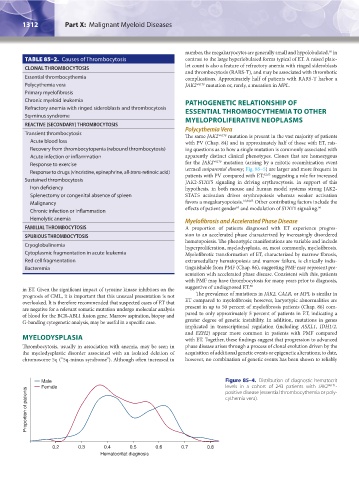
                      Male                                                         Figure 85–4.  Distribution of diagnostic hematocrit
                      Female                                                       levels in a cohort of 243 patients with  JAK2 V617F -
                 Proportion of patients
                                                                                   positive disease (essential thrombocythemia or poly-
                                                                                   cythemia vera).


                         0.2      0.3      0.4     0.5      0.6      0.7     0.8
                                          Hematocritat diagnosis


          Kaushansky_chapter 85_p1307-1318.indd   1312                                                                  9/21/15   11:08 AM

