


Page 1334 - Williams Hematology ( PDFDrive )
P. 1334
1308  Part X:  Malignant Myeloid Diseases                          Chapter 85:  Essential Thrombocythemia            1309


                             A


                             B


                             C
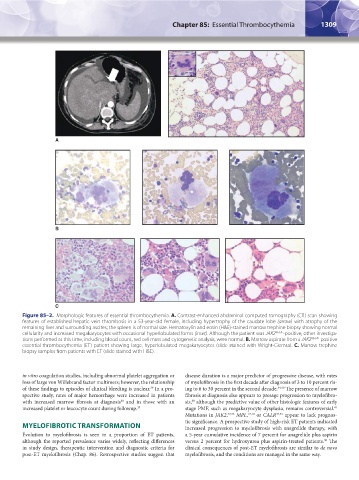
                  Figure 85–2.  Morphologic features of essential thrombocythemia. A. Contrast-enhanced abdominal computed tomography (CT) scan showing
                  features of established hepatic vein thrombosis in a 53-year-old female, including hypertrophy of the caudate lobe (arrow) with atrophy of the
                  remaining liver and surrounding ascites; the spleen is of normal size. Hematoxylin and eosin (H&E)-stained marrow trephine biopsy showing normal
                  cellularity and increased megakaryocytes with occasional hyperlobulated forms (inset). Although the patient was JAK2 V617F -positive, other investiga-
                  tions performed at this time, including blood count, red cell mass and cytogenetic analysis, were normal. B. Marrow aspirate from a JAK2 V617F -positive
                  essential thrombocythemia (ET) patient showing large, hyperlobulated megakaryocytes (slide stained with Wright-Giemsa). C. Marrow trephine
                  biopsy samples from patients with ET (slide stained with H&E).


                  in vitro coagulation studies, including abnormal platelet aggregation or   disease duration is a major predictor of progressive disease, with rates
                  loss of large von Willebrand factor multimers; however, the relationship   of myelofibrosis in the first decade after diagnosis of 3 to 10 percent ris-
                  of these findings to episodes of clinical bleeding is unclear.  In a pro-  ing to 6 to 30 percent in the second decade. 34,40  The presence of marrow
                                                             39
                  spective study, rates of major hemorrhage were increased in patients   fibrosis at diagnosis also appears to presage progression to myelofibro-
                  with increased marrow fibrosis at diagnosis  and in those with an   sis,  although the predictive value of other histologic features of early
                                                                           38
                                                   38
                  increased platelet or leucocyte count during followup. 35  stage PMF, such as megakaryocyte dysplasia, remains controversial.
                                                                                                                          41
                                                                        Mutations in JAK2, 42,43  MPL, 17,18  or CALR 44,45  appear to lack prognos-
                                                                        tic significance. A prospective study of high-risk ET patients indicated
                  MYELOFIBROTIC TRANSFORMATION                          increased progression to myelofibrosis with anagrelide therapy, with
                  Evolution to myelofibrosis is seen in a proportion of ET patients,   a 5-year cumulative incidence of 7 percent for anagrelide plus aspirin
                  although the reported prevalence varies widely, reflecting differences   versus  2  percent  for  hydroxyurea  plus  aspirin-treated  patients.   The
                                                                                                                       30
                  in study design, therapeutic intervention and diagnostic criteria for   clinical consequences of post-ET myelofibrosis are similar to de novo
                  post-ET myelofibrosis (Chap. 86). Retrospective studies suggest that   myelofibrosis, and the conditions are managed in the same way.


          Kaushansky_chapter 85_p1307-1318.indd   1309                                                                  9/21/15   11:08 AM

