


Page 136 - Williams Hematology ( PDFDrive )
P. 136
110  Part III:  Epochal Hematology                       Chapter 7:  Hematology of the Fetus and Newborn              111


                  parenteral route may result rarely in neuromuscular complications,    capillary fragility.  The more  serious  disorders  of  periventricular–
                                                                   293
                  and an association of intramuscular vitamin K prophylaxis and cancer   intraventricular hemorrhage and pulmonary hemorrhage probably
                  in infancy was suggested but not substantiated. Oral administration,   are not caused by coagulation disorders, although such disorders may
                                                                                        300
                                                                290
                  however, appears less reliable and may require repeated doses.  The   increase the bleeding.  Hypoxia seems to affect the clotting status of
                                                                                           301
                  current recommendation of the American Academy of Pediatrics sug-  low-birth-weight infants.  Many infants with markedly abnormal
                  gests that vitamin K , 0.5 to 1.0 mg, be administered intramuscularly at   prothrombin times have had hypoxia during delivery or shortly there-
                                1
                      294
                  birth.  Even the lower (0.5 mg) parenteral dose may be excessive for   after.  Cardiovascular collapse seen with episodes of cardiac arrest or
                                                                            296
                  preterm (<32 weeks’ gestation) infants, although no toxic effects have   with profound shock may cause disseminated intravascular coagulation
                                                       295
                  been reported as a result of very high plasma values.  Recent data sug-  and generalized bleeding. In many sick premature infants, a combina-
                  gest that 0.2 mg vitamin K may be appropriate prophylaxis for infants   tion of shock, sepsis, liver immaturity, hypoxia, and other factors may
                  delivered at fewer than 32 weeks’ gestation, but additional oral supple-  contribute to the pathogenesis of coagulation abnormalities.
                                                      296
                  mentation is needed when feeding is established.  A mixed micellar   Arterial and venous thromboses are relatively frequent in new-
                  vitamin K  preparation is particularly well absorbed and may permit   borns as compared to other age groups, but greater than 90 percent of
                         1
                  prophylaxis with a single oral dose,  but the efficacy and safety of oral   arterial and greater than 80 percent of venous clots are related to cathe-
                                           297
                  prophylaxis require further study.                    ters. Spontaneous thromboses are much less common, and most involve
                     Table  7–6 shows the values for coagulation factors in healthy 30   the renal veins or, rarely, the pulmonary vasculature.  Relative hyperco-
                                                                                                             302
                  to 36 weeks’ gestation premature infants. More prominent decreases   agulability in the newborn could result from a difference in the vascular
                  in factors IX, XI, and XII are noted, which tend to prolong the partial   endothelium, activation of the coagulation cascade, diminished coagu-
                  thromboplastin time. Table  7–6 also shows the values for coagulation   lation inhibitor activity, or a defect in fibrinolysis. Inhibitors of coagu-
                  factors in 28 to 31 weeks’ gestation infants. All of the coagulation factors   lation include antithrombin, heparin cofactor II, protein C, and protein
                  are lower at earlier gestational ages.                S. 283,303  The levels of proteins C and S, which are vitamin K dependent,
                     There are no significant differences in mean prothrombin time   as well as antithrombin and heparin cofactor II, are low in the newborn;
                  determinations between 30 and 36 weeks’ gestation premature and   they are in a range associated with thrombotic episodes in adults with
                                                                                        303
                  full-term infants who have not received vitamin K.  Premature infants   inherited deficiencies.  In addition, the presence of factor V Leiden
                                                      298
                  given vitamin K have a longer mean prothrombin time than do term   may occur in as many as 6 percent of newborns.  This produces resis-
                                                                                                           304
                  infants similarly treated. In some small infants there is no improve-  tance to the action of protein C and may heighten the susceptibility to
                  ment in prothrombin time or levels of prothrombin, and factors VII   thrombosis (Chap. 130). Hyperprothrombinemia caused by the 20210A
                                                                                                                       305
                  and X after the intramuscular administration of vitamin K. 286,299  These   allele prothrombin gene may affect 1 percent of the population,  but
                  results suggest a greater degree of “immaturity” of the liver in the small     the elevated prothrombin level predisposing to thrombosis occurs in
                  infants.                                              older patients.  The combined deficiency of these anticoagulant pro-
                                                                                   306
                                                                        teins may further intensify the thrombotic risk. However, the precise
                  Bleeding and Thrombosis                               role of these inhibitors of coagulation in newborn hypercoagulability
                  Significant bleeding occurs more often in low-birth-weight infants than   is uncertain because a proportionate decrease in vitamin K–dependent
                  in term newborn infants. Increased capillary fragility is frequently found   procoagulant factors (II, VII, IX, X) also is present, and an additional
                  in premature infants in the first 2 days after birth and is not associated   inhibitor, α -macroglobulin, is increased (Chap. 130). Table  7–7 shows
                                                                                 2
                  with thrombocytopenia.  Bleeding under the scalp or in other super-  the values for plasma inhibitors of coagulation in premature and term
                                   286
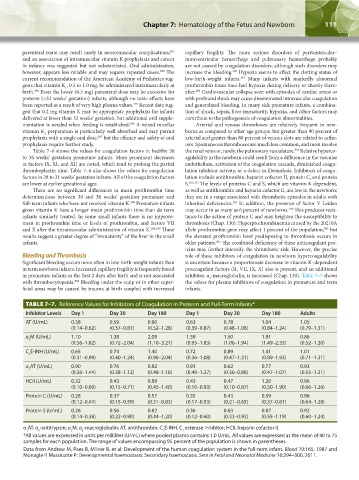
                  ficial areas may be caused by trauma at birth coupled with increased   infants.
                   TABLE 7–7.  Reference Values for Inhibitors of Coagulation in Preterm and Full-Term Infants*
                   Inhibitor Levels  Day 1     Day 30       Day 180      Day 1       Day 30       Day 180      Adults
                   AT (U/mL)      0.38         0.59         0.90         0.63        0.78         1.04         1.05
                                  (0.14–0.62)  (0.37–0.81)  (0.52–1.28)  (0.39–0.87)  (0.48–1.08)  (0.84–1.24)  (0.79–1.31)
                   α M (U/mL)     1.10         1.38         2.09         1.39        1.50         1.91         0.86
                    2
                                  (0.56–1.82)  (0.72–2.04)  (1.10–3.21)  (0.95–1.83)  (1.06–1.94)  (1.49–2.33)  (0.52–1.20)
                   C E-INH (U/mL)  0.65        0.74         1.40         0.72        0.89         1.41         1.01
                    1
                                  (0.31–0.99)  (0.40–1.24)  (0.96–2.04)  (0.36–1.08)  (0.47–1.31)  (0.89–1.93)  (0.71–1.31)
                   α AT (U/mL)    0.90         0.76         0.82         0.93        0.62         0.77         0.93
                    1
                                  (0.36–1.44)  (0.38–1.12)  (0.48–1.16)  (0.49–1.37)  (0.36–0.88)  (0.47–1.07)  (0.55–1.31)
                   HCII (U/mL)    0.32         0.43         0.89         0.43        0.47         1.20         0.96
                                  (0.10–0.60)  (0.15–0.71)  (0.45–1.40)  (0.10–0.93)  (0.10–0.87)  (0.50–1.90)  (0.66–1.26)
                   Protein C (U/mL)  0.28      0.37         0.57         0.35        0.43         0.59         0.96
                                  (0.12–0.44)  (0.15–0.59)  (0.31–0.83)  (0.17–0.53)  (0.21–0.65)  (0.37–0.81)  (0.64–1.28)
                   Protein S (U/mL)  0.26      0.56         0.82         0.36        0.63         0.87         0.92
                                  (0.14–0.38)  (0.22–0.90)  (0.44–1.20)  (0.12–0.60)  (0.33–0.93)  (0.55–1.19)  (0.60–1.24)
                  α AT, α -antitrypsin; α M, α -macroglobulin; AT, antithrombin; C E-INH, C  esterase inhibitor; HCII, heparin cofactor II.
                   1   1          2   2                          1     1
                  *All values are expressed in units per milliliter (U/mL) where pooled plasma contains 1.0 U/mL. All values are expressed as the mean of 40 to 75
                  samples for each population. The range of values encompassing 95 percent of the population is shown in parentheses.
                  Data from Andrew M, Paes B, Milner B, et al: Development of the human coagulation system in the full-term infant. Blood 70:165, 1987 and
                  Monagle P, Massicotte P: Developmental haemostasis: Secondary haemostasis. Sem in Fetal and Neonatal Medicine 16:294–300, 2011.


          Kaushansky_chapter 07_p0097-0118.indd   111                                                                   9/18/15   10:13 PM

