


Page 132 - Williams Hematology ( PDFDrive )
P. 132
108 Part III: Epochal Hematology Chapter 7: Hematology of the Fetus and Newborn 109
Newborn infants commonly have petechiae, particularly on the (helper/inducer phenotype) T-cell subsets in blood of newborns is
239
head, neck, and shoulders, after vertex deliveries. They are presumably higher than in adults. This is a result of an increased total lymphocyte
240
caused by trauma associated with passage through the birth canal and count in neonates (and older children) as compared with adults. The
disappear within a few days. Petechiae usually are not present in infants percentages of major lymphoid subsets (CD2, CD3, CD4, CD8, CD19)
delivered by cesarean section. and natural killer (NK) cells are not markedly different in neonates,
Platelet Antigens and Glycoproteins The glycoprotein complex children, and adults when measured by flow cytometry methods. 241,242
242
GPIIb/IIIa represents approximately 15 percent of platelet surface pro- However, functional defects are present in the NK cell population.
A1
tein and exhibits two allelic forms, Pl and Pl . The Pl antigen can Furthermore, the responses of T-helper type 1 (Th1 cell-mediated
A1
A2 232
233
A1
be identified on fetal platelets by 16 weeks’ gestation. Pl antigen is immunity) and T-helper type 2 (Th2-assisted humoral immunity) differ
observed in a higher percentage of fetuses between 18 and 26 weeks’ ges- in newborns and adults in response to various antigens such as vac-
tation than in adults. Approximately 2 percent of the population in the cines, infectious agents, and environmental antigens. The numbers of
243
United States of European descent is homozygous for Pl and thus are T and B lymphocytes are sustained or increased during the first 2 post-
A2
A1
A1
244
Pl -negative. The complete expression of the Pl antigen during early natal months. There is a trend toward increased CD4 and decreased
gestation likely permits sensitization in women who are Pl -negative CD8 lymphocytes in newborns and children, resulting in an increased
A1
even during their first pregnancy. The membrane glycoprotein GPIb, CD4:CD8 ratio. 245,246 In spite of this, T-cell suppressor activity may be
233
247
as well as the GPIIb/IIIa complex, is expressed by 18 weeks of gestation. increased in newborns. Most responses of the cellular immunity
233
A1
A2
The difference between Pl and Pl is a leucine 33–proline 33 amino acid system, such as antigen recognition and binding, antibody-dependent
polymorphism in glycoprotein IIIA. Prenatal diagnosis of the glyco- cytotoxicity, and graft-versus-host reactivity are present in the new-
232
248
247
protein genotype using DNA from amniocytes and the polymerase chain born, although some are decreased in comparison with adults. The
reaction can establish the potential for neonatal alloimmune thrombocy- in vitro response to phytohemagglutinin of cord blood lymphocytes is
234
topenia, as well as the diagnosis of Glanzmann thrombasthenia. Rarely, increased, 249,250 but the response of the newborn to 2,4-dinitrofluoroben-
a
a
E2
a
other fetal platelet antigens, such as Pl , DUZO , Ko , and Bak have zene, a potent inducer of delayed hypersensitivity, is not as consistent as
251
caused maternal sensitization and neonatal alloimmune thrombocytope- that seen in older children. Impaired T-cell production of interfer-
235
nia. The gestational ages for expression of these antigens have not been on-γ and other lymphokines may be related to immature macrophage
defined but are sufficiently early to permit sensitization. rather than to T-lymphocyte function, because intercellular coopera-
252
tion is a requisite for these processes. Furthermore, cord blood T lym-
NEONATAL LYMPHOPOIESIS phocytes form a functional IL-2 receptor complex and have normal IL-2
253
receptors, but they do not upregulate interferon-γ in response to IL-2.
T-Lymphocyte Functions—Cellular Immunity
The absolute number of lymphocytes in the newborn is equivalent to B-Lymphocyte Functions–Humoral Immunity
that in older children, ages 6 months to 2 years, with lower values in Humoral (B-cell) immunity also develops early in gestation, but it
236
premature infants at birth. Thymus-derived cells (T cells) develop early is not fully active until after birth. In the newborn, approximately 15
in gestation. Tables 7–4 and 7–5 show the various lymphocyte subsets percent of lymphocytes have immunoglobulin on their surface, with
236
in infants and children. 237,238 The absolute number of CD3+ and CD4+ all immunoglobulin isotypes represented. A percentage of these cells
254
are CD5+ B cells (B-1 cells), which produce polyreactive autoantibod-
255
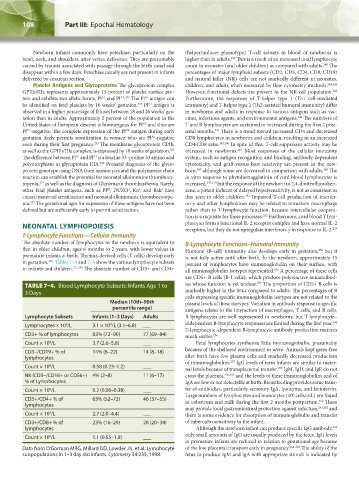
TABLE 7–4. Blood Lymphocyte Subsets: Infants Age 1 to ies whose function is yet unclear. The proportion of CD5+ B cells is
3 Days markedly higher in the fetus compared to adults. The percentages of B
cells expressing specific immunoglobulin isotypes are not related to the
Median (10th–90th plasma levels of those isotypes. Variation in antibody response to specific
percentile range) antigens relates to the interaction of macrophages, T cells, and B cells.
Lymphocyte Subsets Infants (1–3 Days) Adults B lymphocytes are well represented in newborns, but T-lymphocyte–
256
9
9
Lymphocytes × 10 /L 3.1 × 10 /L (3.1–6.8) ___ independent B-lymphocyte responses are limited during the first year.
T-lymphocyte–dependent B-lymphocyte antibody production matures
CD3+ % of lymphocytes 83% (72–90) 77 (69–84) much earlier. 256
Count × 10 /L 3.7 (2.6–5.8) ___ Fetal lymphocytes synthesize little immunoglobulin, presumably
9
CD3–/CD19+ % of 14% (6–22) 14 (8–18) because of the sheltered environment in utero. Animals kept germ-free
lymphocytes after birth have few plasma cells and markedly decreased production
of immunoglobulins. IgG levels of term infants are similar to mater-
257
Count × 10 /L 0.58 (0.23–1.2) ___
9
258
nal levels because of transplacental transfer. IgM, IgD, and IgE do not
NK (CD3–/CD16+ or CD56+) 4% (2–8) 11 (6–17) cross the placenta, 258,259 and the levels of these immunoglobulins and of
% of Lymphocytes IgA are low or not detectable at birth. Breastfeeding provides some trans-
Count × 10 /L 0.2 (0.06–0.38) ___ fer of antibodies, particularly secretory IgA, lysozyme, and lactoferrin.
9
6
Large numbers of lymphocytes and monocytes (10 cells/mL) are found
CD3+/CD4+ % of 63% (52–72) 46 (37–55) in colostrum and milk during the first 2 months postpartum. These
260
lymphocytes
may provide local gastrointestinal protection against infection, 261,262 and
Count × 10 /L 2.7 (2.0–4.4) ___ there is some evidence for absorption of immunoglobulin and transfer
9
CD3+/CD8+ % of 23% (16–29) 28 (20–34) of tuberculin sensitivity to the infant.
263
lymphocytes Although the newborn infant can produce specific IgG antibody,
Count × 10 /L 1.1 (0.55–1.9) ___ only small amounts of IgG are usually produced by the fetus. IgG levels
9
in premature infants are reduced in relation to gestational age because
Data from O’Gorman MRG, Millard DD, Lowder JN, et al: Lymphocyte of the low placental transport early in pregnancy. 264–266 The ability of the
subpopulations in 1–3 day old infants. Cytometry 34:235, 1998. fetus to produce IgM and IgA with appropriate stimuli is indicated by
Kaushansky_chapter 07_p0097-0118.indd 108 9/18/15 10:13 PM

