


Page 137 - Williams Hematology ( PDFDrive )
P. 137
112            Part III:  Epochal Hematology                                                                                                                          Chapter 7:  Hematology of the Fetus and Newborn              113


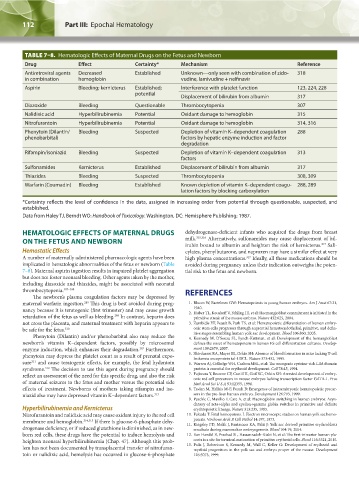
                TABLE 7–8.  Hematologic Effects of Maternal Drugs on the Fetus and Newborn
                Drug              Effect             Certainty*      Mechanism                              Reference
                Antiretroviral agents   Decreased    Established     Unknown—only seen with combination of zido-  318
                in combination    hemoglobin                         vudine, lamivudine + nelfinavir
                Aspirin           Bleeding; kernicterus  Established;   Interference with platelet function  123, 224, 228
                                                     potential
                                                                     Displacement of bilirubin from albumin  317
                Diazoxide         Bleeding           Questionable    Thrombocytopenia                       307
                Nalidixic acid    Hyperbilirubinemia  Potential      Oxidant damage to hemoglobin           315
                Nitrofurantoin    Hyperbilirubinemia  Potential      Oxidant damage to hemoglobin           314, 316
                Phenytoin (Dilantin/  Bleeding       Suspected       Depletion of vitamin K–dependent coagulation   288
                phenobarbital)                                       factors by hepatic enzyme induction and factor
                                                                     degradation
                Rifampin/isoniazid  Bleeding         Suspected       Depletion of vitamin K–dependent coagulation   313
                                                                     factors
                Sulfonamides      Kernicterus        Established     Displacement of bilirubin from albumin  317
                Thiazides         Bleeding           Suspected       Thrombocytopenia                       308, 309
                Warfarin (Coumadin)  Bleeding        Established     Known depletion of vitamin K–dependent coagu-  288, 289
                                                                     lation factors by blocking carboxylation
               *Certainty reflects the level of confidence in the data, assigned in increasing order from potential through questionable, suspected, and
               established.
               Data from Haley TJ, Berndt WO: Handbook of Toxicology. Washington, DC: Hemisphere Publishing; 1987.

               HEMATOLOGIC EFFECTS OF MATERNAL DRUGS                  dehydrogenase-deficient infants who acquired the drugs from breast
               ON THE FETUS AND NEWBORN                               milk. 315,316  Alternatively, sulfonamides may cause displacement of bil-
                                                                                                                    317
                                                                      irubin bound to albumin and heighten the risk of kernicterus.  Sali-
               Hemostatic Effects                                     cylates, phenylbutazone, and naproxen may have a similar effect at very
               A number of maternally administered pharmacologic agents have been   high plasma concentrations.  Ideally, all these medications should be
                                                                                          317
               implicated in hematologic abnormalities of the fetus or newborn (Table   avoided during pregnancy unless their indication outweighs the poten-
               7–8). Maternal aspirin ingestion results in impaired platelet aggregation   tial risk to the fetus and newborn.
               but does not foster neonatal bleeding. Other agents taken by the mother,
               including diazoxide and thiazides, might be associated with neonatal
               thrombocytopenia. 307–309                              REFERENCES
                   The newborn’s plasma coagulation  factors may be  depressed by
               maternal warfarin ingestion.  This drug is best avoided during preg-    1.  Bloom W, Bartelmez GW: Hematopoiesis in young human embryos. Am J Anat 67:21,
                                    289
               nancy because it is teratogenic (first trimester) and may cause growth   1940.
               retardation of the fetus as well as bleeding.  In contrast, heparin does     2.  Huber TL, Kouskoff V, Fehling HJ, et al: Haemangioblast commitment is initiated in the
                                              289
                                                                         primitive streak of the mouse embryo. Nature 432:625, 2004.
               not cross the placenta, and maternal treatment with heparin appears to     3.  Zambidis ET, Peault B, Park TS, et al: Hematopoietic differentiation of human embry-
               be safe for the fetus. 310                                onic stem cells progresses through sequential hematoendothelial, primitive, and defin-
                                                                         itive stages resembling human yolk sac development. Blood 106:860, 2005.
                   Phenytoin (Dilantin) and/or phenobarbital also may reduce the     4.  Kennedy M, D’Souza SL, Lynch-Kattman, et al: Development of the hemangioblast
               newborn’s vitamin K–dependent factors, possibly by microsomal   defines the onset of hematopoiesis in human ES cell differentiation cultures. Develop-
               enzyme induction, which enhances their degradation.  Furthermore,   ment 109:2679, 2007.
                                                       287
               phenytoin may depress the platelet count as a result of prenatal expo-    5.  Shivdasani RA, Mayer EL, Orkin SH: Absence of blood formation in mice lacking T-cell
                                                                         leukemia oncoprotein tal-1/SCL. Nature 373:432, 1995.
               sure  and cause teratogenic effects, for example, the fetal hydantoin     6.  Warren AJ, Colledge WH, Carlton MBL, et al: The oncogenic cysteine-rich LIM domain
                  311
               syndrome.  The decision to use this agent during pregnancy should   protein is essential for erythroid development. Cell 78:45, 1994.
                       312
               reflect an assessment of the need for this specific drug, and also the risk     7.  Fujiwara Y, Browne CP, Cuniff K, Goff SC, Orkin SH: Arrested development of embry-
               of maternal seizures to the fetus and mother versus the potential side   onic red cell precursors in mouse embryos lacking transcription factor GATA-1. Proc
                                                                         Natl Acad Sci U S A 93:12355, 1996.
               effects of  treatment.  Newborns  of  mothers taking  rifampin  and  iso-    8.  Tavian M, Hallais M-F, Peault B: Emergence of intraembryonic hematopoietic precur-
               niazid also may have depressed vitamin K–dependent factors. 313  sors in the pre-liver human embryo. Development 126:793, 1999.
                                                                        9.  Peschle C, Mavilio F, Care A, et al: Haemoglobin switching in human embryos: Asyn-
                                                                         chrony of zeta→alpha and epsilon→gamma-globin switches in primitive and definite
               Hyperbilirubinemia and Kernicterus                        erythropoietic lineage. Nature 313:235, 1985.
               Nitrofurantoin and nalidixic acid may cause oxidant injury to the red cell     10.  Fukuda T: Fetal hemopoiesis. I. Electron microscopic studies on human yolk sac hemo-
               membrane and hemoglobin. 314,315  If there is glucose-6-phosphate dehy-  poiesis. Virchows Arch B Cell Pathol 14:197, 1973.
               drogenase deficiency, or if reduced glutathione is diminished, as in new-    11.  Kingsley PD, Malik J, Fantauzzo KA, Palis J: Yolk sac derived primitive erythroblasts
                                                                         enucleate during mammalian embryogenesis. Blood 104:19, 2004.
               born red cells, these drugs have the potential to induce hemolysis and     12.  Van Handel B, Prashad SL, Hassanzadeh-Kiabi N, et al: The first trimester human pla-
               heighten neonatal hyperbilirubinemia (Chap. 47). Although this prob-  centa is a site for terminal maturation of primitive erythroid cells. Blood 116:3321, 2010.
               lem has not been documented by transplacental transfer of nitrofuran-    13.  Palis J, Robertson S, Kennedy M, Wall C, Keller G: Development of erythroid and
                                                                         myeloid progenitors in the yolk sac and embryo proper of the mouse. Development
               toin or nalidixic acid, hemolysis has occurred in glucose-6-phosphate   126:5073, 1999.


          Kaushansky_chapter 07_p0097-0118.indd   112                                                                   9/18/15   10:13 PM

