


Page 133 - Williams Hematology ( PDFDrive )
P. 133
108  Part III:  Epochal Hematology                       Chapter 7:  Hematology of the Fetus and Newborn              109


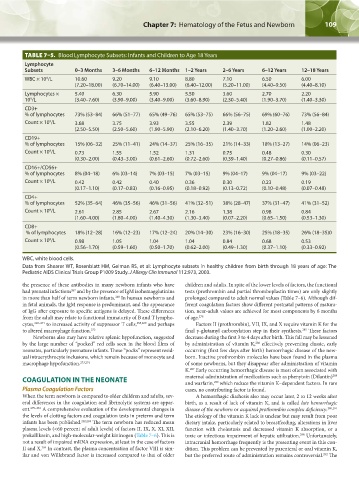
                   TABLE 7–5.  Blood Lymphocyte Subsets: Infants and Children to Age 18 Years
                   Lymphocyte
                   Subsets         0–3 Months   3–6 Months  6–12 Months  1–2 Years   2–6 Years    6–12 Years   12–18 Years
                   WBC × 10 /L     10.60        9.20        9.10        8.80         7.10         6.50         6.00
                          9
                                   (7.20–18.00)  (6.70–14.00)  (6.40–13.00)  (6.40–12.00)  (5.20–11.00)  (4.40–9.50)  (4.40–8.10)
                   Lymphocytes ×   5.40         6.30        5.90        5.50         3.60         2.70         2.20
                   10 /L           (3.40–7.60)  (3.90–9.00)  (3.40–9.00)  (3.60–8.90)  (2.30–5.40)  (1.90–3.70)  (1.40–3.30)
                    9
                   CD3+
                   % of lymphocytes  73% (53–84)  66% (51–77)  65% (49–76)  65% (53–75)  66% (56–75)  69% (60–76)  73% (56–84)
                   Count × 10 /L   3.68         3.75        3.93        3.55         2.39         1.82         1.48
                           9
                                   (2.50–5.50)  (2.50–5.60)  (1.90–5.90)  (2.10–6.20)  (1.40–3.70)  (1.20–2.60)  (1.00–2.20)
                   CD19+
                   % of lymphocytes  15% (06–32)  25% (11–41)  24% (14–37)  25% (16–35)  21% (14–33)  18% (13–27)  14% (06–23)
                   Count × 10 /L   0.73         1.55        1.52        1.31         0.75         0.48         0.30
                           9
                                   (0.30–2.00)  (0.43–3.00)  (0.61–2.60)  (0.72–2.60)  (0.39–1.40)  (0.27–0.86)  (0.11–0.57)
                   CD16+/CD56+
                   % of lymphocytes  8% (04–18)  6% (03–14)  7% (03–15)  7% (03–15)  9% (04–17)   9% (04–17)   9% (03–22)
                   Count × 10 /L   0.42         0.42        0.40        0.36         0.30         0.23         0.19
                           9
                                   (0.17–1.10)  (0.17–0.83)  (0.16–0.95)  (0.18–0.92)  (0.13–0.72)  (0.10–0.48)  (0.07–0.48)
                   CD4+
                   % of lymphocytes  52% (35–64)  46% (35–56)  46% (31–56)  41% (32–51)  38% (28–47)  37% (31–47)  41% (31–52)
                   Count × 10 /L   2.61         2.85        2.67        2.16         1.38         0.98         0.84
                           9
                                   (1.60–4.00)  (1.80–4.00)  (1.40–4.30)  (1.30–3.40)  (0.07–2.20)  (0.65–1.50)  (0.53–1.30)
                   CD8+
                    % of lymphocytes  18% (12–28)  16% (12–23)  17% (12–24)  20% (14–30)  23% (16–30)  25% (18–35)  26% (18–35)0
                   Count × 10 /L   0.98         1.05        1.04        1.04         0.84         0.68         0.53
                           9
                                   (0.56–1.70)  (0.59–1.60)  (0.50–1.70)  (0.62–2.00)  (0.49–1.30)  (0.37–1.10)  (0.33–0.92)
                  WBC, white blood cells.
                  Data from Shearer WT, Rosenblatt HM, Gelman RS, et al: Lymphocyte subsets in healthy children from birth through 18 years of age: The
                  Pediatric AIDS Clinical Trials Group P1009 Study. J Allergy Clin Immunol 112:973, 2003.

                  the presence of these antibodies in many newborn infants who have   children and adults. In spite of the lower levels of factors, the functional
                  had prenatal infections  and by the presence of IgM isohemagglutinins   tests (prothrombin and partial thromboplastin times) are only slightly
                                  267
                  in more than half of term newborn infants.  In human newborns and   prolonged compared to adult normal values (Table  7–6). Although dif-
                                                 268
                  in fetal animals, the IgM response is predominant, and the appearance   ferent coagulation factors show different postnatal patterns of matura-
                  of IgG after exposure to specific antigens is delayed. These differences   tion, near-adult values are achieved for most components by 6 months
                  from the adult may relate to functional immaturity of B and T lympho-  of age. 278
                  cytes, 269–271  to increased activity of suppressor T cells, 258,269  and perhaps   Factors II (prothrombin), VII, IX, and X require vitamin K for the
                  to altered macrophage function. 272                   final γ-glutamyl carboxylation step in their synthesis.  These factors
                                                                                                                285
                     Newborns also may have relative splenic hypofunction, suggested   decrease during the first 3 to 4 days after birth. This fall may be lessened
                  by the large number of “pocked” red cells seen in the blood films of   by administration of vitamin K,  effectively preventing classic, early
                                                                                                286
                  neonates, particularly premature infants. These “pocks” represent resid-  occurring (first few days after birth) hemorrhagic disease of the new-
                  ual intraerythrocyte inclusions, which remain because of monocyte and   born. Inactive prothrombin molecules have been found in the plasma
                  macrophage hypofunction. 273,274                      of some newborns, but they disappear after administration of vitamin
                                                                        K.  Early occurring hemorrhagic disease is most often associated with
                                                                          287
                                                                                                                          288
                  COAGULATION IN THE NEONATE                            maternal administration of medications such as phenytoin (Dilantin)
                                                                        and warfarin,  which reduce the vitamin K–dependent factors. In rare
                                                                                  289
                  Plasma Coagulation Factors                            cases, no contributing factor is found.
                  When the term newborn is compared to older children and adults, sev-  A hemorrhagic diathesis also may occur later, 2 to 12 weeks after
                  eral differences in the coagulation and fibrinolytic systems are appar-  birth, as a result of lack of vitamin K, and is called late hemorrhagic
                  ent. 275–281  A comprehensive evaluation of the developmental changes in   disease of the newborn or acquired prothrombin complex deficiency. 290,291
                  the levels of clotting factors and coagulation tests in preterm and term   The etiology of the vitamin K lack is unclear but may result from poor
                  infants has been published. 282,283  The term newborn has reduced mean   dietary intake, particularly related to breastfeeding, alterations in liver
                  plasma levels (<60 percent of adult levels) of factors II, IX, X, XI, XII,   function with cholestasis and decreased vitamin K absorption, or a
                  prekallikrein, and high-molecular-weight kininogen (Table 7–6). This is   toxic or infectious impairment of hepatic utilization.  Unfortunately,
                                                                                                               290
                  not a result of impaired mRNA expression, at least in the case of factors   intracranial hemorrhage frequently is the presenting event in this con-
                        284
                  II and X.  In contrast, the plasma concentration of factor VIII is sim-  dition. This problem can be prevented by parenteral or oral vitamin K,
                  ilar and von Willebrand factor is increased compared to that of older   but the preferred route of administration remains controversial.  The
                                                                                                                       292


          Kaushansky_chapter 07_p0097-0118.indd   109                                                                   9/18/15   10:13 PM

