


Page 1473 - Williams Hematology ( PDFDrive )
P. 1473
1448           Part X:  Malignant Myeloid Diseases                                                                                                   Chapter 89:  Chronic Myelogenous Leukemia and Related Disorders             1449


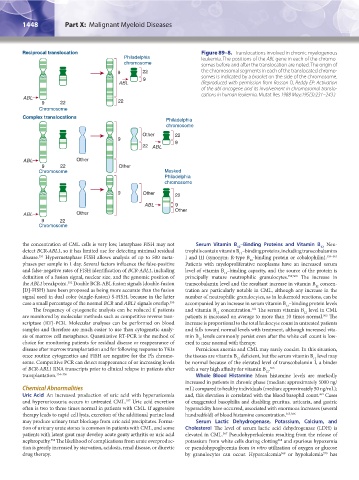
               Reciprocal translocation                                    Figure 89–8.  Translocations involved in chronic myelogenous
                                                 Philadelphia              leukemia. The positions of the ABL gene in each of the chromo-
                                                 chromosome                somes before and after the translocation are noted. The origin of
                                               9        22                 the chromosomal segments in each of the translocated chromo-
                                                        9                  somes is indicated by a bracket on the side of the chromosome.
                                                ABL                        (Reproduced with permission from Rosson D, Reddy EP: Activation
                                                                           of the abl oncogene and its involvement in chromosomal translo-
                                                                           cations in human leukemia. Mutat Res 1988 May;195(3):231–243.)
                ABL
                      9     22                  22
                     Chromosome
               Complex translocations
                                                                Philadelphia
                                                                chromosome
                                                        Other      22
                                               9
                                                                   9
                                                        22  ABL
                ABL               Other
                      9     22                  Other
                     Chromosome                                Masked
                                                               Philadelphia
                                                               chromosome
                                               9        Other      22
                                                        ABL        9
                                                                   Other
                ABL               Other
                      9     22
                     Chromosome


               the concentration of CML cells is very low, interphase FISH may not   Serum Vitamin  B –Binding Proteins and  Vitamin B   Neu-
                                                                                       12
                                                                                                                   12
               detect BCR-ABL1, so it has limited use for detecting minimal residual   trophils contain vitamin B –binding proteins, including transcobalamins
                                                                                        12
               disease.  Hypermetaphase FISH allows analysis of up to 500 meta-  I and III (synonym: R-type B -binding protein or cobalophilin). 359–362
                     351
                                                                                            12
               phases per sample in 1 day. Several factors influence the false-positive   Patients with myeloproliferative neoplasms have an increased serum
               and false-negative rates of FISH identification of BCR-ABL1, including   level of vitamin B –binding capacity, and the source of the protein is
                                                                                   12
               definition of a fusion signal, nuclear size, and the genomic position of   principally mature neutrophilic granulocytes. 359,360  The increase in
               the ABL1 breakpoint.  Double BCR-ABL fusion signals (double-fusion   transcobalamin level and the resultant increase in vitamin B  concen-
                               352
                                                                                                                  12
               [D]-FISH) have been proposed as being more accurate than the fusion   tration are particularly notable in CML, although any increase in the
               signal used in dual color (single-fusion) S-FISH, because in the latter   number of neutrophilic granulocytes, as in leukemoid reactions, can be
               case a small percentage of the normal BCR and ABL1 signals overlap. 353  accompanied by an increase in serum vitamin B –binding protein levels
                                                                                                        12
                   The frequency of cytogenetic analysis can be reduced if patients   and vitamin B  concentration.  The serum vitamin B  level in CML
                                                                                            362
                                                                                12
                                                                                                              12
               are monitored by molecular methods such as competitive reverse tran-  patients is increased on average to more than 10 times normal.  The
                                                                                                                    363
               scriptase (RT)-PCR. Molecular analyses can be performed on blood   increase is proportional to the total leukocyte count in untreated patients
               samples and therefore are much easier to use than cytogenetic analy-  and falls toward normal levels with treatment, although increased vita-
               sis of marrow cell metaphases. Quantitative RT-PCR is the method of   min B  levels commonly persist even after the white cell count is low-
                                                                          12
               choice for monitoring patients for residual disease or reappearance of   ered to near normal with therapy.
               disease after marrow transplantation and for following response to TKIs   Pernicious anemia and CML may rarely coexist. In this situation,
               once routine cytogenetics and FISH are negative for the Ph chromo-  the tissues are vitamin B  deficient, but the serum vitamin B  level may
                                                                                       12
                                                                                                                 12
               some. Competitive PCR can detect reappearance of or increasing levels   be normal because of the elevated level of transcobalamin I, a binder
               of BCR-ABL1 RNA transcripts prior to clinical relapse in patients after   with a very high affinity for vitamin B . 363
                                                                                                 12
               transplantation. 354–356                                   Whole Blood Histamine  Mean histamine levels are markedly
                                                                      increased in patients in chronic phase (median: approximately 5000 ng/
               Chemical Abnormalities                                 mL) compared to healthy individuals (median: approximately 50 ng/mL);
               Uric Acid  An increased production of uric acid with hyperuricemia   and, this elevation is correlated with the blood basophil count.  Cases
                                                                                                                   364
               and hyperuricosuria occurs in untreated CML.  Uric acid excretion   of exaggerated basophilia and disabling pruritus, urticaria, and gastric
                                                  357
               often is two to three times normal in patients with CML. If aggressive   hyperacidity have occurred, associated with enormous increases (several
               therapy leads to rapid cell lysis, excretion of the additional purine load   hundredfold) of blood histamine concentration. 365,366
               may produce urinary tract blockage from uric acid precipitates. Forma-  Serum  Lactic Dehydrogenase,  Potassium,  Calcium,  and
               tion of urinary urate stones is common in patients with CML, and some   Cholesterol  The level of serum lactic acid dehydrogenase (LDH) is
               patients with latent gout may develop acute gouty arthritis or uric acid   elevated in CML.  Pseudohyperkalemia resulting from the release of
                                                                                   367
               nephropathy.  The likelihood of complications from urate overproduc-  potassium from white cells during clotting  and spurious hypoxemia
                         358
                                                                                                     368
               tion is greatly increased by starvation, acidosis, renal disease, or diuretic   or pseudohypoglycemia from in vitro utilization of oxygen or glucose
               drug therapy.                                          by  granulocytes  can occur.  Hypercalcemia   or hypokalemia  has
                                                                                                                    370
                                                                                                      369
          Kaushansky_chapter 89_p1437-1490.indd   1448                                                                  9/18/15   3:41 PM

